
Category: Parkinson's disease: Neuroimaging
Objective: To characterise static and dynamic functional connectivity signatures of disease progression and phenoconversion in a multicentre longitudinal cohort of individuals with isolated REM sleep behaviour disorder (iRBD).
Background: The capacity to flexibly transition between highly integrated and segregated brain states is regulated by noradrenergic and cholinergic projections from the locus coeruleus (LC) and the nucleus basalis of Meynert (NBM), regions vulnerable to Lewy pathology and likely contributors to non-motor symptom emergence in Lewy body disorders. Our prior work has identified dynamic fMRI as a promising method for capturing temporal changes in brain network organisation in these disorders;1 however, it has not yet been evaluated in a large multicentre iRBD cohort.
Method: Resting-state fMRI was acquired from 92 iRBD patients and 95 healthy controls (HC) across two sites (ICEBERG consortium; 47 HC and 60 iRBD longitudinally). Static functional connectivity (FC) was extracted from Yeo resting-state networks2 and from seed regions in the NBM, LC, and basal ganglia (BG). Dynamic FC was characterised using time-varying modularity and participation coefficient (PC). A neuromodulatory coupling index was calculated by time-locking high-amplitude NBM and LC BOLD events (>2 SD) to fluctuations in whole brain PC.3
Results: iRBD demonstrated reduced global FC across all resting state networks both cross-sectionally and longitudinally (p<0.001). Reduced FC was observed between the BG and all resting state networks (p<0.001). Dynamic analysis revealed a more segregated functional architecture in iRBD with increased modularity at baseline compared to HC (p<0.001), and over time (p=0.028). This effect was most pronounced in patients converted to DLB (p=0.031). In HC, high-amplitude NBM activation preceded network segregation, while LC activation preceded network integration, consistent with known neuromodulatory physiology. In contrast, iRBD patients demonstrated a decoupling between neuromodulatory activation and network dynamics (p<0.001).
Conclusion: iRBD is associated with progressive functional network segregation, particularly in those who convert to DLB. Disrupted coupling between neuromodulatory activity and dynamic network organisation may represent a mechanistic substrate underlying early network dysfunction in prodromal synucleinopathies.
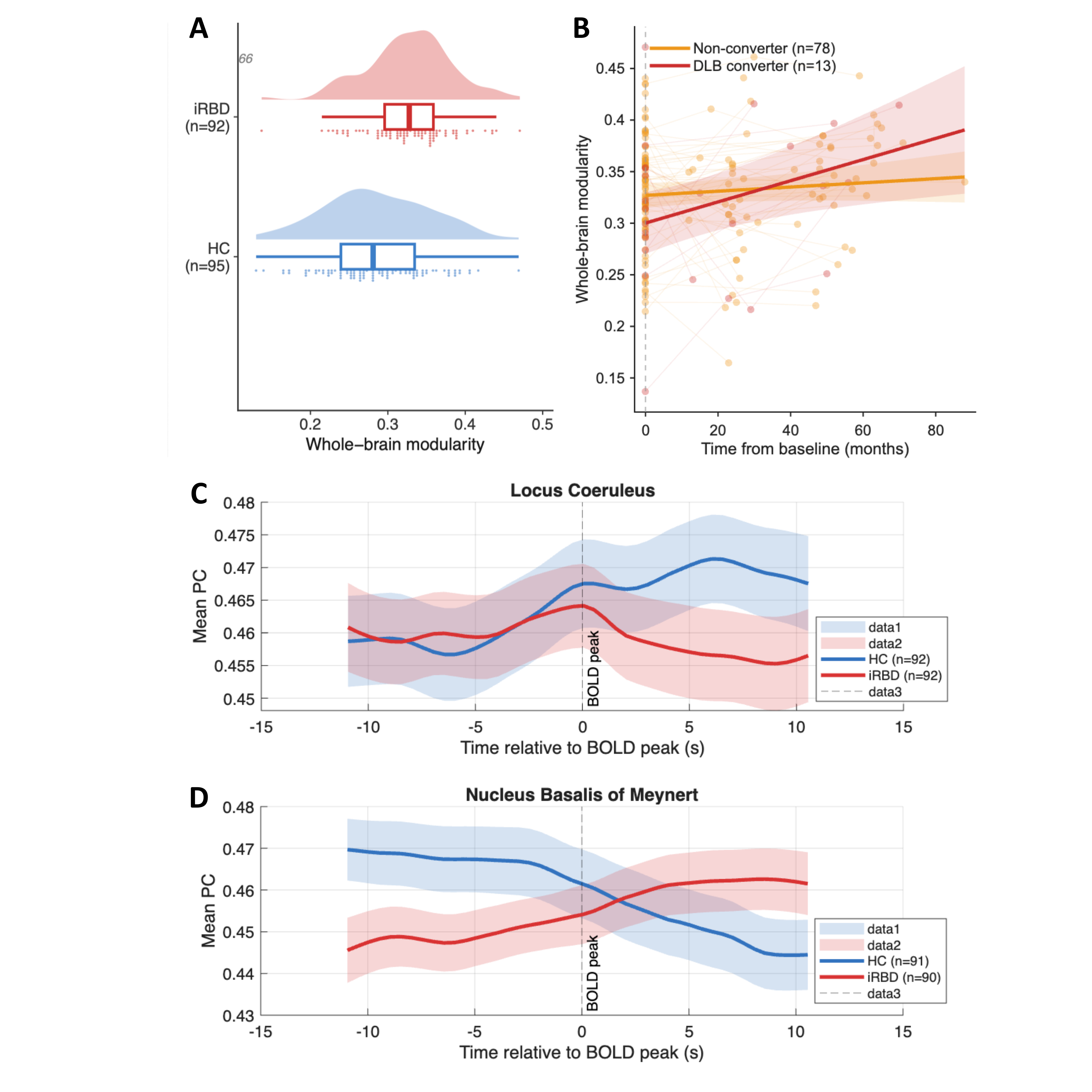
Figure 1
References: 1. Churchill, L. et al. Functional Magnetic Resonance Imaging (fMRI) Signatures of Progression and Phenoconversion in Prodromal Synucleinopathies. Mov. Disord. 40, 2664–2677 (2025).
2. Thomas Yeo, B. T. et al. The organization of the human cerebral cortex estimated by intrinsic functional connectivity. J. Neurophysiol. 106, 1125–1165 (2011).
3. Munn, B. R., Müller, E. J., Wainstein, G. & Shine, J. M. The ascending arousal system shapes neural dynamics to mediate awareness of cognitive states. Nat. Commun. 12, 6016 (2021).
To cite this abstract in AMA style:
L. Churchill, J. Anderson, A. Ignatavicius, A. Konuri, M. Johansson, R. Gaurav, S. Lehéricy, S. Lewis, E. Matar. Progressive Dynamic Functional Network Disorganisation and its Association with Phenoconversion in Isolated REM Sleep Behaviour Disorder: A Multicentre Study [abstract]. Mov Disord. 2026; 41 (suppl 1). https://www.mdsabstracts.org/abstract/progressive-dynamic-functional-network-disorganisation-and-its-association-with-phenoconversion-in-isolated-rem-sleep-behaviour-disorder-a-multicentre-study/. Accessed October 1, 2026.« Back to 2026 International Congress
MDS Abstracts - https://www.mdsabstracts.org/abstract/progressive-dynamic-functional-network-disorganisation-and-its-association-with-phenoconversion-in-isolated-rem-sleep-behaviour-disorder-a-multicentre-study/