
Category: Ataxia
Objective: To report a young patient with progressive spastic ataxia and optic atrophy harboring a GRM1 variant.
Background: Spinocerebellar ataxia type 44 (SCA44) is a rare autosomal dominant cerebellar ataxia caused by mutations in the GRM1 gene, which encodes metabotropic glutamate receptor 1. The clinical phenotype is heterogeneous.
Method: Clinical evaluation, neuroimaging, electrophysiological studies, and whole-exome sequencing were performed.
Results: A 25-year-old female presented with progressive gait instability. She had optic atrophy at age 16 and developed progressive unsteady gait with lower limb weakness and tightness at age 22. Neurological examination showed combined pyramidal and cerebellar signs with spastic-ataxic gait. MRI was unremarkable. Electromyography showed diffuse denervation without reinnervation. Whole-exome sequencing identified a GRM1 variant (c.3386A>T), currently classified as a variant of unknown significance.
Conclusion: This case describes progressive spastic ataxia with optic atrophy associated with a GRM1 variant and highlights the importance of genetic testing in early-onset progressive ataxia.
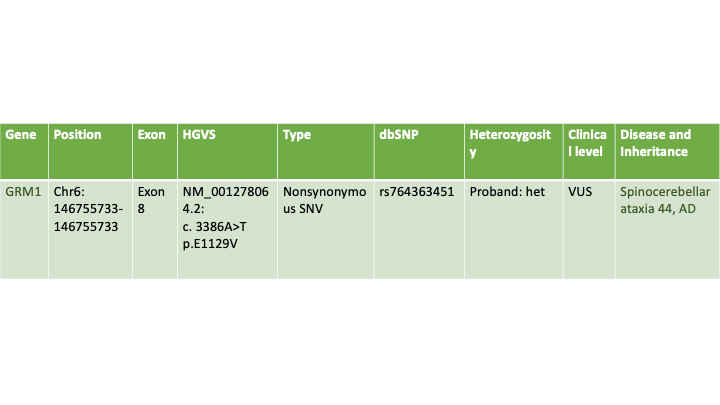
GRM1 variant detected by whole-exome sequencing
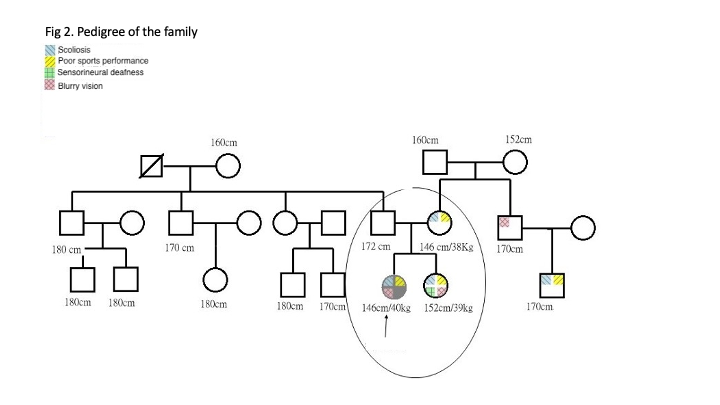
Pedigree of the family
To cite this abstract in AMA style:
WL. Lin, TY. Lin, TL. Lee. Progressive Spastic Ataxia Associated with a GRM1 Variant in a Young Female [abstract]. Mov Disord. 2026; 41 (suppl 1). https://www.mdsabstracts.org/abstract/progressive-spastic-ataxia-associated-with-a-grm1-variant-in-a-young-female/. Accessed October 1, 2026.« Back to 2026 International Congress
MDS Abstracts - https://www.mdsabstracts.org/abstract/progressive-spastic-ataxia-associated-with-a-grm1-variant-in-a-young-female/