
Objective: To compare the differences in cognitive domains assessed with the Montreal Cognitive Assessment (MoCA) among the different psychiatric profiles clusters using the Symptom Checklist-90-Revised (SCL-90-R) in patients with Parkinson.
Background: In Parkinson, studies show that personality or psychiatric profile correlates with worse quality of life [1]; even elevated psychiatric symptoms alone correlate positively with high scores on the Movement Disorders Society Unified Parkinson Disease Rating Scale (MDS-UPDRS) [2], however, the importance of the profiles in cognition remains uncertain.
Method: A cross-sectional study was conducted from June 2022 to February 2026 through clinical evaluation and application of the SCL-90-R, MoCA, and MDS-UPDRS. Using JASP, hierarchical clusters were created using Euclidean distance, Ward.D2 linkage, Z-standardization, and optimized to the Bayesian Information Criterion (BIC) from the 9 domains of the SCL-90-R. The total score and MoCA domains were compared between clusters using Kruskal-Wallis.
Results: 179 patients were included, identifying 5 clusters: C1 (n=50, 27.9%) with scores close to -1 standard deviation (SD) in all domains; C2 (n=58, 32.4%) between 0 and -0.5 SD globally; C3 (n=39, 21.8%) with approximately +0.3 SD in somatization, obsession, anxiety, and phobia; C4 (n=16, 8.9%) with scores close to and greater than +1 SD in obsession, interpersonal sensitivity, depression, paranoia, and psychoticism; and C5 (n=16, 8.9%) with more than +2 SD globally. (Figure 1).
After Bonferroni correction, no significant differences were found between the clusters and the MoCA domains, except for memory between C1 with higher scores than C4 (Table 1).
Conclusion: Five distinct psychiatric profiles are described in our study: C1 (Asymptomatic), C2 (Subclinical/mild), C3 (Anxious-Somatic), C4 (Depressive-Suspicious) and C5 (Severe Psychological Distress). Only memory showed significant differences upon Bonferroni correction. This isolated memory deficit suggests a specific vulnerability of the mesolimbic and hippocampo-frontal networks[3], which may be selectively overwhelmed by the cognitive load of severe depressive and suspicious symptoms, impairing encoding or retrieval processes[4]. Expanding the sample size in future cohorts will be essential to corroborate whether specific psychiatric burdens differentially impact isolated cognitive domains.
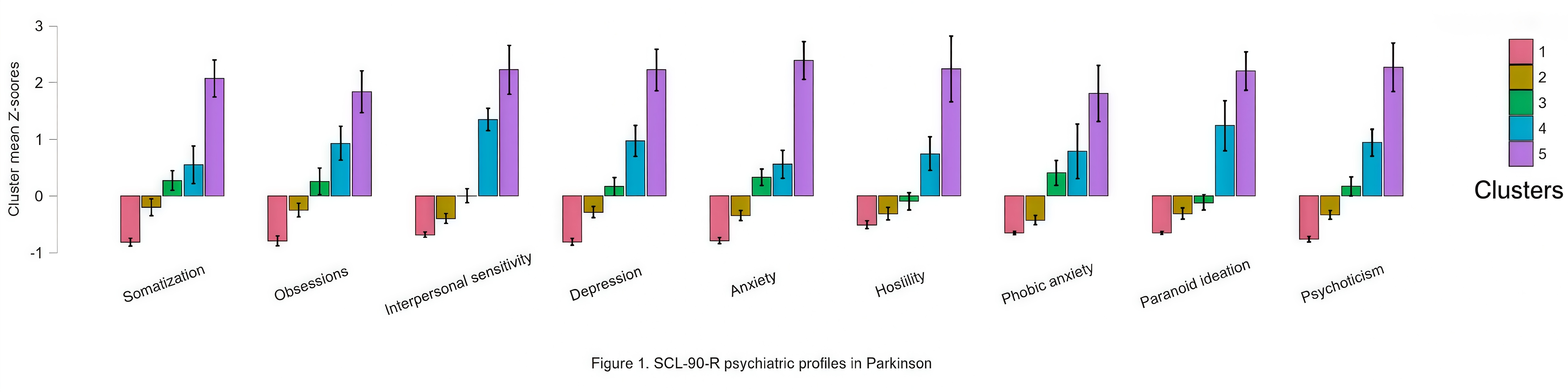
FIGURE 1. SCL90-R Psychiatric Profiles
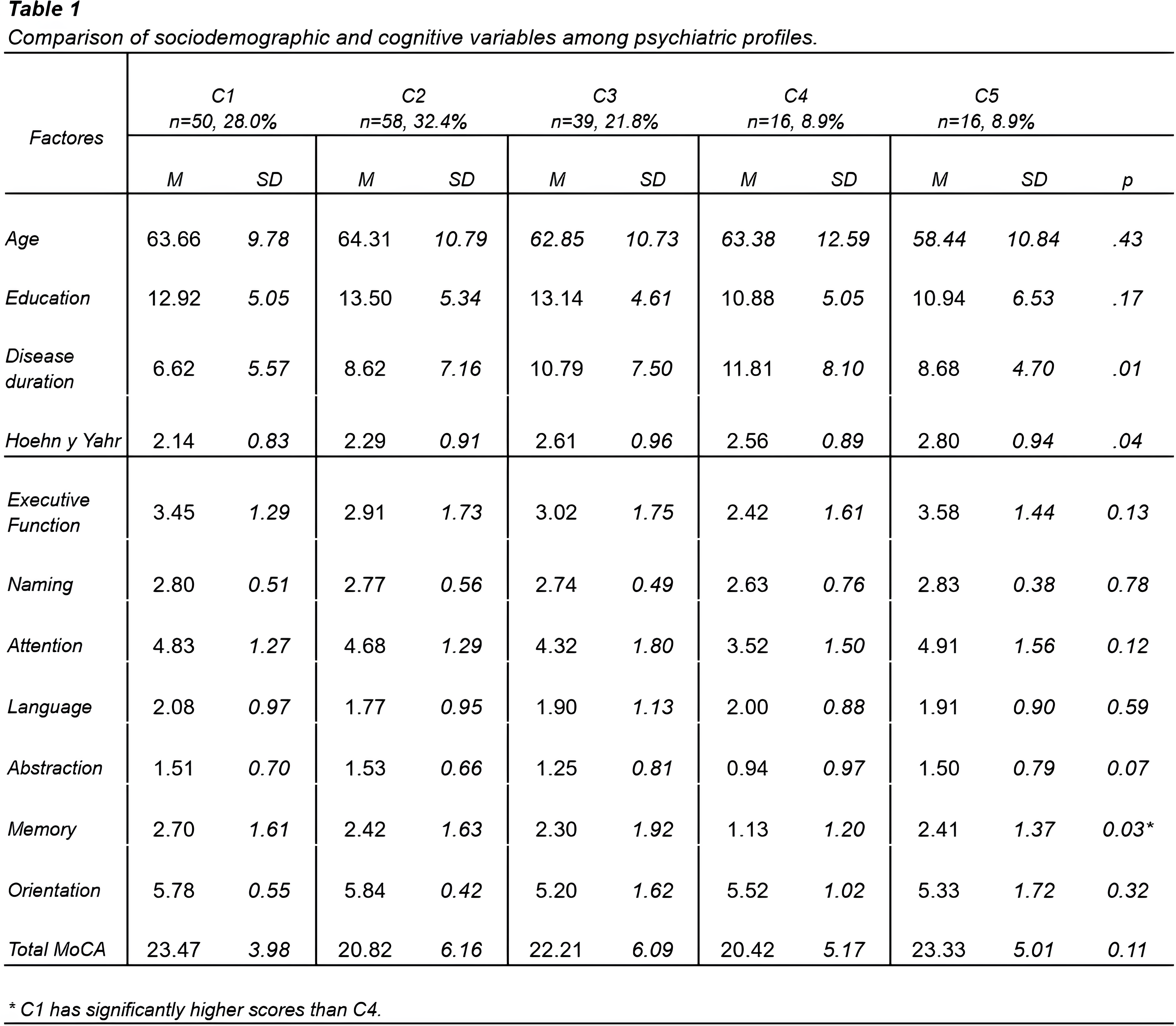
TABLE 1 Comparison of sociodemographic
References: 1.- Carelli L, Solca F, Torre S, Pasquini J, Morelli C, Pezzati R, et al. A novel approach for investigating Parkinson’s disease personality and its association with clinical and psychological aspects. Front Psychol. 2019;10:2265. doi:10.3389/fpsyg.2019.02265.
2.- Siri C, Cilia R, De Gaspari D, Villa F, Goldwurm S, Marco C, et al. Psychiatric symptoms in Parkinson’s disease assessed with the SCL-90R self-reported questionnaire. Neurol Sci. 2010;31(1):35-40. doi:10.1007/s10072-009-0165-0.
3.- Brown G, Hakun J, Lewis MM, De Jesus S, Du G, Eslinger PJ, et al. Frontostriatal and limbic contributions to cognitive decline in Parkinson’s disease. J Neuroimaging. 2023;33(1):121-133. doi:10.1111/jon.13045.
4.- Jones JD, Kurniadi N, Kuhn T, Szymkowicz SM, Bunch J, Rahmani E. Depressive symptoms precede cognitive impairment in de novo Parkinson’s disease patients: Analysis of the PPMI cohort. Neuropsychology. 2019;33(8):1111-1120. doi:10.1037/neu0000578.
To cite this abstract in AMA style:
R. Trejo-Ayala, H. Trujillo-Guerra, P. Téllez-Hernández, K. Trejo-Ayala, B. Chávez-Luévanos, I. Estrada-Bellmann, X. Ortiz-Jiménez. Psychiatric Profiles in Parkinson: A Cluster Analysis of Cognitive Performance [abstract]. Mov Disord. 2026; 41 (suppl 1). https://www.mdsabstracts.org/abstract/psychiatric-profiles-in-parkinson-a-cluster-analysis-of-cognitive-performance/. Accessed October 1, 2026.« Back to 2026 International Congress
MDS Abstracts - https://www.mdsabstracts.org/abstract/psychiatric-profiles-in-parkinson-a-cluster-analysis-of-cognitive-performance/