
Category: Drug-Induced Movement Disorders
Objective: To determine how pathological striatal dopamine fluctuations relate to dyskinesia and motor output in levodopa induced dyskinesia.
Background: Levodopa induced dyskinesia is a major motor complication of advanced Parkinson disease. Direct in vivo evidence linking striatal dopamine dynamics to dyskinesia remains limited.
Method: A severe levodopa induced dyskinesia mouse model was generated by unilateral 6 hydroxydopamine lesion followed by chronic levodopa treatment. Striatal dopamine dynamics in the dorsal striatum were recorded using GRABDA3h fiber photometry with synchronized behavioral recording. Dyskinesia was assessed by abnormal involuntary movement scores and motor output by contralateral rotations. Correlation and partial correlation analyses were performed.
Results: Levodopa induced robust dyskinesia lasting about 140 minutes and produced marked pulsatile striatal dopamine fluctuations in levodopa induced dyskinesia mice but not wild type controls. The rising and plateau phases of dopamine pulses were temporally aligned with abnormal involuntary movement scores, and correlation analyses confirmed a positive association between DA signals and AIMs scores. Rotational behavior, used as an index of motor output, showed a biphasic pattern, with higher rotations during the early and late phases but marked suppression during peak dyskinesia.
Conclusion: Pulsatile striatal dopamine fluctuations are a key driver of levodopa induced dyskinesia. Dopamine exerts a biphasic effect on motor behavior, with lower levels during the early and late phases supporting motor output, whereas suprathreshold peaks are associated with dyskinesia and reduced rotational behavior. Suppressing pathological dopamine peaks may therefore reduce dyskinesia while preserving antiparkinsonian benefit.
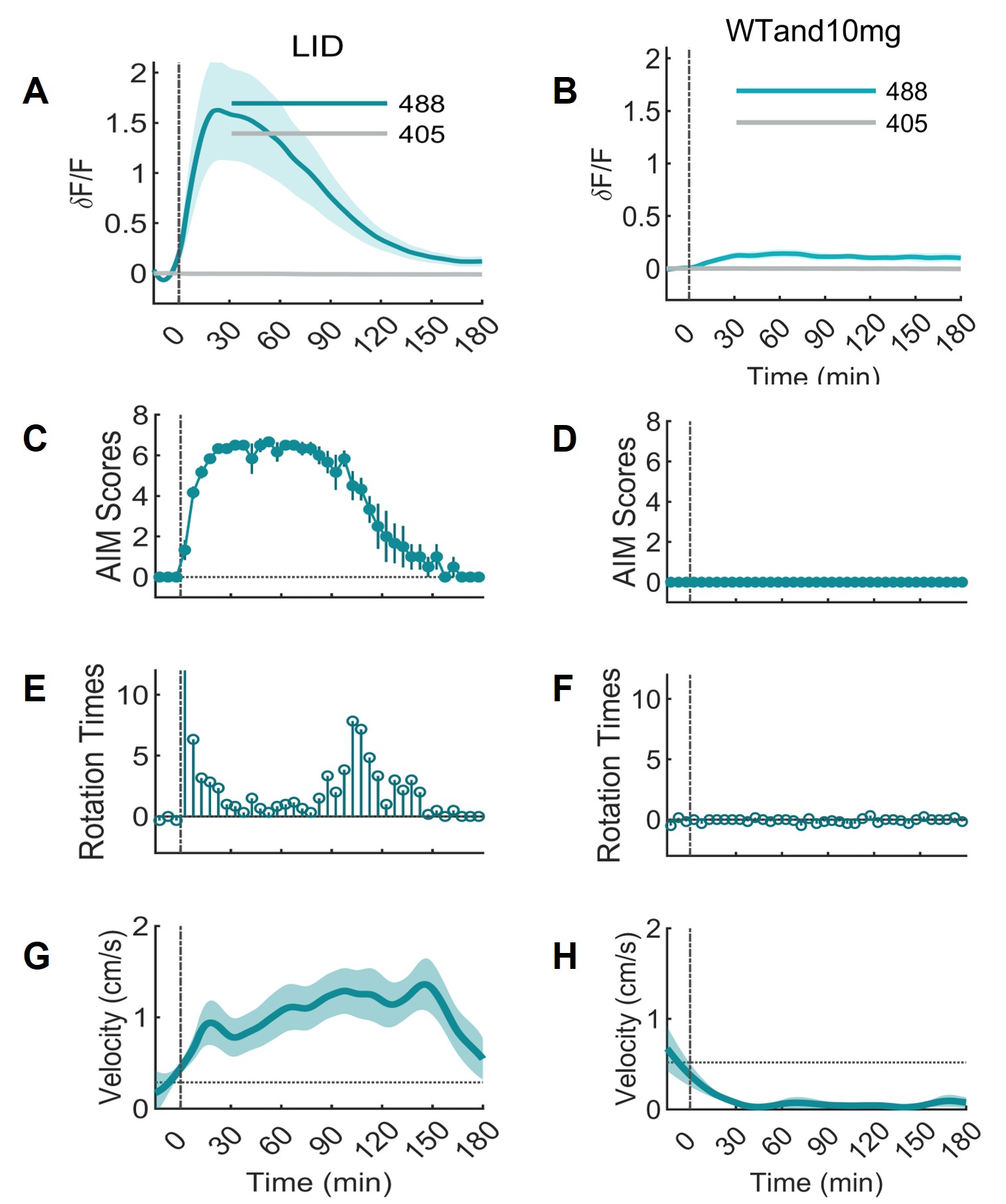
DA Signals, AIMs, Rotations In LID And WT
References: 1. Cenci MA, Lundblad M. Post- versus presynaptic plasticity in L-DOPA-induced dyskinesia. J Neurochem. 2006 Oct;99(2):381-92. doi: 10.1111/j.1471-4159.2006.04124.x. Epub 2006 Aug 29. PMID: 16942598.
2. Sun F, Zeng J, Jing M, Zhou J, Feng J, Owen SF, Luo Y, Li F, Wang H, Yamaguchi T, Yong Z, Gao Y, Peng W, Wang L, Zhang S, Du J, Lin D, Xu M, Kreitzer AC, Cui G, Li Y. A Genetically Encoded Fluorescent Sensor Enables Rapid and Specific Detection of Dopamine in Flies, Fish, and Mice. Cell. 2018 Jul 12;174(2):481-496.e19. doi: 10.1016/j.cell.2018.06.042. PMID: 30007419; PMCID: PMC6092020.
To cite this abstract in AMA style:
L. Su, A. Li, Z. Li, Y. Guo. Pulsatile Striatal Dopamine Dynamics Drive Levodopa Induced Dyskinesia In Advanced Parkinson Disease [abstract]. Mov Disord. 2026; 41 (suppl 1). https://www.mdsabstracts.org/abstract/pulsatile-striatal-dopamine-dynamics-drive-levodopa-induced-dyskinesia-in-advanced-parkinson-disease/. Accessed October 1, 2026.« Back to 2026 International Congress
MDS Abstracts - https://www.mdsabstracts.org/abstract/pulsatile-striatal-dopamine-dynamics-drive-levodopa-induced-dyskinesia-in-advanced-parkinson-disease/