
Category: Parkinson’s Disease: Clinical Trials
Objective: To evaluate the efficacy of Qihuang needle therapy for improving motor and non-motor symptoms in patients with Parkinson’s disease (PD).
Background: Motor symptoms in PD often respond incompletely to medication. Qihuang needle therapy is a contemporary acupuncture system employing deep perimuscular stimulation, yet robust evidence from sham-controlled trials is lacking.
Method: In this randomized, single-blind, sham-controlled trial, 140 patients with idiopathic PD on stable medication were assigned to receive either genuine Qihuang needle therapy or sham acupuncture for 9 sessions over 6 weeks. The primary outcome was the change in the Unified Parkinson’s Disease Rating Scale Part III (UPDRS-III) score from baseline to week 6. Secondary outcomes included the Non-Motor Symptoms Scale (NMSS) and the 39-item Parkinson’s Disease Questionnaire (PDQ-39). Outcomes were assessed by blinded raters.
Results: A total of 129 participants (92.1%) completed the trial. The Qihuang needle group showed significantly greater improvement in UPDRS-III at week 6 (between-group difference: 8.45 points; 95% CI, 5.49 to 11.42; P<.001), with benefits increasing and sustained at the 10-week follow-up (10.88 points; 95% CI, 7.89 to 13.87; P<.001) [figure1]. Significant improvements were also observed in NMSS and PDQ-39 scores at both time points (all P<.001). Subgroup analysis revealed that patients with akinetic-rigid and postural instability/gait difficulty subtypes derived substantially greater motor benefit compared to the tremor-dominant subtype [figure2].
Conclusion: Qihuang needle therapy, as an adjunct to medication, significantly improved motor function, non-motor symptoms, and quality of life in PD patients, with benefits sustained for at least one month. The therapy was particularly effective for non-tremor-dominant motor subtypes, supporting its role as a targeted adjunctive treatment in PD management.
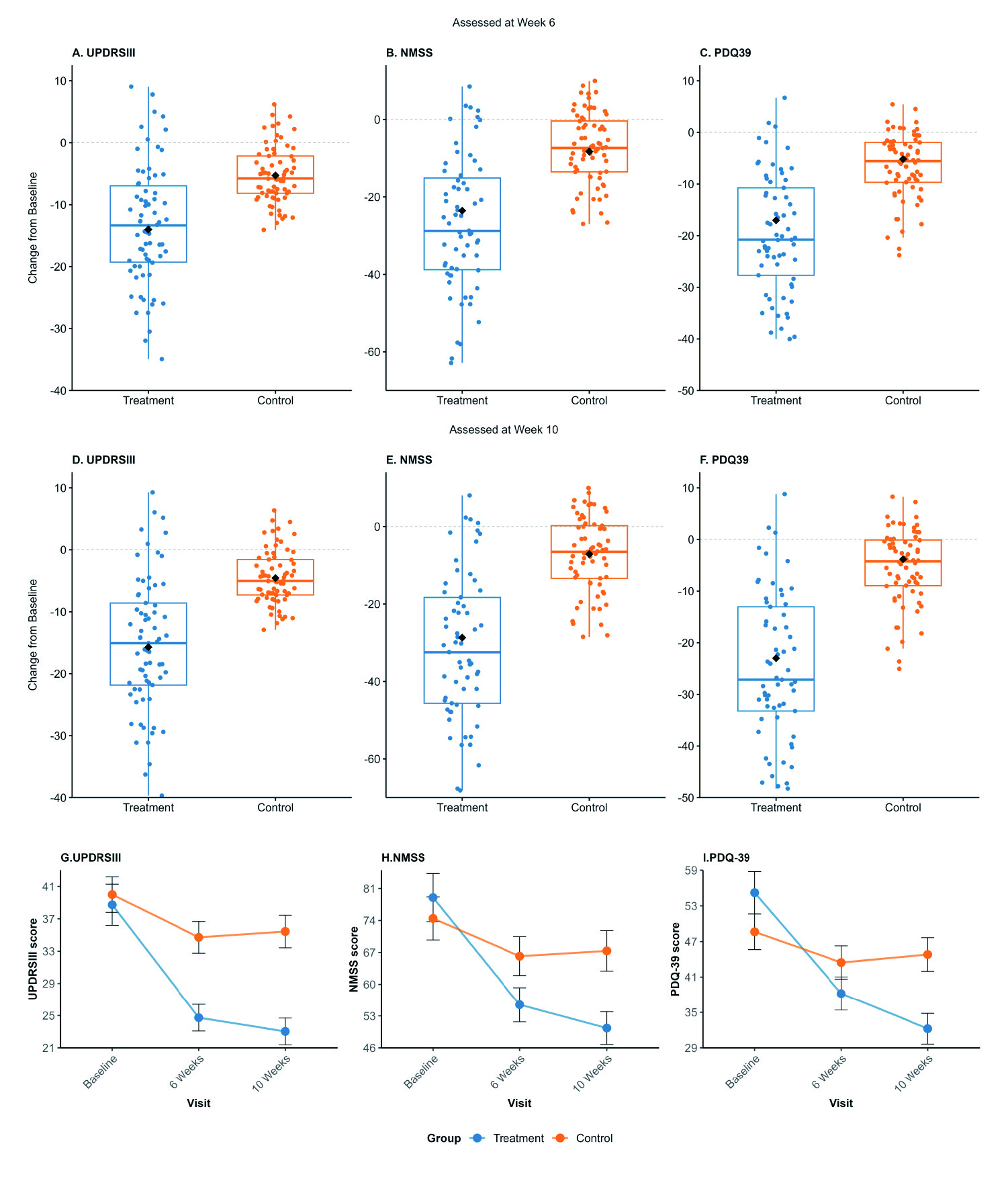
Figure 1
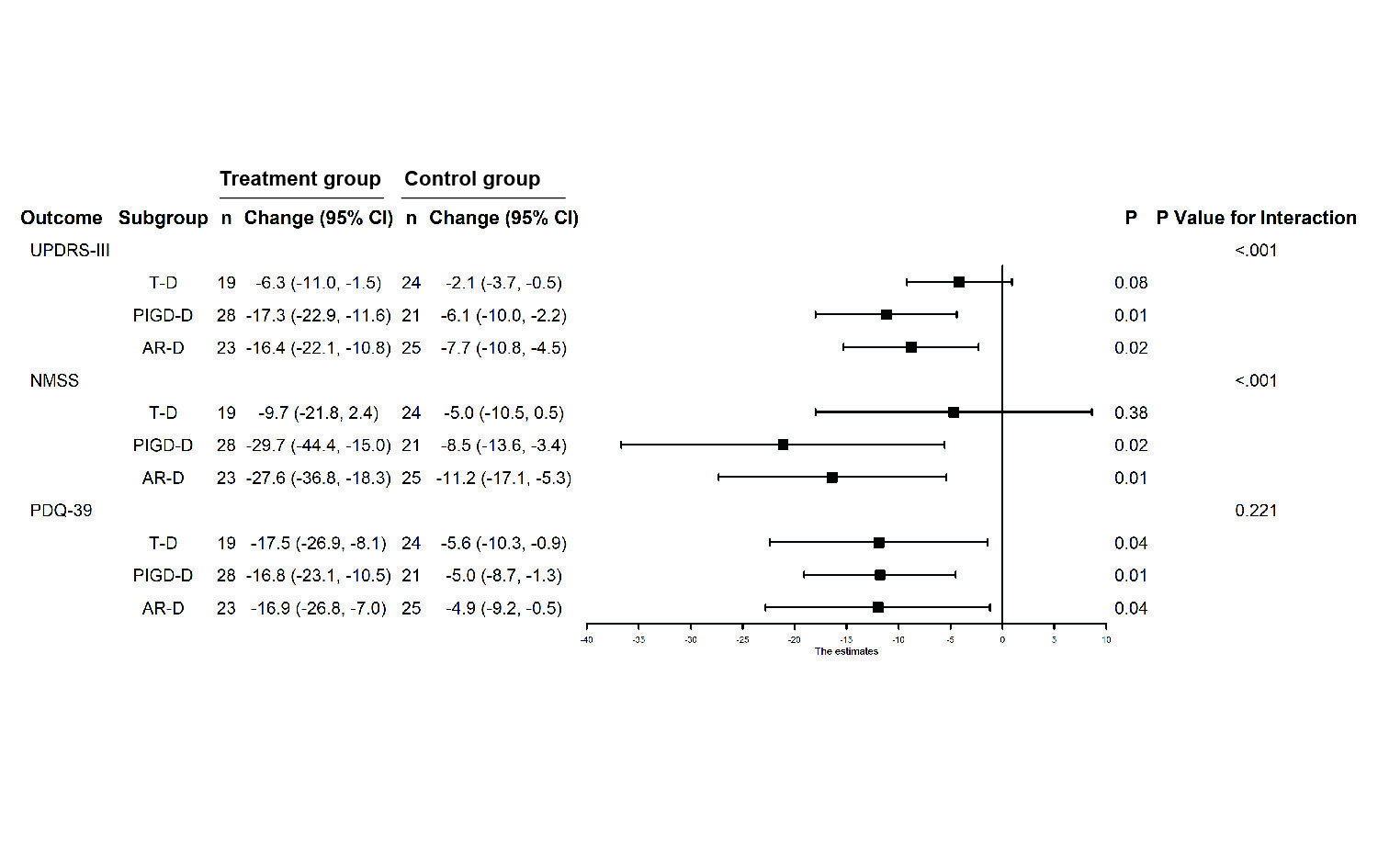
Figure 2
To cite this abstract in AMA style:
WQ. Peng, RH. Zhao, ZT. Huang, NB. Wang, ZH. Chen. Qihuang Needle Therapy for Motor Symptoms in Parkinson’s Disease: A Randomized Controlled Trial [abstract]. Mov Disord. 2026; 41 (suppl 1). https://www.mdsabstracts.org/abstract/qihuang-needle-therapy-for-motor-symptoms-in-parkinsons-disease-a-randomized-controlled-trial/. Accessed October 1, 2026.« Back to 2026 International Congress
MDS Abstracts - https://www.mdsabstracts.org/abstract/qihuang-needle-therapy-for-motor-symptoms-in-parkinsons-disease-a-randomized-controlled-trial/