
Category: Technology
Objective: To assess whether 1) tremor and dyskinesia affect photoplethysmography (PPG) data quality, and 2) heart rate (HR) analysis based on continuous PPG can be used to quantify autonomic dysfunction in Parkinson’s disease (PD) patients.
Background: Autonomic dysfunction is an important non-motor sign of PD, and objective measures are needed to quantify its progression for both patient care and clinical trials.
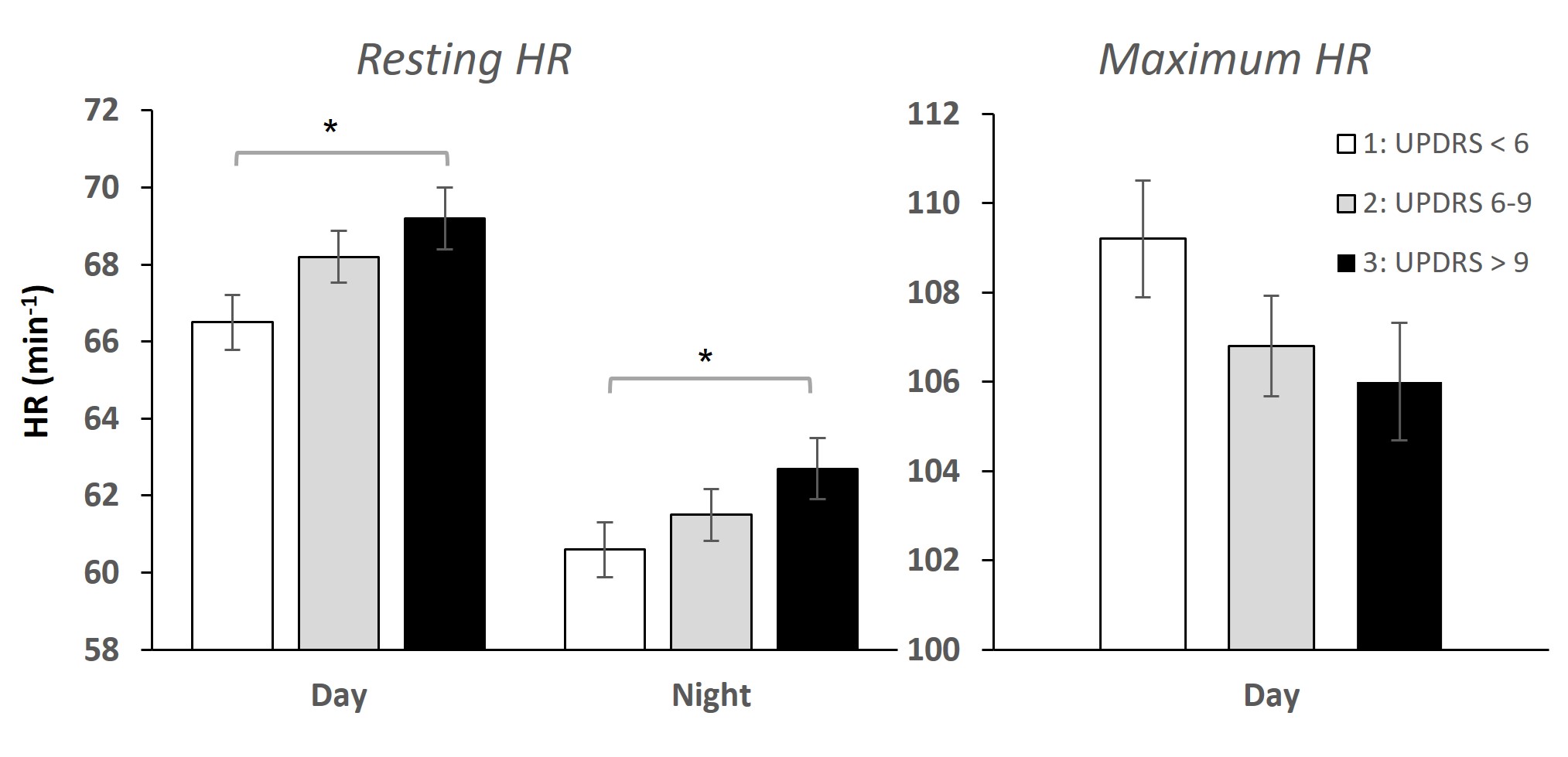
Method: From the Personalized Parkinson Project cohort, we included 486 patients diagnosed with PD for < 5 years. Participants wore a wrist-worn sensor device (mean wear time of 20 hours per day), and we segmented the continuous PPG signal of the first study week into 1-min windows. Using a previously developed algorithm, we classified all windows into high- versus low-quality segments for HR analysis. First, we studied the correlation between the proportion of high-quality segments during the day, and the severity of rest tremor at the arm of the device (MDS-UPDRS item 3.17) and the severity of dyskinesia (MDS-UPDRS items 4.1 and 4.2). Second, we assessed the correlation between HR profiles and existing measures of autonomic dysfunction (the MDS-UPDRS part Ib subtotal). HR was calculated from each high-quality segment by deriving the dominant frequency in the power spectral density. We defined the resting HR as the modal HR over all segments (calculated separately for day- and night-time), and the maximum HR was set at the 99th percentile HR (daytime only).
Results: On average, 65% (IQR: 59 – 71) of the PPG data was classified as high-quality across all 486 patients. The proportion of high-quality PPG segments was not significantly different between patients with different severity of rest tremor (p = 0.46) and dyskinesia (p = 0.14). Patients with more severe non-motor symptoms demonstrated a significantly higher resting HR, both during the day (p = 0.04) and during the night (p = 0.04). Maximum HR was not significantly associated with non-motor symptom severity (p = 0.12).
Conclusion: This large study on real-life sensor-based monitoring of PD revealed no link between motor symptoms and PPG quality, and demonstrated associations between resting HR and autonomic symptoms. This suggests that PPG-based HR assessment could be a promising tool to objectively quantify autonomic dysfunction in PD patients.
To cite this abstract in AMA style:
K. Veldkamp, L. Evers, Y. Raykov, M. Little, M. Brouwer, B. Bloem, J. Thannhauser. Real-life heart rate assessment: a digital biomarker for autonomic dysfunction in early Parkinson’s disease? [abstract]. Mov Disord. 2023; 38 (suppl 1). https://www.mdsabstracts.org/abstract/real-life-heart-rate-assessment-a-digital-biomarker-for-autonomic-dysfunction-in-early-parkinsons-disease/. Accessed October 4, 2026.« Back to 2023 International Congress
MDS Abstracts - https://www.mdsabstracts.org/abstract/real-life-heart-rate-assessment-a-digital-biomarker-for-autonomic-dysfunction-in-early-parkinsons-disease/