
Objective: To describe the efficacy and safety of continuous subcutaneous infusion of foslevodopa/foscarbidopa (LDp/CDp) in advanced Parkinson’s disease (aPD) in routine clinical practice, focusing on patients with MCI or prior mild psychotic history.
Background: LDp/CDp has emerged as a novel device-aided therapy for aPD [1,2]. However, real-world evidence remains limited in clinically complex populations, particularly older patients with mild cognitive impairment (MCI) and mild psychotic symptoms [3,4,5].
Method: Single-center, retrospective real-world observational study including patients with aPD who initiated LDp/CDp at our center. MCI was defined as an MDS-UPDRS Part I item 1 score ≤2. Baseline clinical characteristics, infusion regimen, concomitant oral medication, efficacy, and safety were descriptively analyzed. Motor fluctuations were assessed using MDS-UPDRS Part IV at baseline and after 6 months.
Results: A total of 35 patients started LDp/CDp; 24 met inclusion criteria (all had MCI, and 13 had a history of mild psychosis). Patient characteristics, infusion parameters, concomitant medication, efficacy and safety outcomes are summarized in Table 1. The first nine patients were started on 24-hour infusion, but after gaining experience most subsequent patients received a 16-hour regimen without overnight infusion. Overall, treatment led to a 4-point improvement in MDS-UPDRS Part IV. Neuropsychiatric adverse events (confusion, hallucinations or psychosis) occurred in 7/24 patients and were more common with 24-hour infusion. These events were managed with low-dose quetiapine, withdrawal of overnight exposure, or treatment discontinuation. Treatment was discontinued in 6 patients, more often in the 24-hour group, which also showed a higher frequency of skin reactions. Adverse events and discontinuations are displayed in Figure 1.
Conclusion: Continuous subcutaneous LDp/CDp appears to be an effective and well-tolerated option for motor fluctuations in aPD patients with MCI and a history of mild psychotic symptoms, when individualized titration and careful neuropsychiatric monitoring are applied [3,5]. Shortening exposure to levodopa with a 16-hour regimen may represent a pragmatic strategy to mitigate neuropsychiatric complications in selected patients.
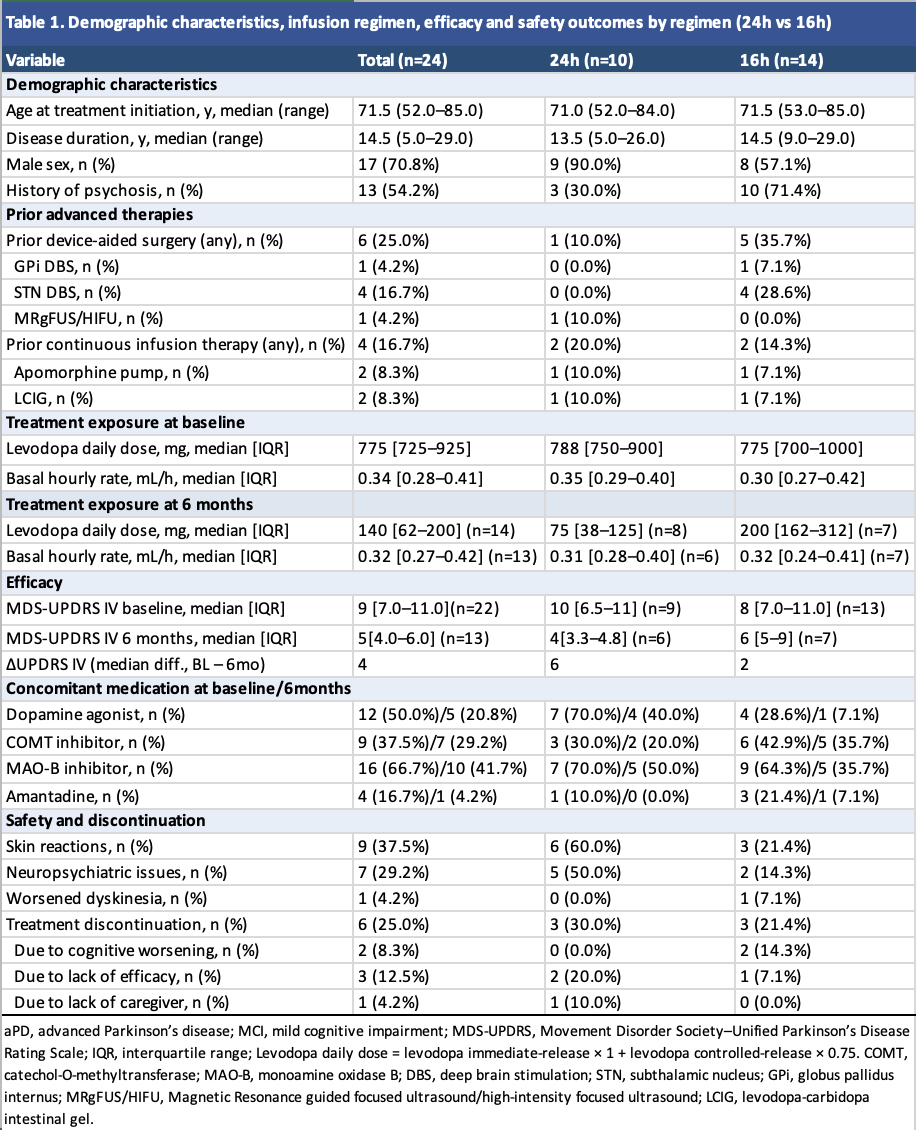
Table 1
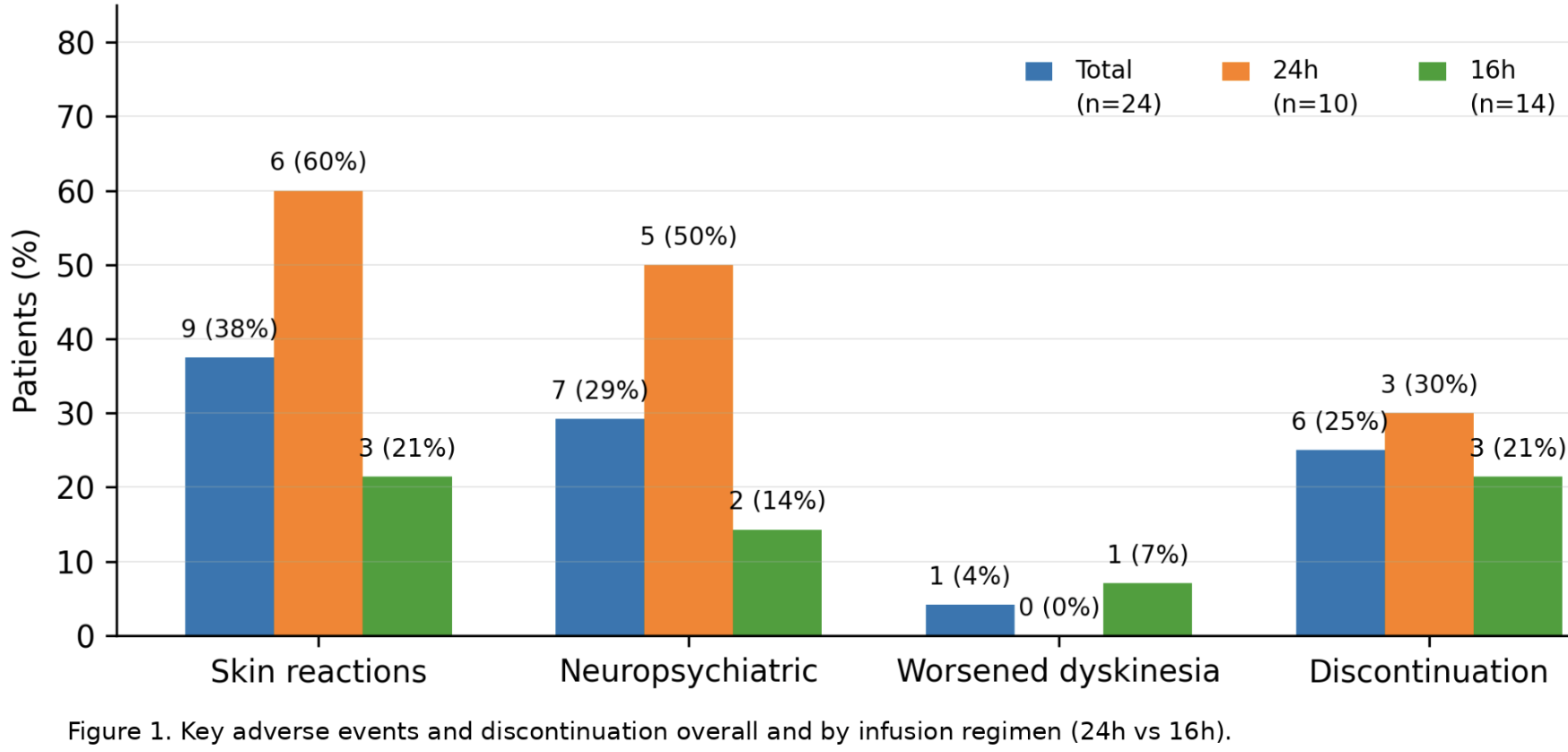
Figure 1
References: [1] Aldred J, Freire-Alvarez E, Amelin AV, Antonini A, Bergmans B, Bergquist F, et al. Continuous subcutaneous foslevodopa/foscarbidopa in Parkinson’s disease: safety and efficacy results from a 12-month, single-arm, open-label, phase 3 study. Neurol Ther. 2023 Dec;12(6):1937-1958. Epub 2023 Aug 26. doi:10.1007/s40120-023-00533-1. PMID:37632656; PMCID:PMC10630297. Erratum in: Neurol Ther. 2023 Dec;12(6):1959-1960. doi:10.1007/s40120-023-00554-w.
[2] Aldred J, Bouchard M, Martínez-Castrillo JC, Soileau MJ, Spiegel AM, Bergmann L, et al. Efficacy and safety of foslevodopa/foscarbidopa monotherapy in patients with Parkinson’s disease. Mov Disord Clin Pract. 2026 Jan;13(1):181-190. Epub 2025 Jul 30. doi:10.1002/mdc3.70245. PMID:40736131; PMCID:PMC12839491.
[3] Chaudhuri KR, Bergmans B, Freire-Alvarez E, Hopes L, Kern DS, Kirsner RS, et al. Considerations for initiation and maintenance of foslevodopa/foscarbidopa for advanced Parkinson’s disease. Mov Disord Clin Pract. Epub 2026 Jan 16. doi:10.1002/mdc3.70489. PMID:41540973.
[4] Koeglsperger T, Berberovic E, Dresel C, Haferkamp S, Kassubek J, Müller R, et al. Real-world experience with continuous subcutaneous foslevodopa/foscarbidopa infusion: insights and recommendations. J Neural Transm (Vienna).2026 Feb;133(2):347-359. Epub 2025 Mar 22. doi:10.1007/s00702-025-02911-5. PMID:40121314; PMCID:PMC12855247.
[5] Rukavina K, Ebersbach G, Gruber D. Foslevodopa/foscarbidopa continuous subcutaneous infusion in Parkinson’s disease: real-world short-term data on tolerability, infusion rate adjustments and concomitant medication. Mov Disord Clin Pract. 2025 Dec;12(12):2317-2323. Epub 2025 Jul 28. doi:10.1002/mdc3.70249. PMID:40879572; PMCID:PMC12715349.
To cite this abstract in AMA style:
MN. Afkir Ortega, E. Navarro Mocholi, I. Sastre Bataller, M. Campins Romeu, C. Morata Martínez, R. Baviera Muñoz, J. Perez Garcia, I. Martinez Torres. Real-World Clinical Experience With Continuous Subcutaneous Foslevodopa/Foscarbidopa Infusion In Advanced Parkinson’s Disease Patients With Mild Cognitive Impairment And History Of Psychosis [abstract]. Mov Disord. 2026; 41 (suppl 1). https://www.mdsabstracts.org/abstract/real-world-clinical-experience-with-continuous-subcutaneous-foslevodopa-foscarbidopa-infusion-in-advanced-parkinsons-disease-patients-with-mild-cognitive-impairment-and-history-of-psychosis/. Accessed October 1, 2026.« Back to 2026 International Congress
MDS Abstracts - https://www.mdsabstracts.org/abstract/real-world-clinical-experience-with-continuous-subcutaneous-foslevodopa-foscarbidopa-infusion-in-advanced-parkinsons-disease-patients-with-mild-cognitive-impairment-and-history-of-psychosis/