
Category: Tremor
Objective: To investigate whether pre-treatment rest tremor severity predicts outcomes in a cohort of patients with essential tremor/essential tremor plus (ET/ET+) and dystonic tremor (DT).
Background: MRI-guided focused ultrasound (MRgFUS) VIM thalamotomy is an established treatment for medication-refractory tremor. Rest tremor is the clinical hallmark Parkinson’s disease tremor (PDT). Recent studies have suggested PDT responds less durably to VIM thalamotomy1,2. Though less typical, rest tremor is a recognised feature of ET/ET+ and DT, and syndromic overlap is well recognised. Whether rest tremor predicts outcomes following MRgFUS thalamotomy in these tremor syndromes has not been systematically studied.
Method: We conducted a retrospective cohort study of consecutively enrolled patients with ET/ET+ and DT who underwent unilateral MRgFUS thalamotomy for medically refractory tremor. Patients with PDT or other tremor syndromes were excluded. Tremor syndromes were clinically classified prior to treatment according to MDS consensus criteria3. Data were prospectively collected at predefined intervals up to 5 years. Primary outcomes were post-treatment Hand Tremor Score (HTS) and Clinical Rating Scale for Tremor (CRST). Linear mixed models adjusted for baseline severity, age and tremor aetiology were used, with timepoint as a factor.
Results: 171 patients underwent MRgFUS VIM thalamotomy between November 2018 and January 2025. Of these, 118 patients with ET/ET+ (n=77) or DT (n=41) met inclusion criteria. Median follow-up was 12 months (IQR 12–60).
Rest tremor did not predict post-treatment HTS (β=0.26, p=0.39) or CRST (β=0.15, p=0.84) after adjusting for baseline tremor severity and age. Higher baseline tremor severity was the strongest predictor of poorer post-treatment tremor scores (HTS β=0.50, p<0.001; CRST β=0.67, p<0.001). Older age also predicted worse scores (HTS β=0.16, p<0.001; CRST β=0.25, p=0.026). Outcomes did not differ between DT and ET/ET+ (HTS β=0.55, p=0.48; CRST β=0.10, p=0.96). Results were consistent whether rest tremor was modelled as continuous or binary.
Conclusion: In patients with ET/ET+ or DT, rest tremor did not predict worse post-treatment outcomes following MRgFUS VIM thalamotomy. These findings suggest rest tremor in isolation should not be considered a negative prognostic factor when evaluating candidacy for MRgFUS thalamotomy.
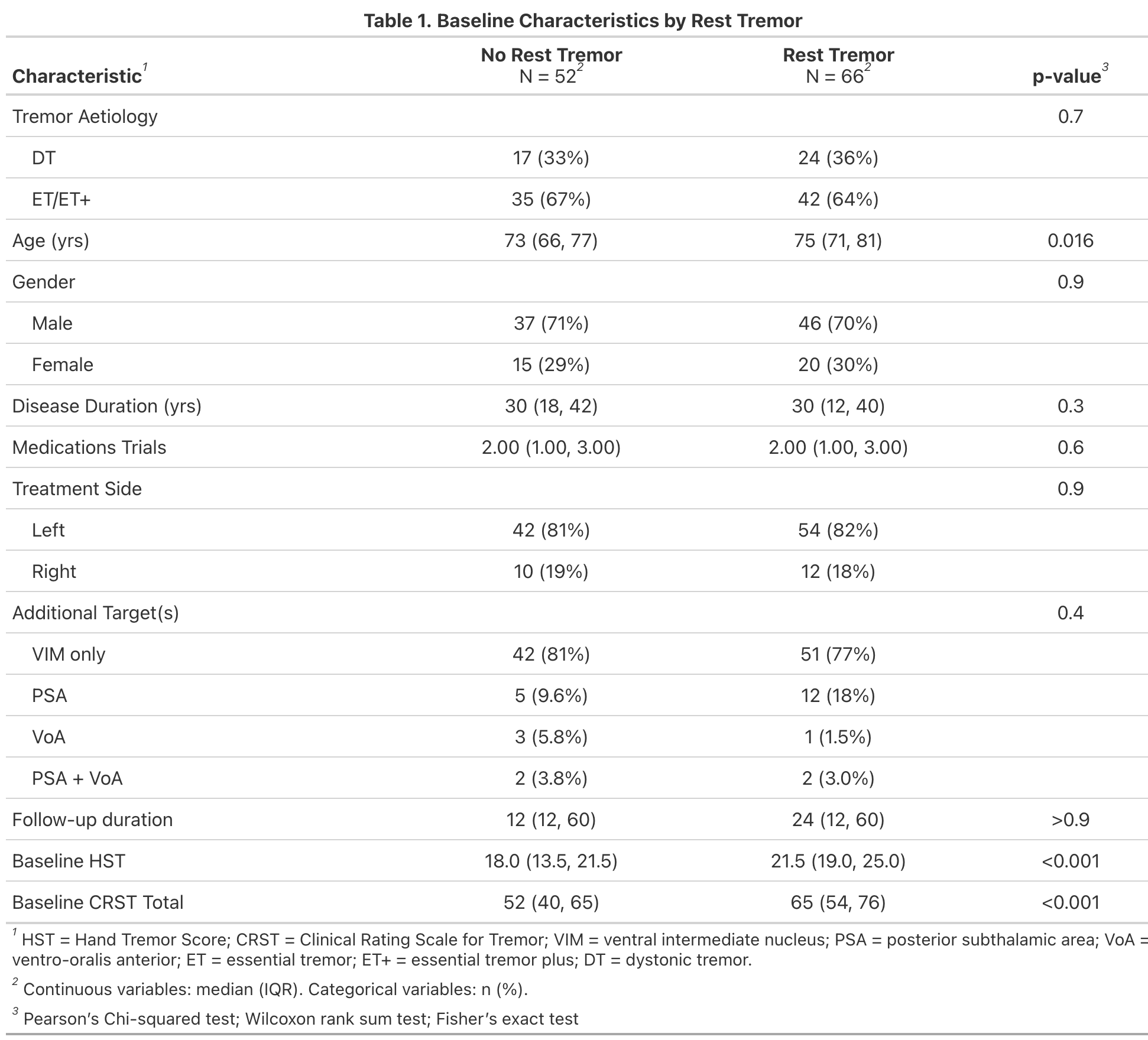
Baseline Characteristics
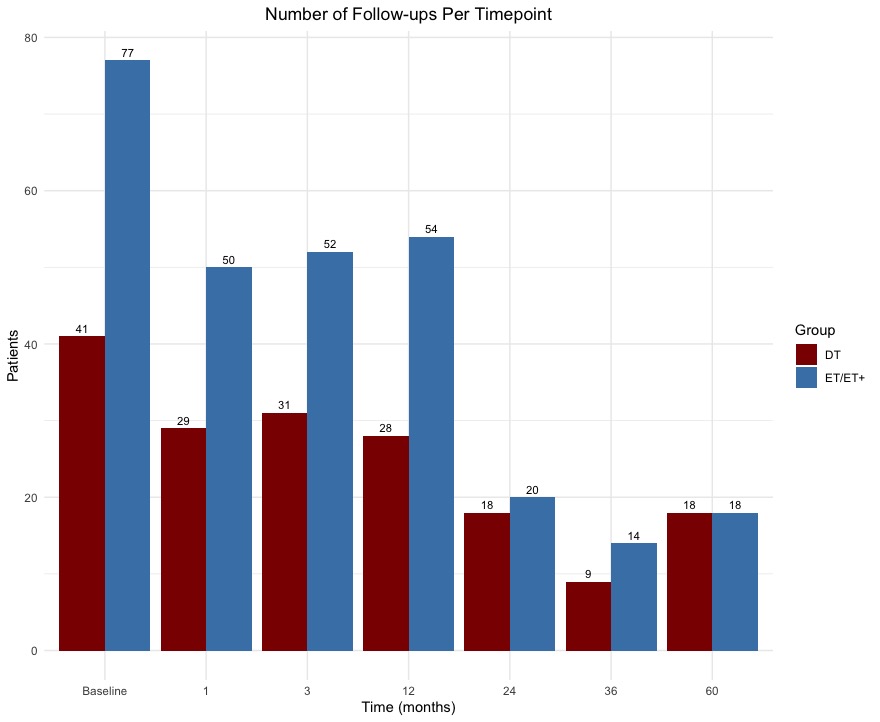
Follow-up Data
References: 1.Bond AE, Shah BB, Huss DS, et al. Safety and Efficacy of Focused Ultrasound Thalamotomy for Patients With Medication-Refractory, Tremor-Dominant Parkinson Disease: A Randomized Clinical Trial. JAMA Neurology. 2017;74(12):1412-1418. doi:10.1001/jamaneurol.2017.3098
2.Peters J, Maamary J, Kyle K, et al. Outcomes of Focused Ultrasound Thalamotomy in Tremor Syndromes. Movement Disorders. 2024;39(1):173-182. doi:10.1002/mds.29658
3.Bhatia KP, Bain P, Bajaj N, et al. Consensus Statement on the classification of tremors. from the task force on tremor of the International Parkinson and Movement Disorder Society. Movement Disorders. 2018;33(1):75-87. doi:https://doi.org/10.1002/mds.27121
To cite this abstract in AMA style:
O. Chan, J. Peters, J. Maamary, L. Jones, S. Bolitho, Y. Barnett, B. Jonker, S. Tisch. Rest Tremor does Not Predict Response to Focused Ultrasound Thalamotomy in Essential Tremor and Dystonic Tremor [abstract]. Mov Disord. 2026; 41 (suppl 1). https://www.mdsabstracts.org/abstract/rest-tremor-does-not-predict-response-to-focused-ultrasound-thalamotomy-in-essential-tremor-and-dystonic-tremor/. Accessed October 1, 2026.« Back to 2026 International Congress
MDS Abstracts - https://www.mdsabstracts.org/abstract/rest-tremor-does-not-predict-response-to-focused-ultrasound-thalamotomy-in-essential-tremor-and-dystonic-tremor/