
Objective: To develop a conversational system using AI and Retrieval-Augmented Generation (RAG) grounded in curated Parkinson’s disease knowledge for evidence-based patient education and structured clinical pre-assessment. It would guide patients through adaptive questionnaires aligned with the MDS-UPDRS, convert unstructured symptom descriptions into structured reports, and support pre-visit triage.
Background: Patients with Parkinson’s disease (PD) often seek reliable symptoms and management guidance between visits, yet trustworthy information remains limited. Encounters frequently begin with unstructured symptom descriptions requiring clinicians to translate narratives into standardized scales like MDS-UPDRS – a time-consuming process compounded by fragmented inter-visit information. Large language models enable conversational interfaces but may produce inaccurate or non-traceable content. RAG addresses this by grounding responses in a curated knowledge base, enabling evidence-based outputs while supporting structured data collection.
Method: We built a chatbot using a graph-based RAG framework from curated PD literature, providing education on symptoms, medications, and daily living with source-traceable responses. For pre-assessment, it identifies symptom domains and guides patients through validated questionnaires tailored to their concerns. Free-text responses are interpreted via decision logic aligned with clinical criteria to produce structured summaries for clinician review. The system uses locally deployed models to preserve privacy.
Results: Preliminary specialist review indicates RAG-based responses are more personalized and comprehensible than commercial LLM outputs, which tend to be overly detailed yet generic. By incorporating patient context with curated references, the system tailors responses individually. In testing with real patients, the chatbot guided them through MDS-UPDRS Parts I, II, and IV, converting input into clinically interpretable summaries. Clinicians confirm these captured critical assessment details and improved consultation efficiency.
Conclusion: A RAG-based system supports PD education and structured clinical pre-assessment. Blinded evaluation confirmed RAG responses were preferred over generic LLM outputs. Converting unstructured input into structured reports may improve pre-visit assessment.
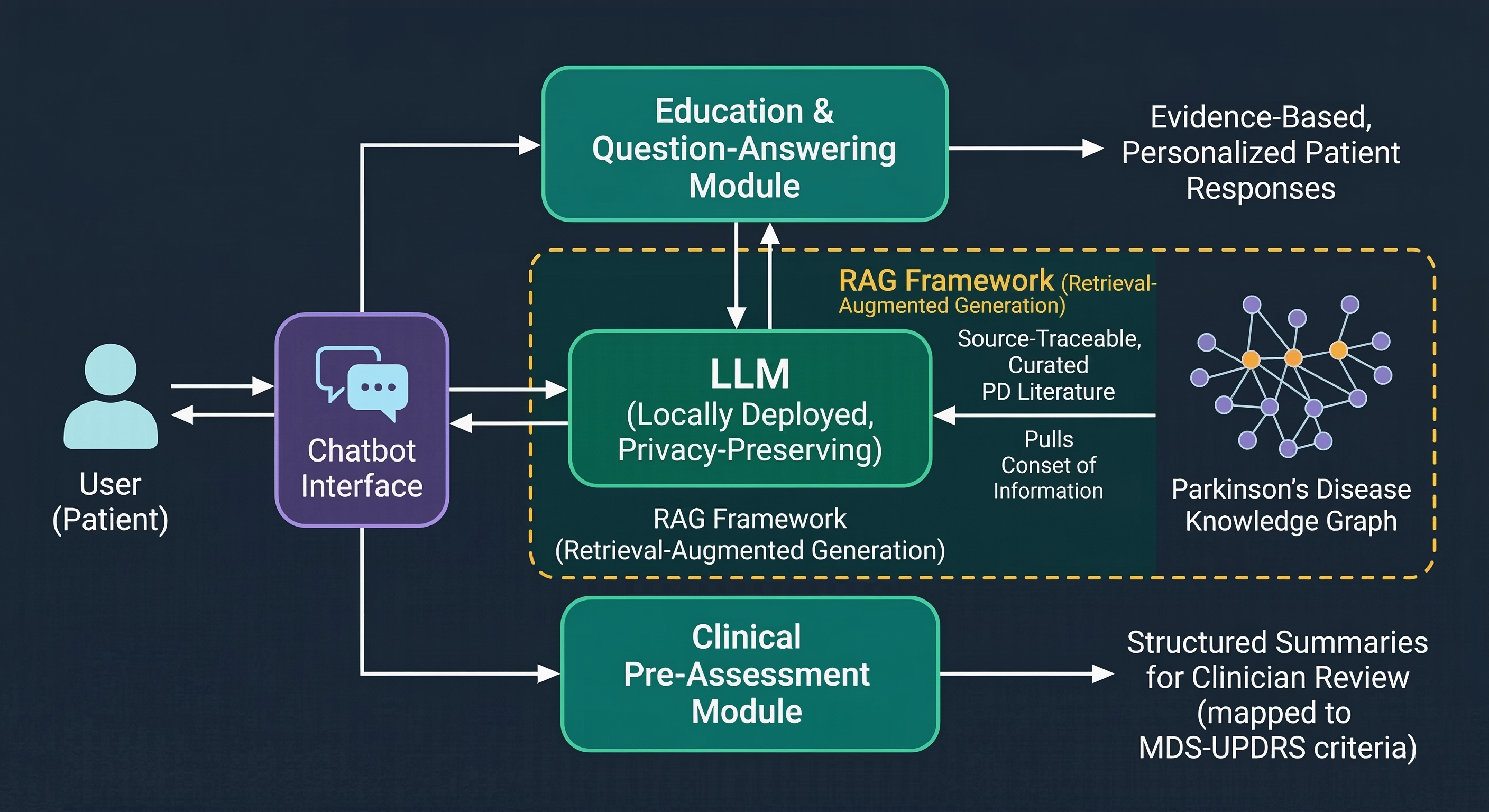
Overview
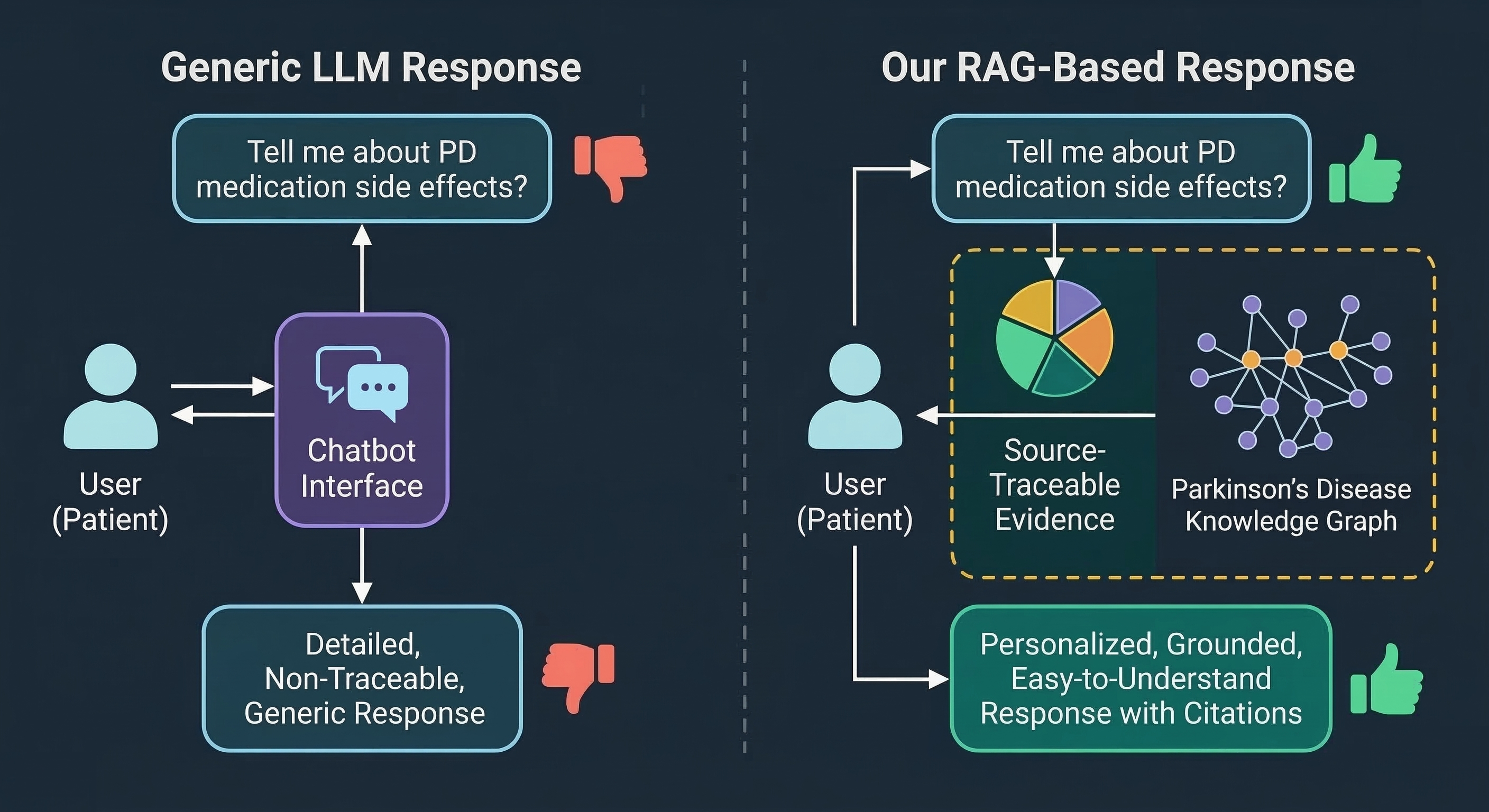
Evaluation: Generic LLM vs. RAG
To cite this abstract in AMA style:
H. Ng, T. Mi, L. Guo, J. Gao, M. Grundy, E. Sierra, J. Wang, M. Mckeown. Retrieval-Augmented Generation (RAG) Chatbot for Parkinson’s Disease Patient Education and AI-Assisted Clinical Pre-Assessment [abstract]. Mov Disord. 2026; 41 (suppl 1). https://www.mdsabstracts.org/abstract/retrieval-augmented-generation-rag-chatbot-for-parkinsons-disease-patient-education-and-ai-assisted-clinical-pre-assessment/. Accessed October 1, 2026.« Back to 2026 International Congress
MDS Abstracts - https://www.mdsabstracts.org/abstract/retrieval-augmented-generation-rag-chatbot-for-parkinsons-disease-patient-education-and-ai-assisted-clinical-pre-assessment/