
Objective: To identify risk factors for non-motor dysautonomic fluctuations in people living with Parkinson’s disease (PwP).
Background: Advanced Parkinson’s disease (PD) is characterized by motor fluctuations, but non-motor fluctuations (NMF) have also been recognized, with dysautonomic symptoms being the most prevalent (49% in PwP), particularly drenching sweats (64%). Risk factors for NMF include female gender (OR=5.33) and chronic levodopa treatment. Further controlled clinical trials focusing on NMF are urgently needed.
Method: Mexican PwP were included in this cross-sectional observational study. Dysautonomic NMF were categorized into two groups using the NoMoFa Questionnaire items 21-27: (i) PwP with dysautonomic NMF, if symptoms were reported in either “on” or “off” states, and (ii) PwP without dysautonomic NMF, if symptoms were reported as “no difference.” A logistic regression was performed, adjusting for age, gender, toxic exposure, hypertension, polypharmacy, disease duration, MDS-UPDRS total score, PDQ-39 index, MoCA, HRSD, and HRSA total scores. Performance metrics and a ROC curve were also analyzed.
Results: A total of 158 Mexican PwP (55.1% male, mean age 64.9 ± 11.2 years, disease duration 20.2 ± 5.6 years) were included. Most were on levodopa treatment (98.7%), and 25.3% had arterial hypertension. The most common dysautonomic NMF was frequent urination (39.1%). Logistic regression identified higher anxiety scores (using HRSA) as a significant predictor (p = 0.001, β = 1.6, SE = 0.7, 95% CI = 0.7–2.5, OR = 4.9). Other variables were not statistically significant; although the HRSD total score (depression) had a marginal effect (p = 0.053, OR = 0.42), it did not reach statistical significance [table 1]. ROC curve accuracy was 0.708, with an AUC of 0.7618 [figure 1].
Conclusion: Higher HRSA scores emerged as the most relevant risk factor for dysautonomic fluctuations in PwP. These findings emphasize the importance of systematic neuropsychiatric screening, particularly for anxiety symptoms, to ensure early detection and appropriate management. Given the high prevalence of dysautonomic fluctuations and their impact on quality of life, clinicians should actively monitor anxiety symptoms in PwP and consider targeted interventions to reduce the burden of non-motor fluctuations. Further prospective studies are needed to validate these findings and explore potential therapeutic strategies to mitigate these symptoms.
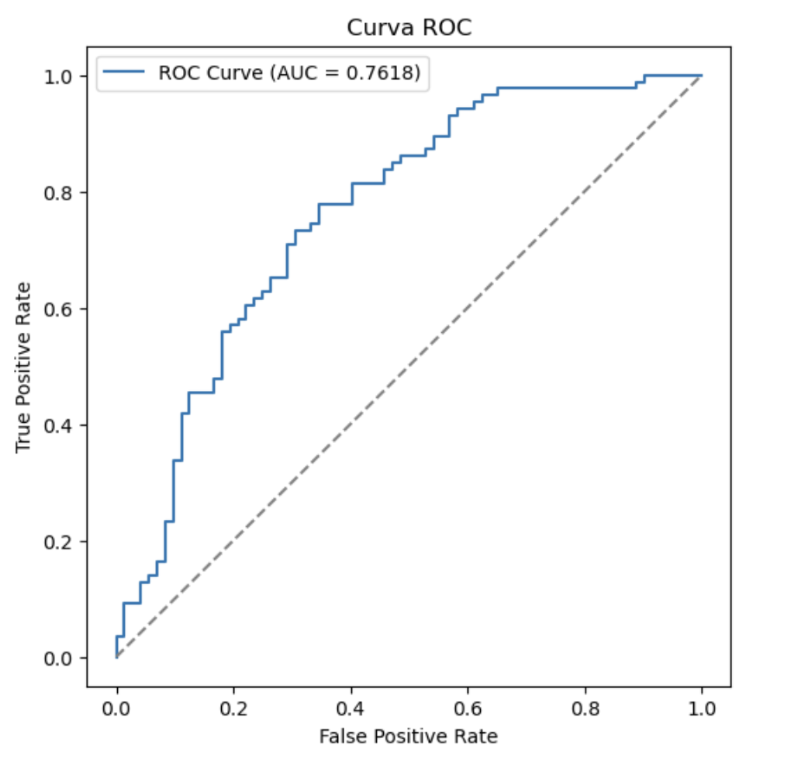
ROC curve
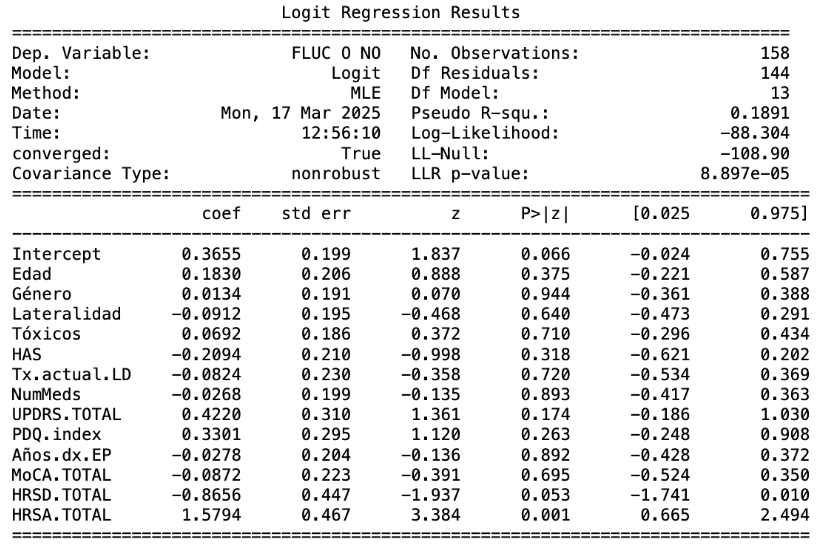
Regression results
References: 1.Brun L, Lefaucheur R, Fetter D, Derrey S, Borden A, Wallon D, Bourre B, Maltête D. Non-motor fluctuations in Parkinson’s disease: prevalence, characteristics and management in a large cohort of parkinsonian outpatients. Clin Neurol Neurosurg. 2014 Dec;127:93-6. doi: 10.1016/j.clineuro.2014.10.006. Epub 2014 Oct 16. PMID: 25459250.
2. Picillo M, Palladino R, Moccia M, Erro R, Amboni M, Vitale C, Barone P, Pellecchia MT. Gender and non motor fluctuations in Parkinson’s disease: A prospective study. Parkinsonism Relat Disord. 2016 Jun;27:89-92. doi: 10.1016/j.parkreldis.2016.04.001. Epub 2016 Apr 4. PMID: 27066847.
3. Marsden CD, Parkes JD. “On-off” effects in patients with Parkinson’s disease on chronic levodopa therapy. Lancet . 1976; 292–296.
To cite this abstract in AMA style:
MF. Medina-Pérez, MF. Velasco-Delgado, A. Cervantes-Arriaga, R. Solís-Vivanco, M. Rodríguez-Violante. Risk factors for dysautonomic fluctuations in Mexican PwP [abstract]. Mov Disord. 2026; 41 (suppl 1). https://www.mdsabstracts.org/abstract/risk-factors-for-dysautonomic-fluctuations-in-mexican-pwp/. Accessed October 1, 2026.« Back to 2026 International Congress
MDS Abstracts - https://www.mdsabstracts.org/abstract/risk-factors-for-dysautonomic-fluctuations-in-mexican-pwp/