
Category: Parkinson’s Disease: Clinical Trials
Objective: This study aimed to evaluate the safety and preliminary efficacy of NCR201 transplantation in a PRKN-EOPD patient, providing a first proof-of-concept for this hypoimmune cell therapy.
Background: Inherited Parkinson’s disease (PD) accounts for 10-15% of cases. PRKN mutations are the most common cause of autosomal recessive early-onset PD (EOPD) marked by early dopaminergic neuron loss. Cell replacement therapy represents a promising approach for PRKN-PD. We developed clinical-grade hypoimmune iPSC-derived dopaminergic progenitor (iDAP) cells (Product ID: NCR201) to bypass HLA-matching requirements.
Method: A 37-year-old PRKN-PD patient (onset age 22) received robot-assisted bilateral stereotactic putaminal transplantation of 4 million NCR201 cells. A minimized, 6-month immunosuppressive regimen was employed to complement the cells’ hypoimmune profile. Clinical efficacy was rigorously evaluated via the MDS-UPDRS, Non-Motor scale, and [18F]-FP-CIT PET imaging (Figure1).
Results: NCR201 consists of high purity >90% iDAPs (FOXA2+), and achieved high yield >80% of mDA (TH+). GLP studies confirmed a favorable efficacy, safety and low-immune profile in rodent and NHP models. The robotic-guided procedure and minimized immunosuppression were well tolerated, with no NCR201-related AE reported. Rapid motor recovery manifested by Day 28. At 6 months, the MDS-UPDRS III score decreased from 39 to 10 in OFF state and from 24 to 10 in ON state, with notable resolution of rigidity and postural instability. The mean daily OFF time was eliminated at Day28 (4.5 to 0 h) and sustained through 6 months. Improved non-motor symptoms enabled oral medication cessation and a full return to normal life by 6 months (Figure2). [18F]-FP-CIT PET imaging at 3 and 6 months confirmed a significant increase in striatal radiotracer binding, providing objective evidence of successful graft engraftment and functional dopaminergic maturation (Figure3).
Conclusion: As the first hypoimmune iDAPs product entering clinical trial, the latest results demonstrate a safety profile and robust functional recovery in a PRKN-EOPD patient. The close correlation between clinical improvement and restored dopaminergic neural innervation presents a prove of concept for NCR201 cell replacement therapy in PRKN-EOPD intervention. These preliminary findings warrant an expanded study involving more inherited PD patients with long-term observation.
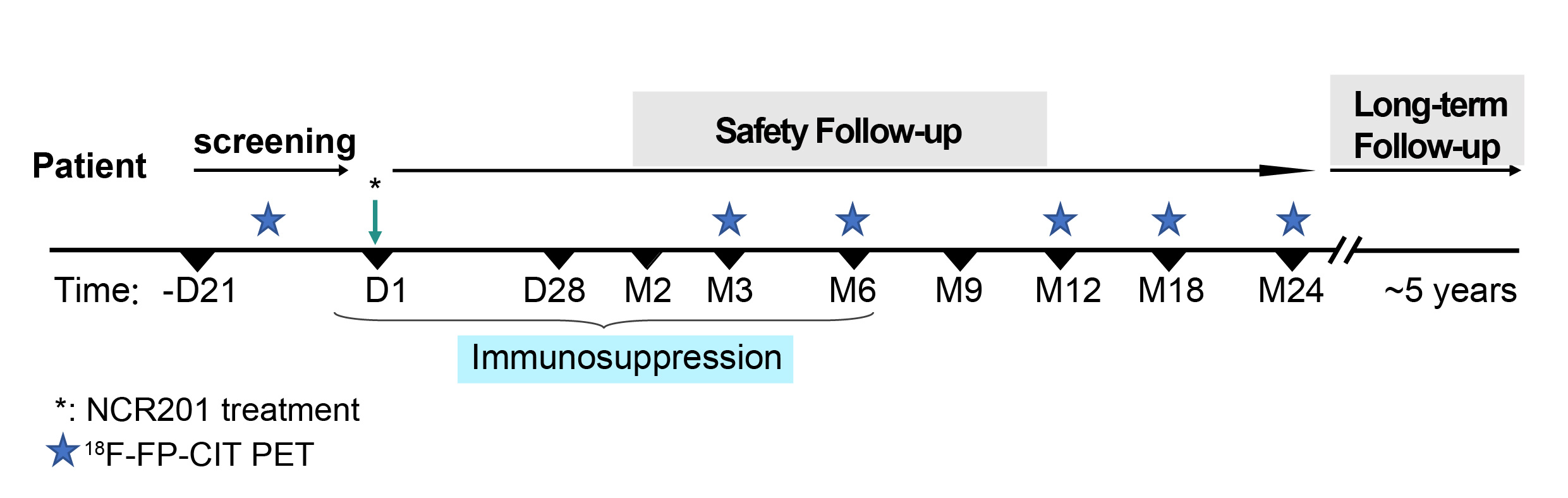
The study design
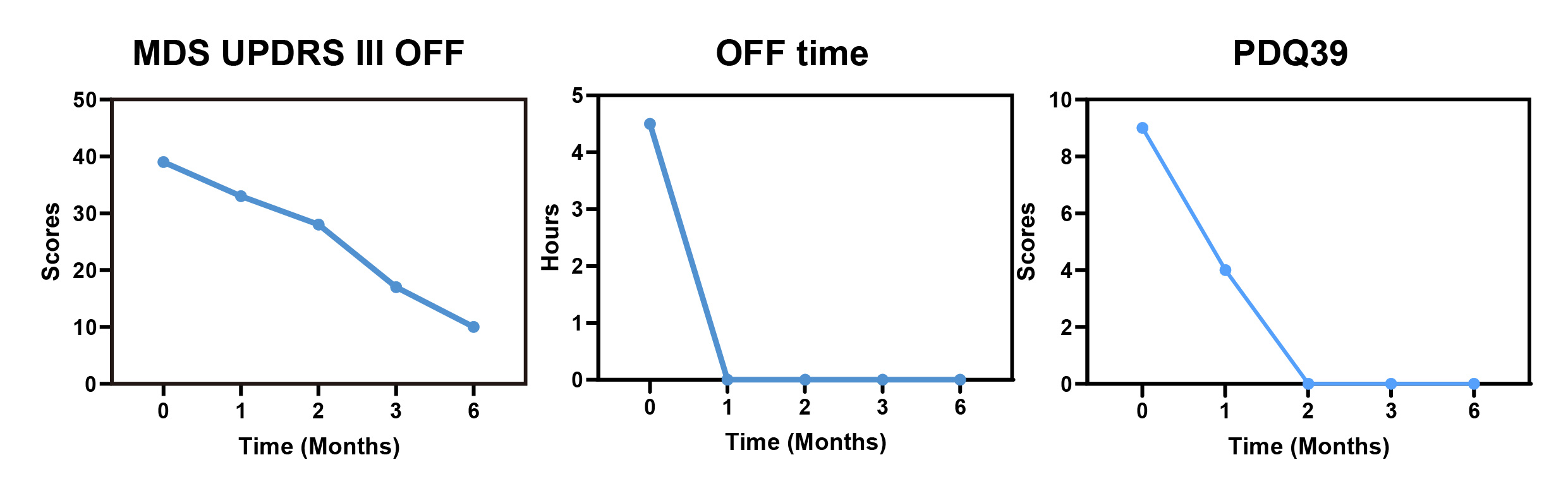
Clinical outcomes 6 months after transplantation
![[18F]-FP-CIT PET uptake signal in the striatum](https://www.mdsabstracts.org/wp-content/uploads/2026/09/0988_1474_001027_3.jpg)
[18F]-FP-CIT PET uptake signal in the striatum
To cite this abstract in AMA style:
J. Guo, J. Shi, Y. Zhang, C. Han, L. Yao, L. Jiao, R. Qian, J. Yu, A. Chen. Robot-Assisted Transplantation of Hypoimmune iPSC-Derived Dopaminergic Progenitor Cells for PRKN-EOPD [abstract]. Mov Disord. 2026; 41 (suppl 1). https://www.mdsabstracts.org/abstract/robot-assisted-transplantation-of-hypoimmune-ipsc-derived-dopaminergic-progenitor-cells-for-prkn-eopd/. Accessed October 1, 2026.« Back to 2026 International Congress
MDS Abstracts - https://www.mdsabstracts.org/abstract/robot-assisted-transplantation-of-hypoimmune-ipsc-derived-dopaminergic-progenitor-cells-for-prkn-eopd/