
Category: Technology
Objective: To investigate whether sensor-derived metrics can quantify dyskinesia in Parkinson’s disease (PD), and to compare supervised and unsupervised assessments.
Background: Dyskinesia is a common motor complication in PD, characterized by involuntary movements that can significantly impact daily functioning. Its clinical assessment mainly relies sporadic visual examinations and semi-quantitative rating scales, which may lack objectivity. Wearable sensors enable ecological motion analysis, offering new opportunities for objective and remote monitoring of dyskinetic movements in PD.
Method: Forty PD patients (H&Y 2.5-4) were recruited across two Movement Disorders centers. Subjects performed 60s standing tasks recorded using an inertial sensor (Movit, Captiks Srl, Italy) on the lower back. Eight subjects were additionally equipped with a wearable device (STAT-ONTM, Sense4Care, Spain) on their waist and monitored at home for one week. The dyskinesia index (DyskIdx) was calculated as the total power in the 0-4 Hz acceleration frequency band, extracted when subjects were in a static position. Correlation between DyskIdx and clinical scales (MDS-UPDRS IV, UDysRS) was assessed using the Spearman ρ and associated p-value, while differences between dyskinedic (PD-Dys) vs non-dyskinedic (PD-nDys) subjects were assessed using the Mann-Whitney U-test.
Results: The median DyskIdx computed at home over a week was significantly different between PD-Dys and PD-nDys (U=15, p=0.018), and strongly correlated with UDysRS (ρ = 0.93, p=0.009) and MDS-UPDRS IV (ρ = 0.91, p=0.005). The median DyskIdx calculated in the laboratory during the standing tasks was not significantly different between PD-Dys and PD-nDys (U=8, p=0.068), and correlation with UDysRS (ρ = 0.70, p=0.144) and MDS-UPDRS IV (ρ = 0.75, p=0.094) was moderate but not significant. Extending the laboratory analysis to the entire sample (n=40) showed that the median DyskIdx was significantly different between PD-Dys and PD-nDys (U=265, p=0.007), with lower but significant correlation with UDysRS (ρ = 0.38, p=0.018) and MDS-UPDRS IV (ρ = 0.40, p=0.015).
Conclusion: Sensor-derived metrics can quantify dyskinesia in PD and show meaningful correlations with clinical scales. Continuous home monitoring appears more sensitive than short laboratory assessments, supporting the potential of wearable sensors for objective and ecological dyskinesia evaluation.
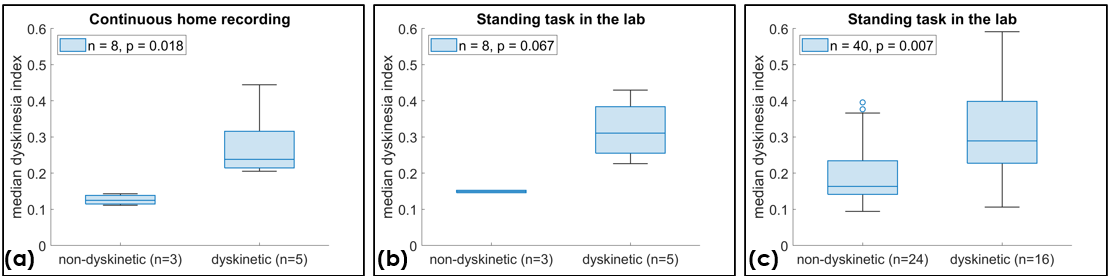
Dyskinesia index in subjects w/wo dyskinesia
References: This study is part of the “Objective monitoring of axial symptoms in Parkinson’s disease: quantitative assessment in daily life based on the use of wearables, video sensing and artificial intelligence (OMNIA-PARK)” project, funded by European Union – Next Generation EU within the PRIN 2022 PNRR program (D.D.1409 del 14/09/2022 Ministero dell’Università e della Ricerca). This manuscript reflects only the authors’ views and opinions, and the Ministry cannot be considered responsible for them.
To cite this abstract in AMA style:
L. Borzì, R. Toska, C. Ferraris, G. Amprimo, S. Gallo, G. Imbalzano, M. Patera, M. Ghislieri, G. Olmo, A. Suppa, C. Artusi. Sensor-based quantification of dyskinesia in Parkinson’s Disease: supervised vs unsupervised settings [abstract]. Mov Disord. 2026; 41 (suppl 1). https://www.mdsabstracts.org/abstract/sensor-based-quantification-of-dyskinesia-in-parkinsons-disease-supervised-vs-unsupervised-settings/. Accessed October 1, 2026.« Back to 2026 International Congress
MDS Abstracts - https://www.mdsabstracts.org/abstract/sensor-based-quantification-of-dyskinesia-in-parkinsons-disease-supervised-vs-unsupervised-settings/