
Category: Myoclonus/Tics/Stereotypies
Objective: To determine if accelerated repetitive transcranial magnetic stimulation (rTMS) will augment Comprehensive Behavioral Intervention for Tics (CBIT) for Tourette Syndrome (TS) symptoms.
Background: rTMS targeted at the supplementary motor area (SMA) has demonstrated tic reduction; neither an accelerated protocol nor an adjunctive CBIT protocol have been previously studied.
Method: Patients with TS ≥ 18 years and moderate tics (Yale Global Tic Severity Scale (YGTSS) ≥ 20) were randomized to active (N=4) vs sham (N=3) rTMS, receiving 16 sessions/4 days followed by CBIT. rTMS protocol: 6 trains of 5-min pulses with 1-min intertrain interval at 110% resting motor threshold. Primary outcome was YGTSS. Secondary outcomes were Beck Depression Inventory (BDI), Beck Anxiety Inventory (BAI), Yale-Brown Obsessive Compulsive Scale (Y-BOCS), Adult ADHD Self-Reports Scale (ASRS), the Gilles de la Tourette Syndrome–Quality of Life scale (GTS-QOL), and fMRI. Outcomes were measured at baseline (T0), post-rTMS (T1), and post-CBIT (T2).
Results: There were 3/7 female participants; mean age = 42.9 years; average age at tic onset = 5.83 years. rTMS was well-tolerated without significant adverse events. There was a trend toward improved total tic severity (active: -8.25; sham: -0.5; p=0.125) and global YGTSS (active: -19.25; sham: -10.67; p=0.541) with active but not sham at T1 and lower total tic severity (active: 26; sham: 37.5; p=0.448) and global YGTSS (active: 49.22; sham: 82.5; p=0.321) with active vs. sham at T2. Secondary outcomes revealed trends toward clinical improvements in active vs. sham at T1 for all outcomes and at T2 for some outcomes: BDI (T1: -5.75 vs. -1.00, p=0.288; T2: 5.33 vs. 3.50, p=0.764); BAI (T1: -3.5 vs. 4.0, p=0.116; T2: -2.0 vs 1.0, p=0.497); Y-BOCS (T1: -1.75 vs. 1.67, p=0.230; T2: -2.0 vs. -0.5, p=0.435); ASRS (T1: -7.0 vs. 3.0, p=0.149; T2: 2.0 vs. -1.5, p=0.365); GTS-QOL total (T1: -14.5 vs. 10, p=0.137; T2: 13.33 vs. -6.5, p=0.120); and GTS-QOL satisfaction (T1: 4.75% vs. -5.0%, p=0.273; T2: -3.0% vs. 0%, p=0.730). fMRI analysis, including 7 age/sex-matched healthy controls, is ongoing.
Conclusion: This study suggests accelerated rTMS + CBIT is safe, well-tolerated, and may improve tic symptoms; larger trials are needed to confirm.
This abstract expands upon the preliminary data (presented at MDS in 2025) by including newly enrolled subjects and T2 outcomes analysis.
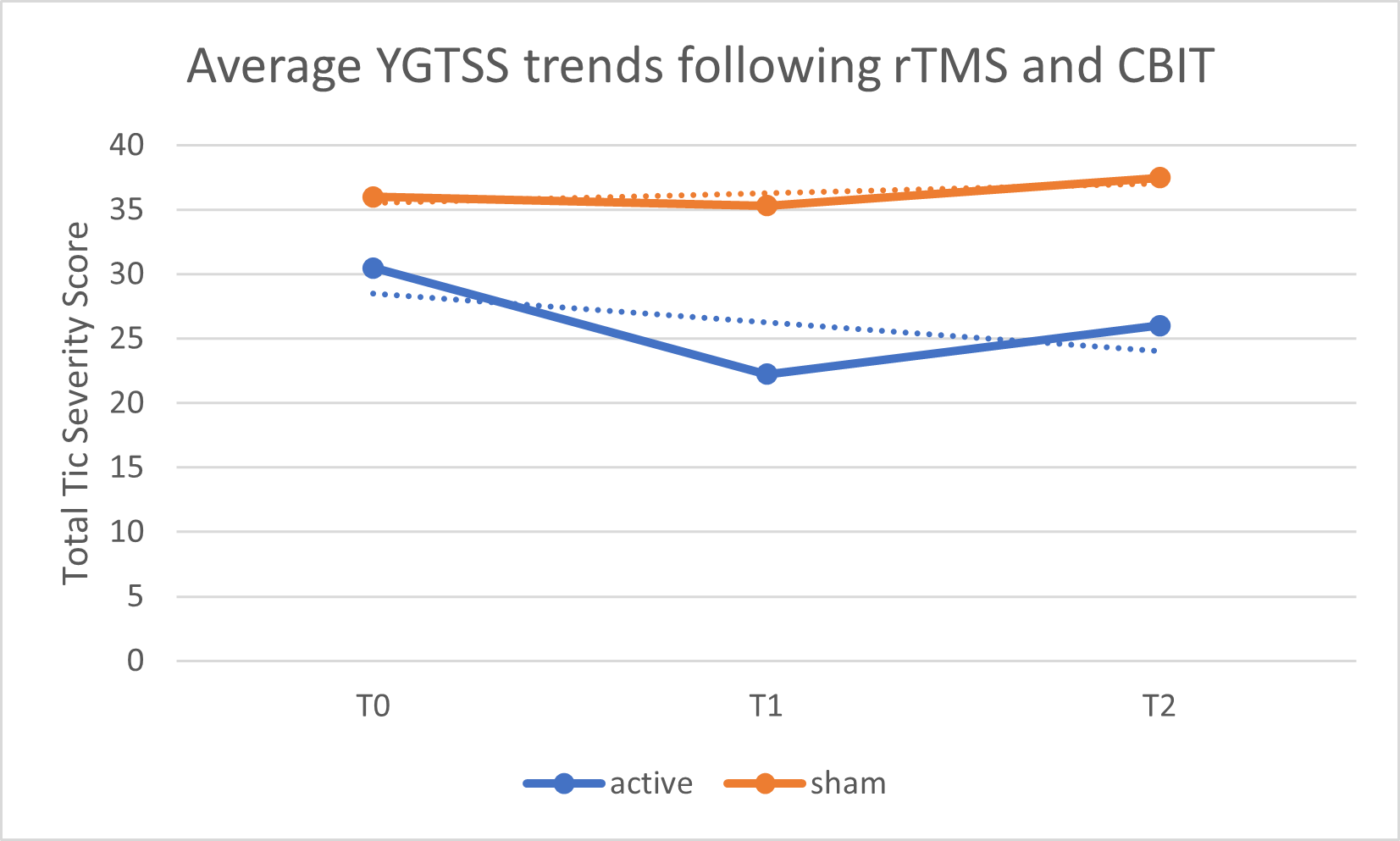
YGTSS trends in active vs. sham rTMS
To cite this abstract in AMA style:
J. Frey, J. Sherman, T. Mcgaughey, J. Suffrdige, E. Reid, M. Khan, U. Najib, A. Wagle Shukla, A. Murray, M. Okun, I. Malaty. STOP-TIC Updates: Strengthening Tourette Treatment Options using TMS to Improve CBIT: A randomized sham-controlled trial [abstract]. Mov Disord. 2026; 41 (suppl 1). https://www.mdsabstracts.org/abstract/stop-tic-updates-strengthening-tourette-treatment-options-using-tms-to-improve-cbit-a-randomized-sham-controlled-trial/. Accessed October 1, 2026.« Back to 2026 International Congress
MDS Abstracts - https://www.mdsabstracts.org/abstract/stop-tic-updates-strengthening-tourette-treatment-options-using-tms-to-improve-cbit-a-randomized-sham-controlled-trial/