
Objective: Describe the post-marketing safety profile of Sublingual apomorphine (SL-APO) in Europe during the first 18 months after launch.
Background: SL-APO is an on-demand therapy for the management of OFF episodes in Parkinson’s disease, being important to understand safety in real-world setting.
Method: The drug global safety database was searched for European valid post-marketing reports (spontaneous reports, health authorities, literature reports, non-interventional studies, excluding marketing studies) from launch (April 2025) to October end 2025. Expectedness was assessed based on the current European Summary of Product Characteristics (SmPC) for SL-APO.
Results: A total of 346 events were collected from 159 valid cases: 94 male (59%), mean age 65 years, from Germany (90, 57%), Portugal (44, 28%) and Spain (25, 16%). The 3 most common reported events were “nausea” (48, 14%), “dizziness” (22, 6%) and “vomiting” (15, 4%), consistent with known safety profile of SL-APO. Oropharyngeal events accounted for 47 (14%) of all events, most commonly “aphthous ulcer”(7) and “oral pain”(4) (Table1). Overall, 326 (94%) events were considered non-serious, and “syncope”(4) was the only serious event reported more than once. SL-APO was withdrawn, temporarily or permanently, in 72 (45%) cases, including 18 (11%) due to oropharyngeal events.
Conclusion: Reported events were predominantly non-serious and consistent with SL-APO known safety profile, supporting its favorable tolerability in real-world practice. The apparent discontinuation rate should be interpreted cautiously, given the reporting bias inherent to spontaneous post-marketing data and increased vigilance during the early post-launch period. These observations underscore the importance of ongoing pharmacovigilance, proactive management of tolerability issues, and patient education to optimize adherence.
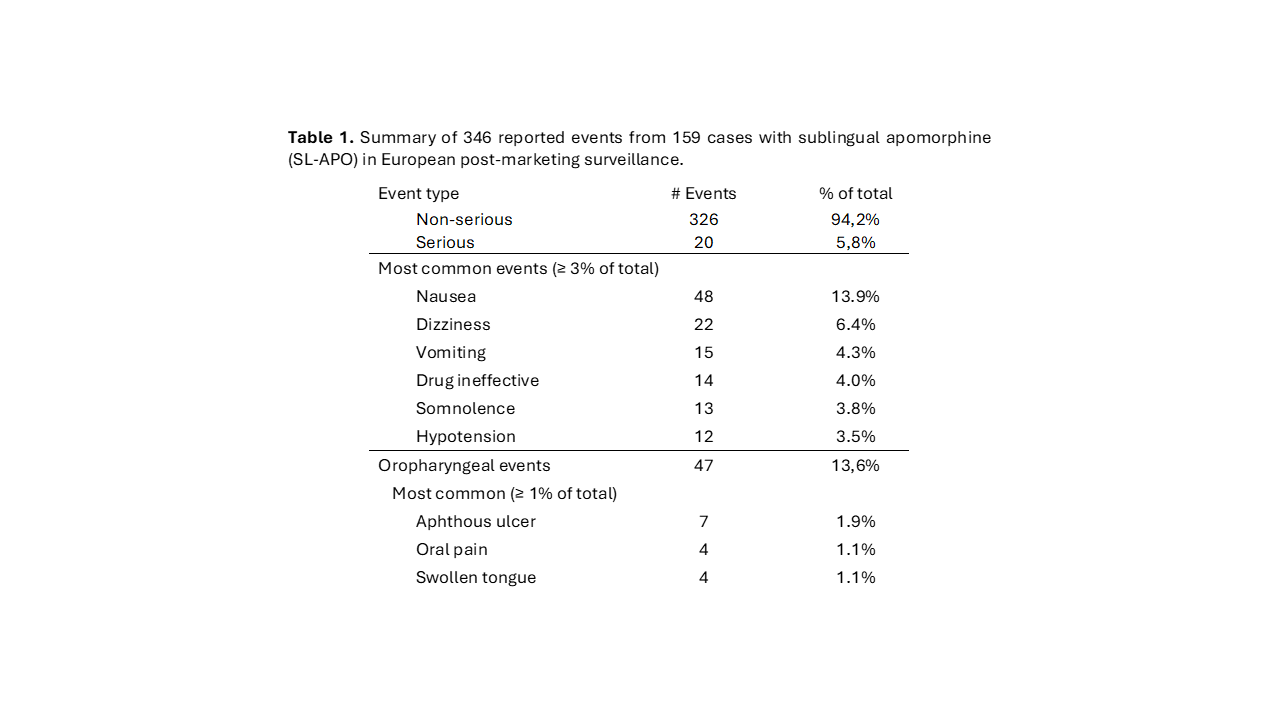
Table 1
To cite this abstract in AMA style:
J. Kassubek, R. García-Ramos, M. F. Gago, H. Brigas, C. Deneck-Muhr, D. Lopes, C. Meneses, J. Holenz. Sublingual Apomorphine Tolerability in Clinical Practice: 18-months Post launch experience in Europe [abstract]. Mov Disord. 2026; 41 (suppl 1). https://www.mdsabstracts.org/abstract/sublingual-apomorphine-tolerability-in-clinical-practice-18-months-post-launch-experience-in-europe/. Accessed October 1, 2026.« Back to 2026 International Congress
MDS Abstracts - https://www.mdsabstracts.org/abstract/sublingual-apomorphine-tolerability-in-clinical-practice-18-months-post-launch-experience-in-europe/