
Category: Parkinson's Disease (Other)
Objective: To compare the effects of telerehabilitation and conventional rehabilitation on motor function and quality of life (QoL) in patients with Parkinson’s disease (PD).
Background: Telerehabilitation typically involves the remote delivery of physical therapy, exercise coaching, and functional training through video‑based platforms. It has emerged as an alternative model of providing rehabilitation for PD, potentially overcoming barriers related to access, mobility, and cost. However, its comparative effectiveness relative to conventional in‑person rehabilitation remains debated.
Method: A systematic review and meta‑analysis were conducted using PubMed to identify randomized controlled trials (RCTs) comparing telerehabilitation with conventional rehabilitation in adults with PD. The measured outcomes were motor (MDS UPDRS‑III) and QoL (PDQ‑39/PDQ‑8). Pooled analyses were performed using inverse‑variance methods. Mean differences (MD) and standardized mean differences (SMD) with 95% confidence intervals (CI) were calculated. Random‑effects models were applied in the presence of significant heterogeneity.
Results: Six RCTs encompassing 283 participants evaluated QoL outcomes, and four RCTs with 249 participants assessed motor outcomes. Meta‑analysis of MDS UPDRS‑III scores showed no statistically significant difference between telerehabilitation and conventional therapy (MD 1.66 points, 95% CI −7.87 to 11.18; I2= 94%) [Figure 1]. For QoL, pooled analysis demonstrated no significant advantage of either intervention (SMD −0.32, 95% CI −1.06 to 0.43; I2 = 71%) [Figure 2]. Across individual trials, telerehabilitation achieved outcomes comparable to conventional rehabilitation.
Conclusion: Evidence from RCTs suggests that telerehabilitation provides benefits in motor function and QoL similar to those of conventional rehabilitation in PD. Despite substantial heterogeneity, telerehabilitation appears to be a viable alternative to in‑person therapy, particularly for patients with limited access to traditional care. However, its applicability in real‑world settings may be limited by insurance policy coverage, which can restrict access to or reimbursement for remote rehabilitation services. Further large‑scale, standardized RCTs are needed to refine optimal delivery models.
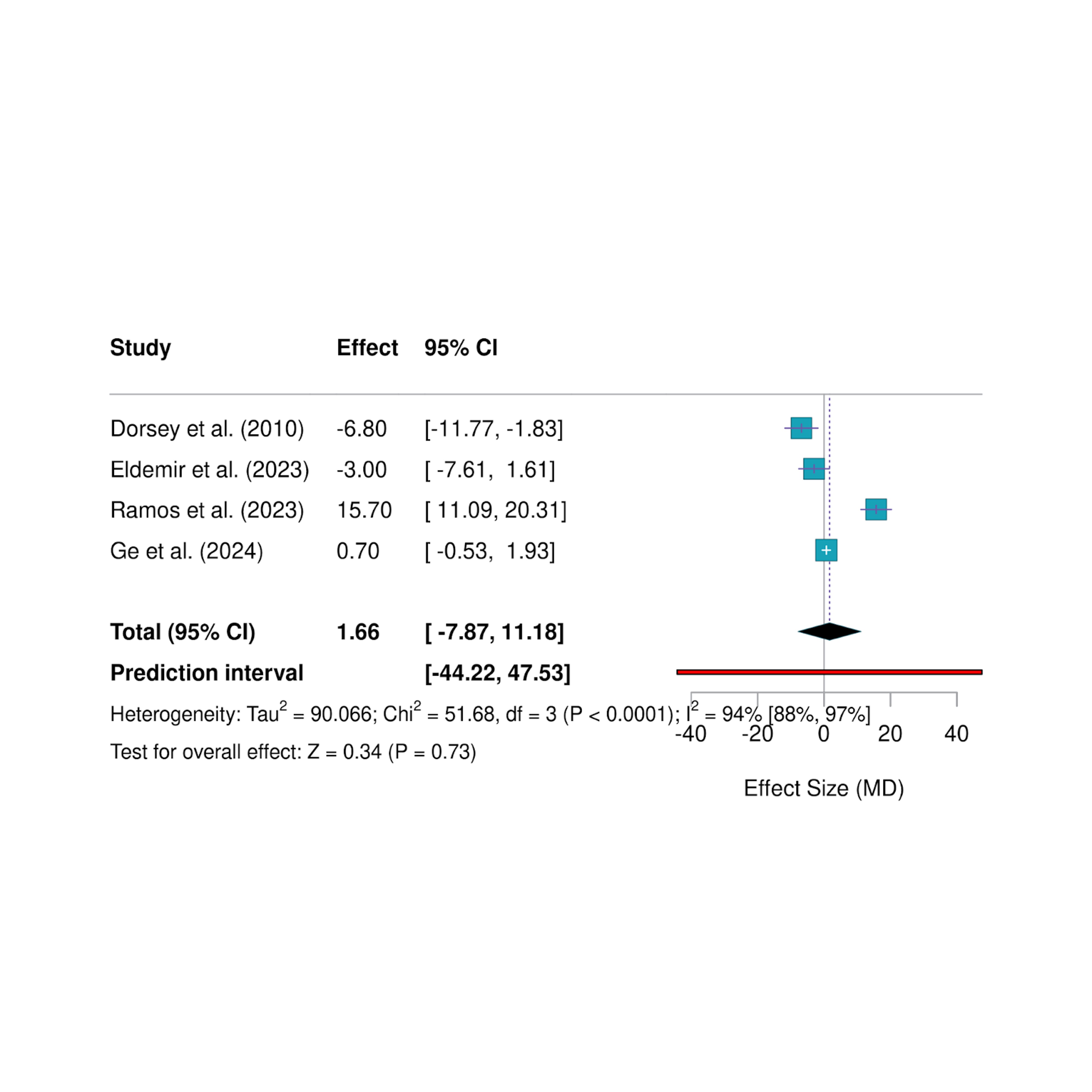
Figure 1. Pooled MD of motor outcomes.
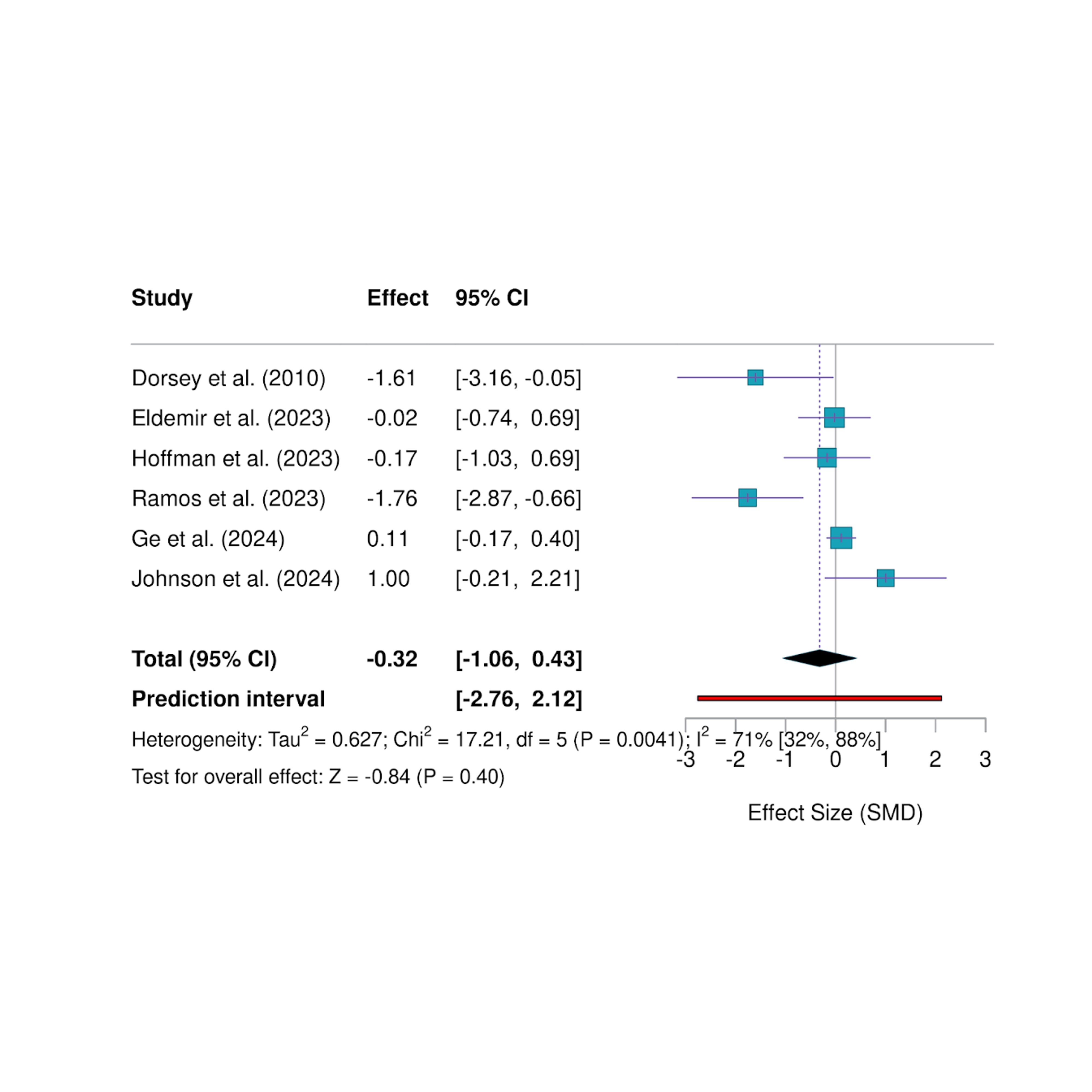
Figure 2. Pooled SMD of QoL outcomes.
To cite this abstract in AMA style:
A. Fornari Caprara, J. Pitton Rissardo, J. Patino, A. Mcgarry, I. Walker. Telerehabilitation Versus Conventional Therapy in Parkinson’s Disease: Evidence from Randomized Controlled Trials [abstract]. Mov Disord. 2026; 41 (suppl 1). https://www.mdsabstracts.org/abstract/telerehabilitation-versus-conventional-therapy-in-parkinsons-disease-evidence-from-randomized-controlled-trials/. Accessed October 1, 2026.« Back to 2026 International Congress
MDS Abstracts - https://www.mdsabstracts.org/abstract/telerehabilitation-versus-conventional-therapy-in-parkinsons-disease-evidence-from-randomized-controlled-trials/