
Objective: This study evaluated the anxiolytic effects of CBD, THC, and their combination in a reserpine-induced Parkinson’s mouse model using the Elevated Plus Maze (EPM)
Background: Anxiety is a prevalent non-motor symptom in Parkinson’s disease (PD), often preceding the onset of motor impairments. The involvement of serotonergic, dopaminergic, and endocannabinoid systems in anxiety provides a rationale for investigating phytocannabinoids such as cannabidiol (CBD) and Δ⁹-tetrahydrocannabinol (THC) in PD models
Method: Forty-two adult mice were divided into seven groups (n=6). Group I (normal control) was treated with 10 ml/kg of distilled water, Group II was administered reserpine (0.5 mg/kg i.p. for 10 days) to induce Parkinson-like symptoms. Groups III–VII received reserpine followed by post-treatment with CBD (30 or 60 mg/kg), THC (4 or 6 mg/kg), or a combination of CBD (60 mg/kg) and THC (6 mg/kg) for 14 days. Anxiety-like behaviour was assessed using the Elevated Plus Maze, focusing on the percentage time spent in open arms and percentage entries into the open arms which gave rise to the index of open arm avoidance.
Results: Reserpine significantly increased anxiety-like behaviour, with a marked increase in open-arm avoidance (96.25 ± 3.75 %) compared to the control group (67.25 ± 1.44 %). Post-treatment with CBD (30 mg/kg: 71.75 ± 0.85 %, 60 mg/kg: 68.50 ± 1.66 %) and THC (4 mg/kg: 61.25 ± 4.13 %, 6 mg/kg: 69.25 ± 5.63 %) significantly reduced the open-arm avoidance compared to the reserpine group (96.25 ± 3.75 %). The combination group (70.25 ± 0.85 %) showed a significant decrease in open arm avoidance, comparable to control group (67.25 ± 1.44 %)
Conclusion: Both CBD and THC individually and in combination exhibited anxiolytic effects in the PD mouse model. These findings support the potential of cannabinoid-based interventions in the management of PD-associated anxiety.
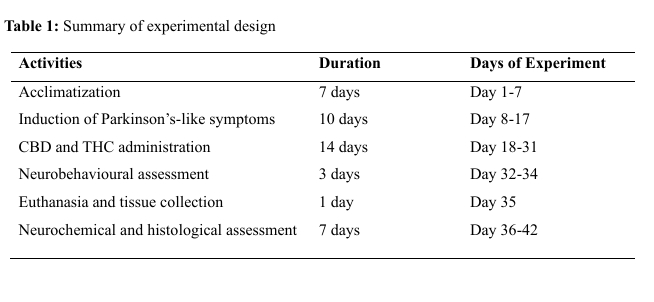
Table 1
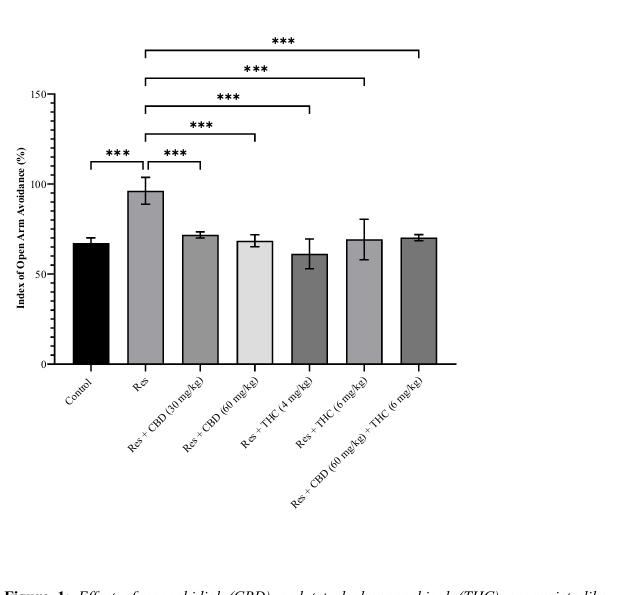
Figure 1
References: 1. Hazekamp A, Ware MA, Muller-Vahl KR, Abrams D, Grotenhermen F. The medicinal use of cannabis and cannabinoids—An international cross-sectional survey on administration forms. J Psychoactive Drugs. 2013;45(3):199-210. doi:10.1080/02791072.2013.805976
2. Kaskie B, Ayyagari P, Milavetz G, Shane D, Arora K. The increasing use of cannabis among older Americans: A public health crisis or viable policy alternative? Gerontologist. 2017;57(6):1166-1172. doi:10.1093/geront/gnw166
3. Hazekamp A, Heerdink ER. The prevalence and incidence of medicinal cannabis on prescription in The Netherlands. Eur J Clin Pharmacol. 2013;69(8):1575-1580. doi:10.1007/s00228-013-1503-y
4. Pertwee RG. The diverse CB1 and CB2 receptor pharmacology of three plant cannabinoids: Δ9-tetrahydrocannabinol, cannabidiol and Δ9-tetrahydrocannabivarin. Br J Pharmacol. 2008;153(2):199-215. doi:10.1038/sj.bjp.0707442
5. Bhattacharyya S, Fusar-Poli P, Borgwardt S, Martin-Santos R, Nosarti C, O’Carroll C, et al. Modulation of mediotemporal and ventrostriatal function in humans by Δ9-tetrahydrocannabinol: A neural basis for the effects of Cannabis sativa on learning and psychosis. Arch Gen Psychiatry. 2009;66(4):442-451. doi:10.1001/archgenpsychiatry.2009.17
6. Babalonis S, Haney M, Malcolm RJ, Lofwall MR, Votaw VR, Sparenborg S, Walsh SL. Oral cannabidiol does not produce a signal for abuse liability in frequent marijuana smokers. Drug Alcohol Depend. 2017;172:9-13. doi:10.1016/j.drugalcdep.2016.11.030
7. Agnello L, Gambino CM, Ciaccio AM, Masucci A, Vassallo R, Tamburello M, et al. Molecular biomarkers of neurodegenerative disorders: A practical guide to their appropriate use and interpretation in clinical practice. Int J Mol Sci. 2024;25(8):4323. doi:10.3390/ijms25084323
8. Bhattacharyya S, Morrison PD, Fusar-Poli P, Martin-Santos R, Borgwardt S, Winton-Brown T, et al. Opposite effects of Δ9-tetrahydrocannabinol and cannabidiol on human brain function and psychopathology. Neuropsychopharmacology. 2010;35(3):764-774. doi:10.1038/npp.2009.184
9. Wang T, Collet JP, Shapiro S, Ware MA. Adverse effects of medical cannabinoids: A systematic review. CMAJ. 2008;178(13):1669-1678. doi:10.1503/cmaj.071178
10. Urbi B, Corbett J, Hughes I, Owusu MA, Thorning S, Broadley SA, et al. Effects of cannabis in Parkinson’s disease: A systematic review and meta-analysis. J Parkinsons Dis. 2022;12(2):495-508. doi:10.3233/JPD-212923
11. Blessing EM, Steenkamp MM, Manzanares J, Marmar CR. Cannabidiol as a potential treatment for anxiety disorders. Neurotherapeutics. 2015;12(4):825-836. doi:10.1007/s13311-015-0387-1
12. Cunha DMG, Becegato M, Meurer YSR, Lima AC, Gonçalves N, Bioni VS, et al. Neuroinflammation in early, late and recovery stages in a progressive parkinsonism model in rats. Front Neurosci. 2022;16:923957. doi:10.3389/fnins.2022.923957
13. Cohen J, Mathew A, Dourvetakis KD, Sanchez-Guerrero E, Pangeni RP, Gurusamy N, et al. Recent research trends in neuroinflammatory and neurodegenerative disorders. Cells. 2024;13(6):511. doi:10.3390/cells13060511
14. Qiao CM, Huang WY, Zhou Y, Quan W, Niu GY, Li T, et al. Akkermansia muciniphila is beneficial to a mouse model of Parkinson’s disease, via alleviated neuroinflammation and promoted neurogenesis, with involvement of SCFAs. Brain Sci. 2024;14(3):238. doi:10.3390/brainsci14030238
15. Park BK, Kim YR, Kim YH, Yang C, Seo CS, Jung IC, et al. Antidepressant-like effects of Gyejibokryeong-hwan in a mouse model of reserpine-induced depression. Biomed Res Int. 2018;2018:5845491. doi:10.1155/2018/5845491
16. Aigbe FR, Adeyemi OO, Sofidiya MO. The aqueous root extract of Aristolochia ringens (Vahl.) Aristolochiaceae inhibits chemically induced inflammation in rodents. Pak J Pharm Sci. 2014;27(6):1885-1889.
17. Loru L, Sassu A, Fois X, Pantaleoni RA. Ethyl acetate: A possible alternative for anaesthetizing insects. Ann Soc Entomol Fr (NS). 2010;46(3-4):422-424. doi:10.1080/00379271.2010.10697677
18. Komada M, Takao K, Miyakawa T. Elevated plus maze for mice. J Vis Exp. 2008;(22):1088. doi:10.3791/1088
19. Ferrazzo S, Gunduz-Cinar O, Stefanova N, Pollack GA, Holmes A, Schmuckermair C, Ferraguti F. Increased anxiety-like behaviour following circuit-specific catecholamine denervation in mice. Neurobiol Dis. 2019;125:55-66. doi:10.1016/j.nbd.2019.01.009
20. Scarante FF, Vila-Verde C, Detoni VL, Ferreira-Junior NC, Guimarães FS. Cannabidiol inhibits the cataleptic behavior induced by reserpine in mice. Prog Neuropsychopharmacol Biol Psychiatry. 2017;79:369-376. doi:10.1016/j.pnpbp.2017.07.007
21. Sourkes TL. Historical perspective on the development of the reserpine model of Parkinsonism. Mov Disord. 2020;35(10):1761-1763. doi:10.1002/mds.28258
22. Campos AC, Fogaça MV, Sonego AB, Guimarães FS. Cannabidiol, neuroprotection and neuropsychiatric disorders. Pharmacol Res. 2017;112:119-127. doi:10.1016/j.phrs.2016.01.033
23. de Almeida EM, de Oliveira FC, da Silva ML, Pacheco DD, Moreira FA. Cannabidiol improves the quality of life in patients with Parkinson’s disease. J Psychopharmacol. 2019;33(9):1165-1171. doi:10.1177/0269881119849811
24. Patricio T, et al. Cannabidiol ameliorates fine motor impairment and enhances neuronal maturation in Parkinsonian rats. Neuropharmacology. 2024;237:109734. doi:10.1016/j.neuropharm.2024.109734
25. Lastres-Becker I, et al. Cannabidiol improves non-motor symptoms, attenuates neuroinflammation and favors hippocampal newborn neuronal maturation in a rat model of Parkinsonism. Acta Neuropsychiatr. 2024;36(1):45-56. doi:10.1017/neu.2023.17
26. de Cruz Guedes LF, et al. Cannabidiol attenuates behavioral alterations and neurodegeneration in reserpine-induced Parkinson’s model. Front Pharmacol. 2025;16:1539783. doi:10.3389/fphar.2025.1539783
27. López-Moreno JA, González-Cuevas G, Moreno G, Navarro M. The pharmacology of the endocannabinoid system: Functional and structural interactions with other neurotransmitter systems and their repercussions in behavioral addiction. Addict Biol. 2018;23(1):136-157. doi:10.1111/adb.12401
28. Liu Y, et al. Acute effects of THC and CBD on cognition in Parkinson’s disease: A randomized, double-blind trial. Mov Disord. 2023;38(6):1064-1072. doi:10.1002/mds.29442
29. Mitarnun W, et al. Safety and preliminary efficacy of CBD/THC on cognition in Parkinson’s disease: A randomized controlled trial. Clin Neuropharmacol. 2025;48(1):12-20. doi:10.1097/WNF.0000000000000541
To cite this abstract in AMA style:
H. Tanko, T. Muhammad, A-S. Isa. The Anxiolytic Effect of Cannabidiol and Tetrahydrocannabinol in a Reserpine Model of Parkinson’s Disease in Mice [abstract]. Mov Disord. 2026; 41 (suppl 1). https://www.mdsabstracts.org/abstract/the-anxiolytic-effect-of-cannabidiol-and-tetrahydrocannabinol-in-a-reserpine-model-of-parkinsons-disease-in-mice/. Accessed October 1, 2026.« Back to 2026 International Congress
MDS Abstracts - https://www.mdsabstracts.org/abstract/the-anxiolytic-effect-of-cannabidiol-and-tetrahydrocannabinol-in-a-reserpine-model-of-parkinsons-disease-in-mice/