
Category: Parkinson’s Disease: Clinical Trials
Objective: To assess the pharmacological and methodological factors underlying the “GLP-1 paradox” by comparing the outcomes of lixisenatide and exenatide, with an emphasis on kinetics, assessment states, and molecular weight [1-4].
Background: GLP-1RAs exhibit preclinical neuroprotective capabilities [5, 6]. Early exenatide trials stabilized symptoms, and the 2024 LIXIPARK trial decelerated motor progression; however, recent phase III trials of high-molecular-weight analogues (NLY01) were unsuccessful. It is important to explain this difference for future trial design.
Method: We combined phase II and III data, using MDS-UPDRS Part III scores 4 to measure how well the treatment worked. The analysis focused on medication states (ON vs. OFF), blood-brain barrier (BBB) kinetics, and microglial-mediated suppression of neurotoxic A1 astrocytes [5, 6].
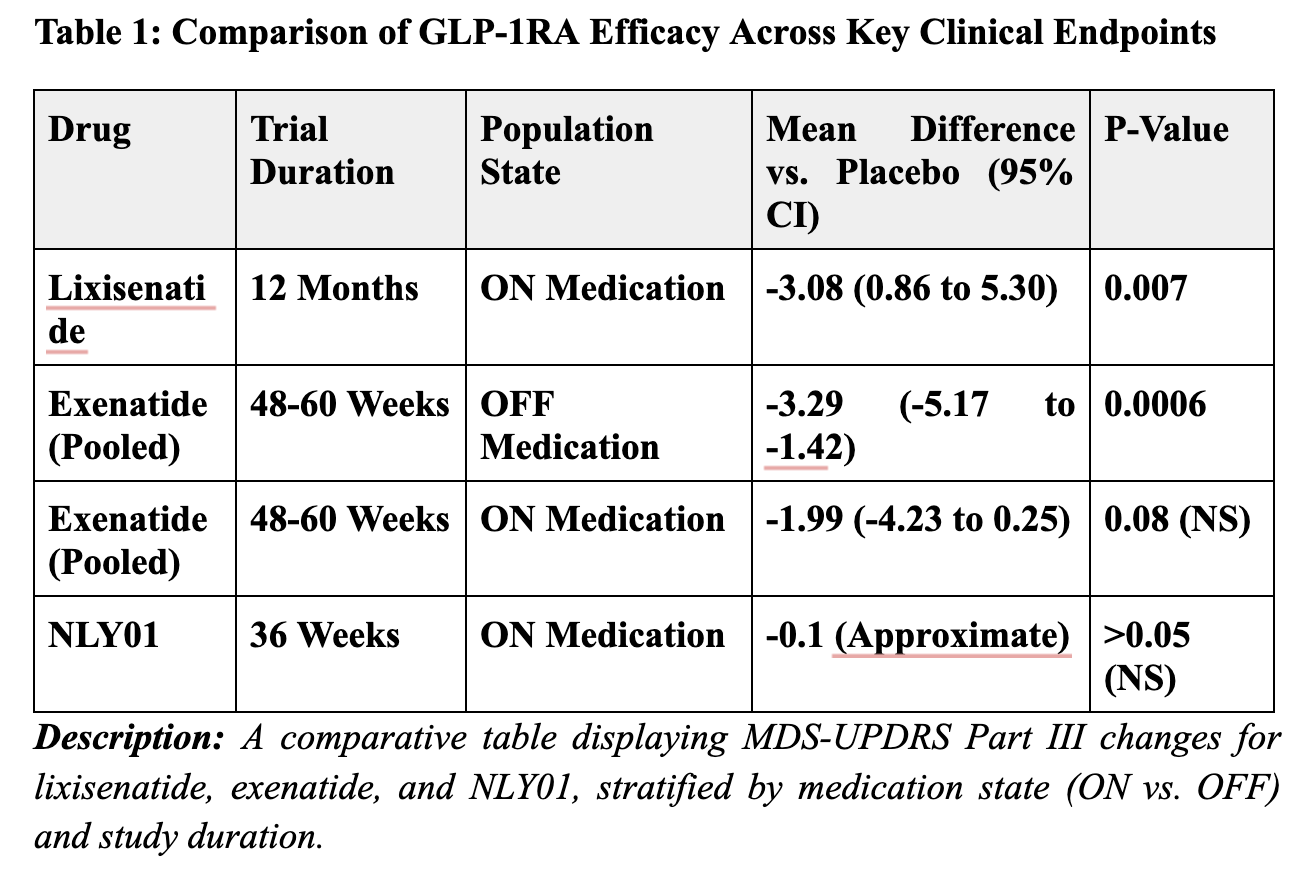
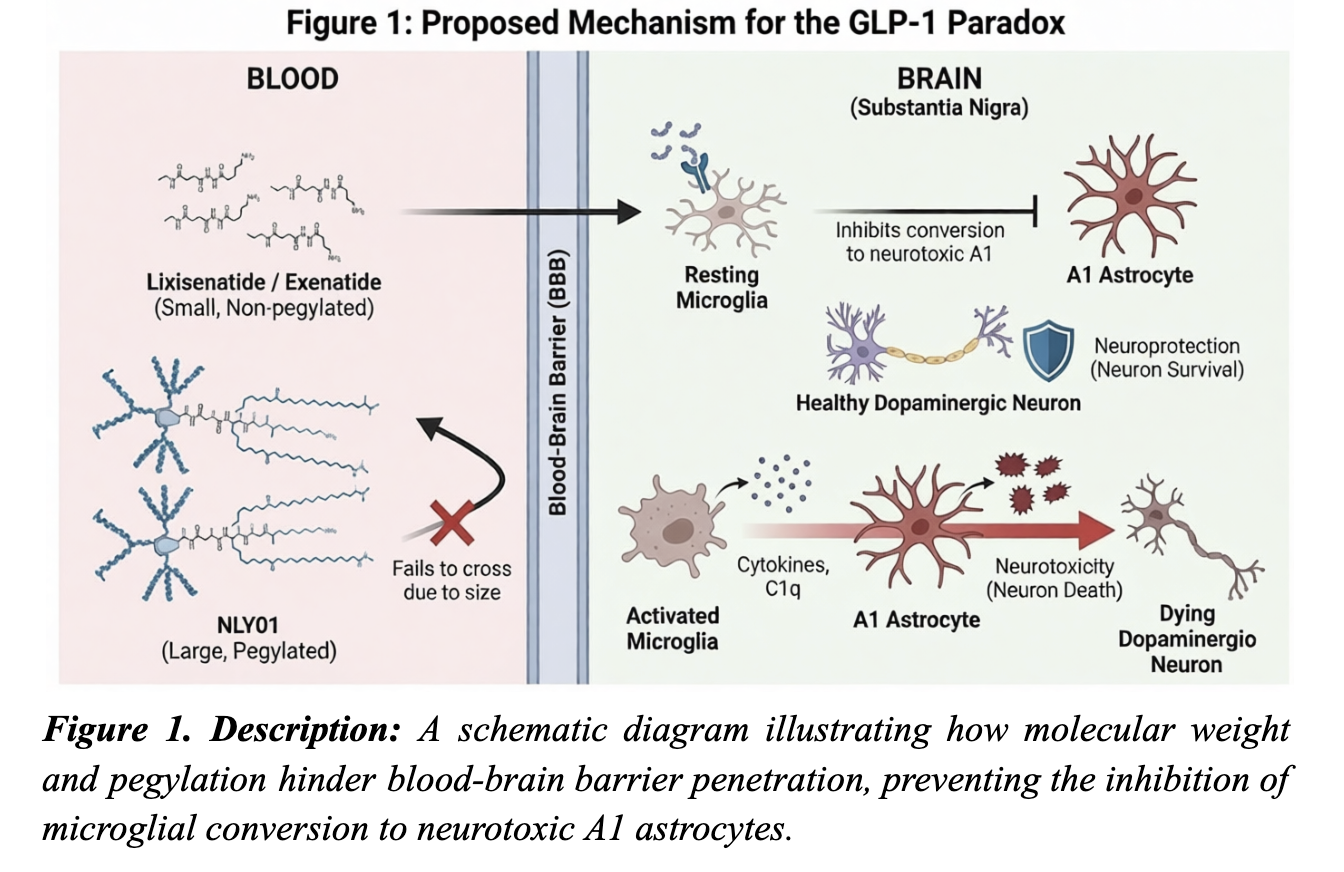
Results: Lixisenatide significantly maintained motor function at 12 months (-0.04 vs. 3.04 worsening in placebo; difference: 3.08; P=0.007) [1]. Meta-analyses demonstrate that exenatide-class medications markedly enhance OFF-state motor function (MD: -3.29; p=0.0006) [4, 5], whereas ON-state outcomes frequently yield non-significant results (MD: -1.99; p=0.08) [4]. Success is linked to BBB penetration, and big pegylated analogues show little central influx [5]. Mechanistically, the activation of GLP-1R inhibits A1 astrocyte-mediated dopaminergic degeneration. Nausea is still a common side effect [1, 4]. [see table 1] [see figure 1]
Conclusion: The GLP-1 paradox stems from pharmacokinetic variations and assessment timing. Optimal BBB penetration is essential to block A1 astrocyte neurotoxicity. Future trials must prioritize central influx and standardize OFF-state assessments to demonstrate disease modification.
at the end of result
at the end of result, after table1
References: [1] Meissner WG, Remy P, Giordana C, et al. Trial of Lixisenatide in Early Parkinson’s Disease. N Engl J Med. 2024;390(13):1176-1185. doi:10.1056/NEJMoa2312323
[2] Athauda D, Maclagan K, Skene SS, et al. Exenatide once weekly versus placebo in Parkinson’s disease: a randomized, double-blind, placebo-controlled trial. Lancet. 2017;390(10103):1664-1675. doi:10.1016/S0140-6736(17)31585-4
[3] Helal MM, AbouShawareb H, Abbas OH, et al. GLP-1 receptor agonists in Parkinson’s disease: an updated comprehensive systematic review with meta-analysis. Diabetol Metab Syndr. 2025;17(1):352. doi:10.1186/s13098-025-01888-1
[4] McGarry A, Rosanbalm S, Leinonen M, et al. Safety, tolerability, and efficacy of NLY01 in early untreated Parkinson’s disease: a randomized, double-blind, placebo-controlled trial. Lancet Neurol. 2024;23(1):37-45. doi:10.1016/S1474-4422(23)00378-2
[5] Yun SP, Kam TI, Panicker N, et al. Block of A1 astrocyte conversion by microglia is neuroprotective in models of Parkinson’s disease. Nat Med. 2018;24(7):931-938. doi:10.1038/s41591-018-0051-5
[6] Messak M, Abdelmageed A, Senbel AA, et al. Efficacy and safety of GLP-1 agonists in Parkinson’s disease: a systematic review and meta-analysis of randomized controlled trials. Naunyn Schmiedebergs Arch Pharmacol. 2025;398:9721–9736. doi:10.1007/s00210-025-03932-3
To cite this abstract in AMA style:
F. Al-Zaidi. The GLP-1 Agonist Paradox in Parkinson’s Disease: A Comparative Analysis of Lixisenatide and Exenatide Phase III Trial Outcomes and Neuroprotective Mechanisms [abstract]. Mov Disord. 2026; 41 (suppl 1). https://www.mdsabstracts.org/abstract/the-glp-1-agonist-paradox-in-parkinsons-disease-a-comparative-analysis-of-lixisenatide-and-exenatide-phase-iii-trial-outcomes-and-neuroprotective-mechanisms/. Accessed October 1, 2026.« Back to 2026 International Congress
MDS Abstracts - https://www.mdsabstracts.org/abstract/the-glp-1-agonist-paradox-in-parkinsons-disease-a-comparative-analysis-of-lixisenatide-and-exenatide-phase-iii-trial-outcomes-and-neuroprotective-mechanisms/