
Category: Ataxia
Objective: To characterize the global transcriptomic changes and molecular pathways disrupted by frataxin deficiency in a Drosophila model of Friedreich’s Ataxia (FA) to identify potential therapeutic targets.
Background: Frataxin loss causes mitochondrial dysfunction and metabolic stress in FA. Drosophila FRDA model flies have been used for different purposes in FRDA research. However, no single study has investigated transcriptomic changes in these flies versus wild-type flies. This unbiased profiling reveals how early molecular defects drive disease symptoms and neuronal decay.
Method: Total RNA was extracted in triplicate from fh mutant (EMS-induced S136R mutation in fh gene, #67161) and wild-type third instar larvae. Poly-A enriched mRNA was used for standard Illumina cDNA library preparation and sequencing. Differential gene expression was evaluated with DESeq2—using corrected p-values and log2 fold changes for significance—and visualized via volcano plots. Affected biological pathways were identified through GO, REACTOME, and KEGG enrichment analyses
Results: Out of 2035 genes, 1260 were upregulated and 775 downregulated. FBgn0000261 (Catalase) and FBgn0024958 (Irp1A) were significantly down in fh-/- mutants, while FBgn0039561 (mitoferrin) was significantly up (padj<0.01) (Figure 1). GO enrichment highlighted proteolysis as the top biological process, followed by small molecule metabolism and transmembrane transport. KEGG and REACTOME analyses confirmed enrichment in oxidative phosphorylation, metabolic pathways, and immune processes (FDR<0.001). These defects reveal mitochondrial dysfunction and oxidative stress in the disease model.
Conclusion: This first-time transcriptomic analysis of Drosophila FRDA model mirrors human FRDA pathology by showing similar disruptions in oxidative stress and iron pathways, driven by downregulation of Catalase and Irp1A and upregulation of Mitoferrin. It also reveals broad changes in metabolic processes, transport, and neuronal regulation, which closely mimic findings in patient-derived cell lines and clinical models.
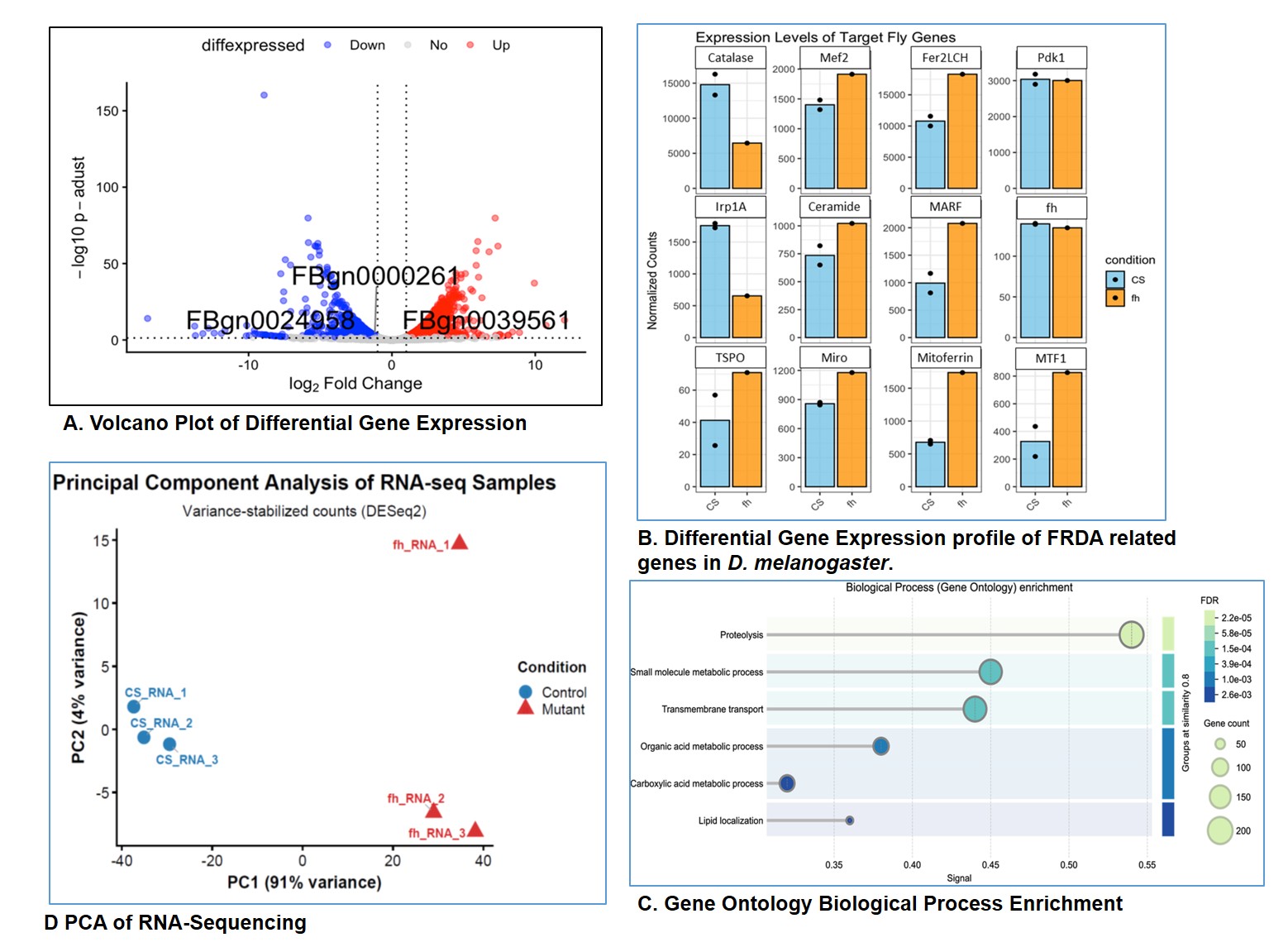
Transcriptomic analysis: FA modeled and WT larvae
To cite this abstract in AMA style:
V. Swarup, R. Yadav, A. Ahuja, P. Yadav, A. Srivastava, D. Garg. Transcriptomic Profiling of Frataxin-Deficient Drosophila melanogaster to Identify Molecular Drivers and Pathway Disruptions in Friedreich’s Ataxia [abstract]. Mov Disord. 2026; 41 (suppl 1). https://www.mdsabstracts.org/abstract/transcriptomic-profiling-of-frataxin-deficient-drosophila-melanogaster-to-identify-molecular-drivers-and-pathway-disruptions-in-friedreichs-ataxia/. Accessed October 1, 2026.« Back to 2026 International Congress
MDS Abstracts - https://www.mdsabstracts.org/abstract/transcriptomic-profiling-of-frataxin-deficient-drosophila-melanogaster-to-identify-molecular-drivers-and-pathway-disruptions-in-friedreichs-ataxia/