
Category: Spasticity
Objective: To assess transcutaneous spinal cord stimulation (tSCS) as a treatment for hereditary spastic paraplegias (HSPs).
Background: Hereditary spastic paraplegias (HSPs) are genetic disorders characterized by degeneration of the distal corticospinal tracts and dorsal columns causing lower extremity weakness, spasticity, and neurogenic bladder1,2.
Transcutaneous spinal cord stimulation (tSCS) is a non-invasive technique that enhances motor function in people with spinal cord injury (SCI) by improving strength and reducing spasticity when combined with targeted physical or occupational therapy3,4,5,6.
Given the anatomic overlap of HSPs and SCI, we postulated that tSCS has potential to improve function for people with HSP.
Method: Two patients with HSP participated in this preliminary study. Each participant received five days of intensive locomotor training with 60 minutes/day of tSCS via electrodes at T11 and L1 spinal levels. tSCS was delivered at 30Hz with a 10kHz carrier frequency, with biphasic waveform and a pulse width of 1ms [Fig 1]. The current was individualized based on observed benefits and tolerance of skin sensation. We collected baseline dynamometric, electrophysiologic, and clinical data for each patient before, during, and after the five-day session.
Results: The first participant (P1), a 62-year-old male, had an average 2.8-fold increase in strength across five lower extremity muscle groups [Fig2A], a 34% reduction in mean lower extremity Modified Ashworth Scale (MAS) score [Fig2B], a 54% improvement in stimulation-off 25 meter walk test (25MWT) time [Fig2C], a reduction in the spastic paraplegia rating scale (SPRS) from 27 to 21 [Fig2D], and a reduction in the ratio of the maximum amplitude of the Hoffmann reflex to the maximum motor response (Hmax/Mmax) over the course of the session [Fig2E].
The second participant (P2), a 32-year-old male, showed an average 1.8-fold increase in strength across five lower extremity muscle groups [Fig 2A], a 16.5% reduction in mean lower extremity MAS score [Fig2B], a 2% improvement in stimulation-off 25MWT time [Fig2C], and a reduction in SPRS from 38 to 36 [Fig2D]. We were unable to obtain reliable electrophysiologic data due to edema in this participant.
Conclusion: tSCS may increase strength and decrease spasticity in patients with HSPs. Larger randomized and sham-controlled studies are needed to confirm the feasibility and efficacy of this therapy.
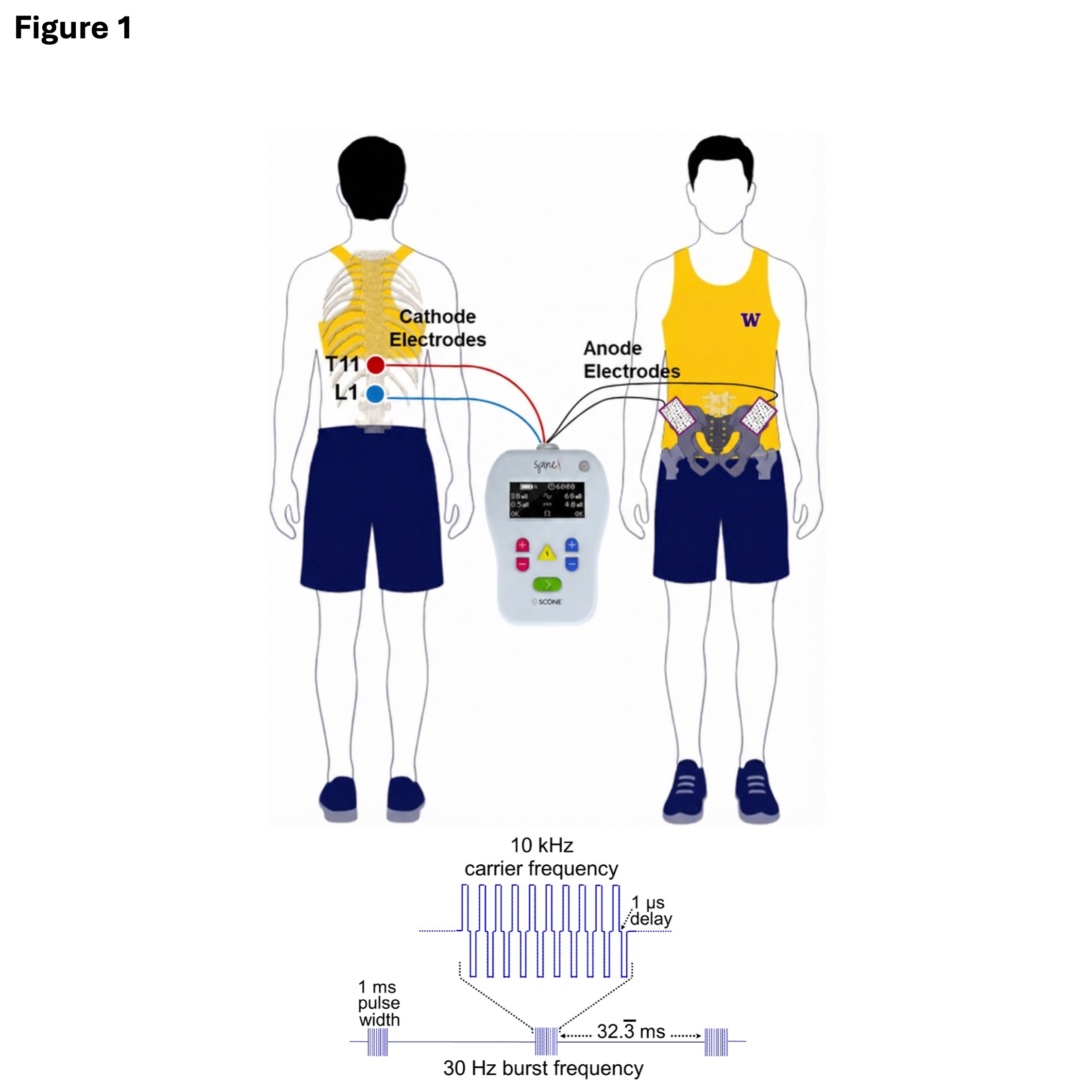
Figure 1
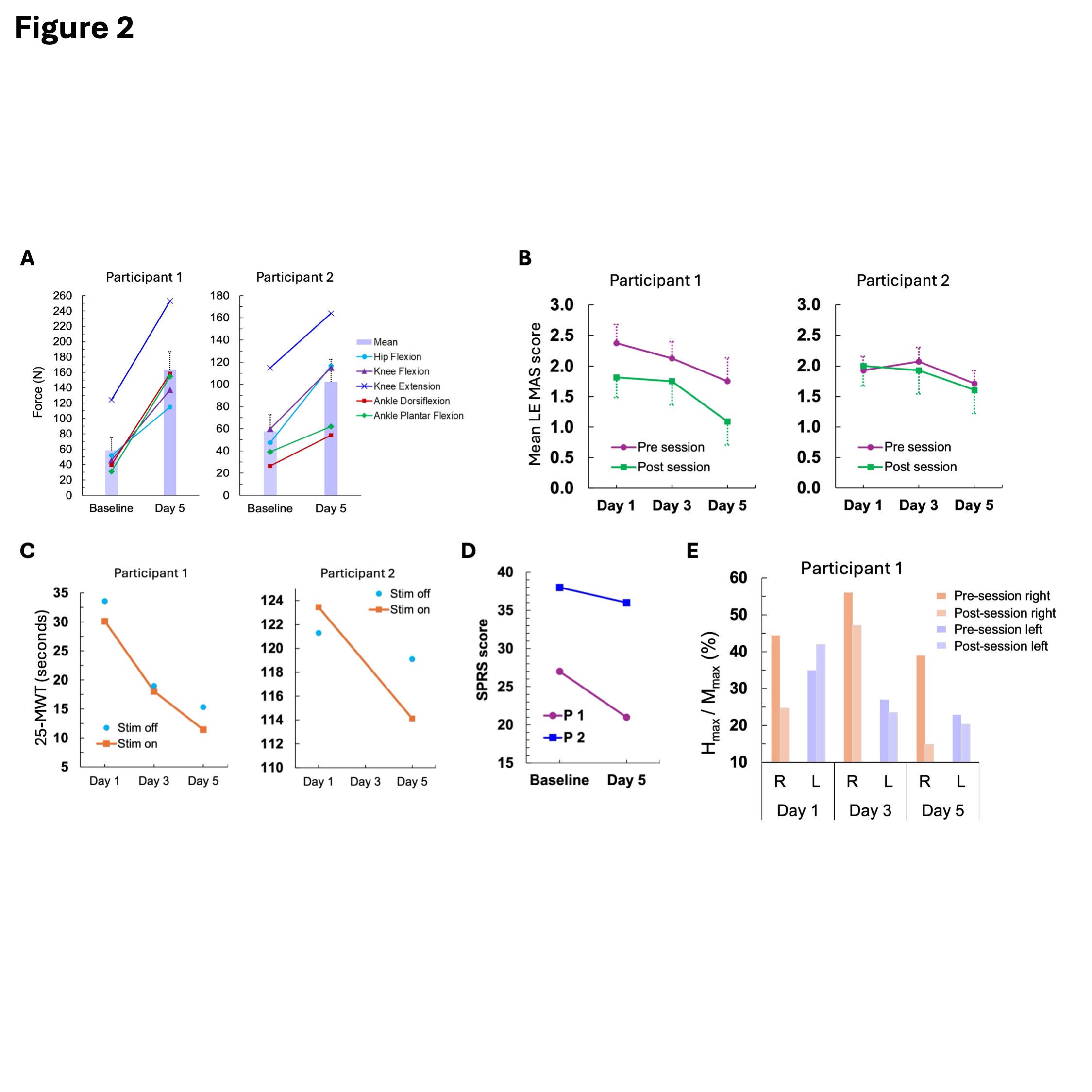
Figure 2
References: 1. Fink, J. K. (2023). The hereditary spastic paraplegias. Handbook of Clinical Neurology, 196, 59–88. https://doi.org/10.1016/B978-0-323-98817-9.00022-3
2. Blackstone, C. (2018). Hereditary spastic paraplegia. Handbook of Clinical Neurology, 148, 633–652. https://doi.org/10.1016/B978-0-444-64076-5.00041-7
3. Tefertiller, C., Trumbower, R. D., Morse, L., Pradarelli, J., Gelenitis, K., D’Amico, J. M., Moritz, C., & Field-Fote, E. C. (2025). Home-Based Noninvasive Spinal Cord Stimulation Safely Enhances Hand and Arm Function in People With Spinal Cord Injury. Neurology. Clinical Practice, 15(6). https://doi.org/10.1212/CPJ.0000000000200537
4. Moritz, C., Field-Fote, E. C., Tefertiller, C., van Nes, I., Trumbower, R., Kalsi-Ryan, S., Purcell, M., Janssen, T. W. J., Krassioukov, A., Morse, L. R., Zhao, K. D., Guest, J., Marino, R. J., Murray, L. M., Wecht, J. M., Rieger, M., Pradarelli, J., Turner, A., D’Amico, J., … Courtine, G. (2024). Non-invasive spinal cord electrical stimulation for arm and hand function in chronic tetraplegia: a safety and efficacy trial. Nature Medicine, 30(5), 1276–1283. https://doi.org/10.1038/S41591-024-02940-9
5. Inanici, F., Brighton, L. N., Samejima, S., Hofstetter, C. P., & Moritz, C. T. (2021). Transcutaneous Spinal Cord Stimulation Restores Hand and Arm Function After Spinal Cord Injury. IEEE Transactions on Neural Systems and Rehabilitation Engineering : A Publication of the IEEE Engineering in Medicine and Biology Society, 29, 310–319. https://doi.org/10.1109/TNSRE.2021.3049133
6. Inanici, F., Samejima, S., Gad, P., Edgerton, V. R., Hofstetter, C. P., & Moritz, C. T. (2018). Transcutaneous Electrical Spinal Stimulation Promotes Long-Term Recovery of Upper Extremity Function in Chronic Tetraplegia. IEEE Transactions on Neural Systems and Rehabilitation Engineering : A Publication of the IEEE Engineering in Medicine and Biology Society, 26(6), 1272–1278. https://doi.org/10.1109/TNSRE.2018.2834339
To cite this abstract in AMA style:
J. Sanderson, M. Davis, H. Farhadi, C. Moritz, F. Inanici. Transcutaneous Spinal Cord Stimulation in Hereditary Spastic Paraplegias [abstract]. Mov Disord. 2026; 41 (suppl 1). https://www.mdsabstracts.org/abstract/transcutaneous-spinal-cord-stimulation-in-hereditary-spastic-paraplegias/. Accessed October 1, 2026.« Back to 2026 International Congress
MDS Abstracts - https://www.mdsabstracts.org/abstract/transcutaneous-spinal-cord-stimulation-in-hereditary-spastic-paraplegias/