
Category: Tremor
Objective: This study aims to characterize the electrophysiological features of tremor during smiling, laughing, and smiling with vocalization.
Background: Tremor on smiling, also referred to as smiling tremor, is a facial tremor that occurs during smiling. Only a few cases have been reported in the literature. The facial muscles involved vary across cases, ranging from the entire facial musculature, including the masseters, to only the lower facial muscles such as the orbicularis oris and risorius. The tremor frequency has been reported to range from 5 to 10 Hz, and the bursting pattern varies from semi-regular to regular. Smiling tremor has been observed in patients with essential tremor but has not been reported in other tremor disorders.
Laughter represents another form of facial expressive movement; however, it also involves vocalization and chest wall activity and is more closely associated with emotional expression.
Method: Three patients with tremor on smiling were recruited. Surface EMG and scalp EEG were recorded bilaterally from facial muscles during smiling, laughing, and smiling with vocalization. This study was funded by E-DA Hospital, EDAHS114023.
Results: The tremor frequency ranged from 8.8 to 9.2 Hz. Two patients exhibited bilateral tremor with left-sided predominance, while one patient had tremor confined to the left side. The burst duration ranged from 35 to 70 ms. Given the short burst duration, jerk-locked back-averaging was performed based on the first EMG jerk. No associated cortical activity was identified.
Two patients demonstrated fatigability: tremor activity diminished 2–3 seconds after the initiation of smiling but re-emerged with subsequent smiles.
Laughing did not elicit similar tremor activity. In contrast, smiling accompanied by vocalization, whether sequential or synchronized, preserved the tremor activity.
Conclusion: Our findings suggest that tremor during smiling is a rhythmic yet asymmetric tremulous movement predominantly involving the lower facial muscles, particularly the risorius and zygomaticus. The tremor is characterized by a short burst duration and occurs specifically during smiling. These features suggest that tremor during smiling represents a form of task-specific tremor.
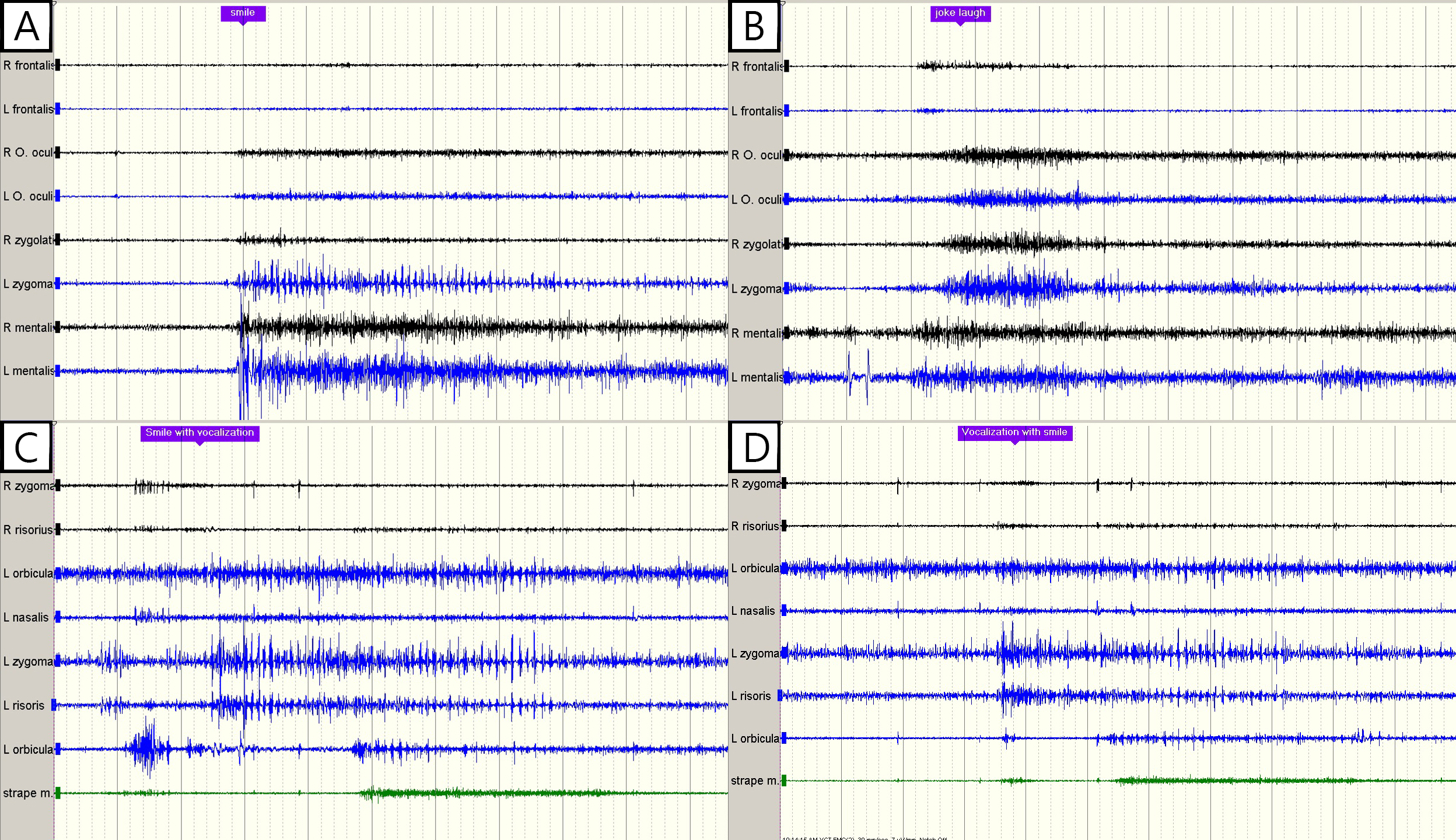
Tremorgram of smiling, laughing, and vocalizaiton
References: 1. Jacome DE, Yanez GF. Tremors of the smile. J Neurol Neurosurg Psychiatry 1987;50:489-490.
2. Schwingenschuh P, Cordivari C, Czerny J, Esposito M, Bhatia KP. Tremor on smiling. Mov Disord 2009;24:1542-1545.
3. Mascaro M, Seron FJ, Perales FJ, Varona J, Mas R. Laughter and smiling facial expression modelling for the generation of virtual affective behavior. PLoS One 2021;16:e0251057.
4. Radmard S, Amlang CJ, Weimer L, Pullman SL. A Case Series of Isolated Smiling Tremor: What Is the Phenomenology? Mov Disord Clin Pract 2024;11:171-174.
5. Cavallieri F, Di Rauso G, Fioravanti V, Senesi C, Esposito M, Valzania F. Just smile or not? A case of isolated smiling tremor. Neurol Sci 2025;46:1051-1053.
6. Chen JC, Grippe T, Mahjoub Y, Kleiner G, Chen R. Smiling Tremor in a Patient with Essential Tremor. Mov Disord Clin Pract 2026;13:560-562.
7. Bhatia KP, Bain P, Bajaj N, et al. Consensus Statement on the classification of tremors. from the task force on tremor of the International Parkinson and Movement Disorder Society. Mov Disord 2018;33:75-87.
To cite this abstract in AMA style:
Y. Tai, T. Lin. Tremor on Smiling but Not Laughing: An Electrophysiological Study [abstract]. Mov Disord. 2026; 41 (suppl 1). https://www.mdsabstracts.org/abstract/tremor-on-smiling-but-not-laughing-an-electrophysiological-study/. Accessed October 1, 2026.« Back to 2026 International Congress
MDS Abstracts - https://www.mdsabstracts.org/abstract/tremor-on-smiling-but-not-laughing-an-electrophysiological-study/