
Category: Paroxysmal Movement Disorders
Objective: To characterize the clinical phenotype, diagnostic journey and one year treatment outcomes in paroxysmal kinesigenic dyskinesia (PKD) at a tertiary movement disorder centre in Northern India, and to quantify the burden of the misdiagnosis.
Background: PKD is the commonest paroxysmal movement disorder ajnd one of neurology’s most treatable conditions; yet it masquerades convincingly as epilepsy, condemning patients to years of ineffective polytherapy. Data from South Asia where this diagnostic trap is possibly most consequential, remains strikingly sparse.
Method: Consecutive cohort study of 25 consecutive patients from January 2012 to December 2024 fulfilling Bruno’s criteria for PKD at a single Northern India tertiary centre, none were excluded on clinical grounds with a minimum one year follow up.
Demographic, semiological, investigative, treatment and one- year follow up data were systematically analysed.
Patients without a documented relapse event at one-year review were classified as relapse-free.
Results: There were 22 males, 3 females (M:F 7.3:1) with a mean age 21.5 ± 4.6 years, mean age of onset 13.6 ± 4.7 years.
Median diagnostic delay was staggering- 8 years (range 0.25 to 22) with 5 patients ( 20%) receiving levetiracetam, valproate or lacosamide under an epilepsy label before correct diagnosis.
All 25 had a kinesigenic trigger. Dystonic posturing occurred in 96%, cranio-cervical involvement in 48%, ictal ataxia in 20%, 96% had attacks under 30 seconds.
Hemidystonic pattern was seen in 44%, all four limb involvement in 28%. Family history was positive in 12%. Investigations (performed in 40%) were normal in 9/10 patients. Carbamazepine (CBZ)(76%) and oxcarbazepine (OXC) (20%) at a mean dose od 238 168mg/day achieved symptom freedom in 84% at one year. Drug-free remission was attained in 4%. True pharmacological failure rate :0% for CBZ/OXC.
Conclusion: In this Northern India cohort, PKD masqueraded as epilepsy or was undiagnosed for nearly a decade before correct diagnosis, a delay that is avoidable, harmful and must end. Sodium channel blockers achieve near-universal symptoms control to zero pharmacological failures. Recognising PKD is not an academic exercise, it is the difference between eight years of wrong treatment or no treatment to one tablet that works. It is time to act.
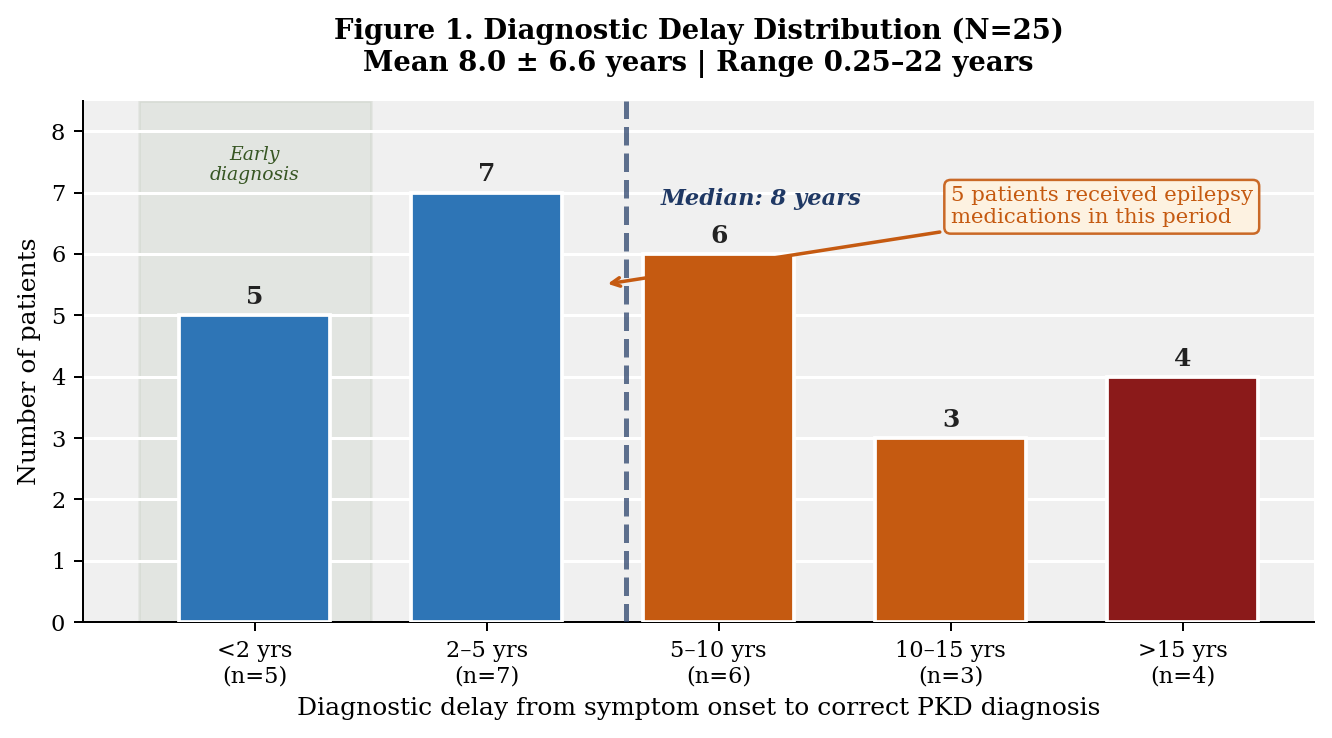
FIGURE 1 DIAGNOSTIC DELAY
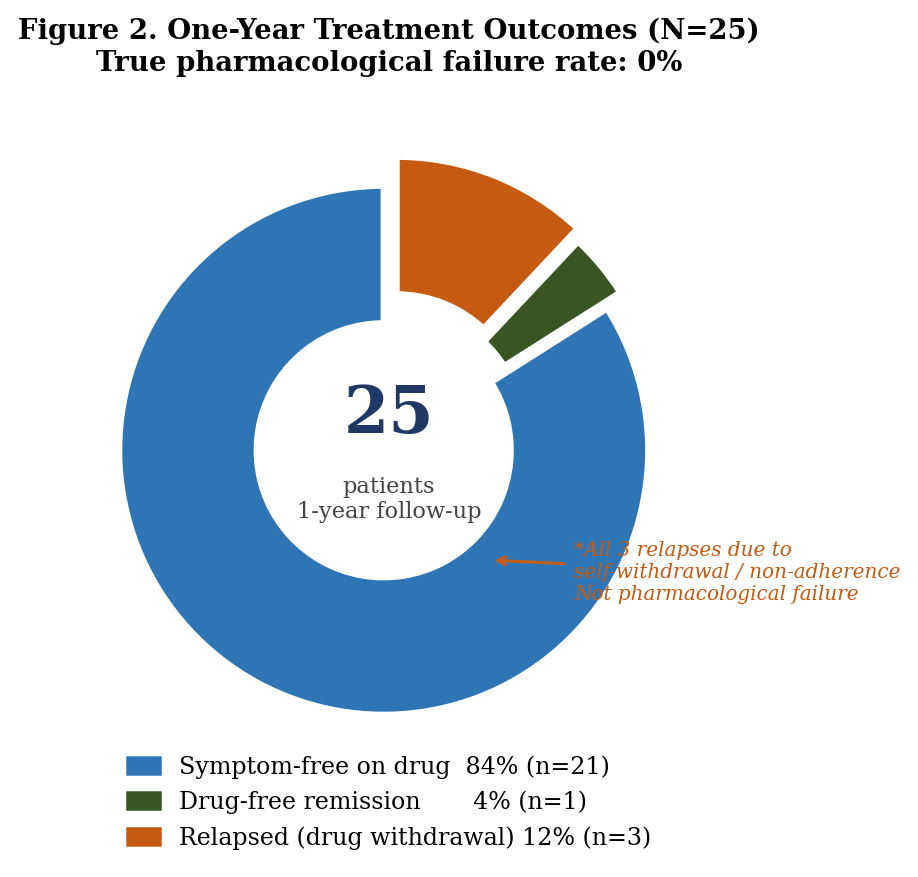
FIGURE 2 OUTCOMES
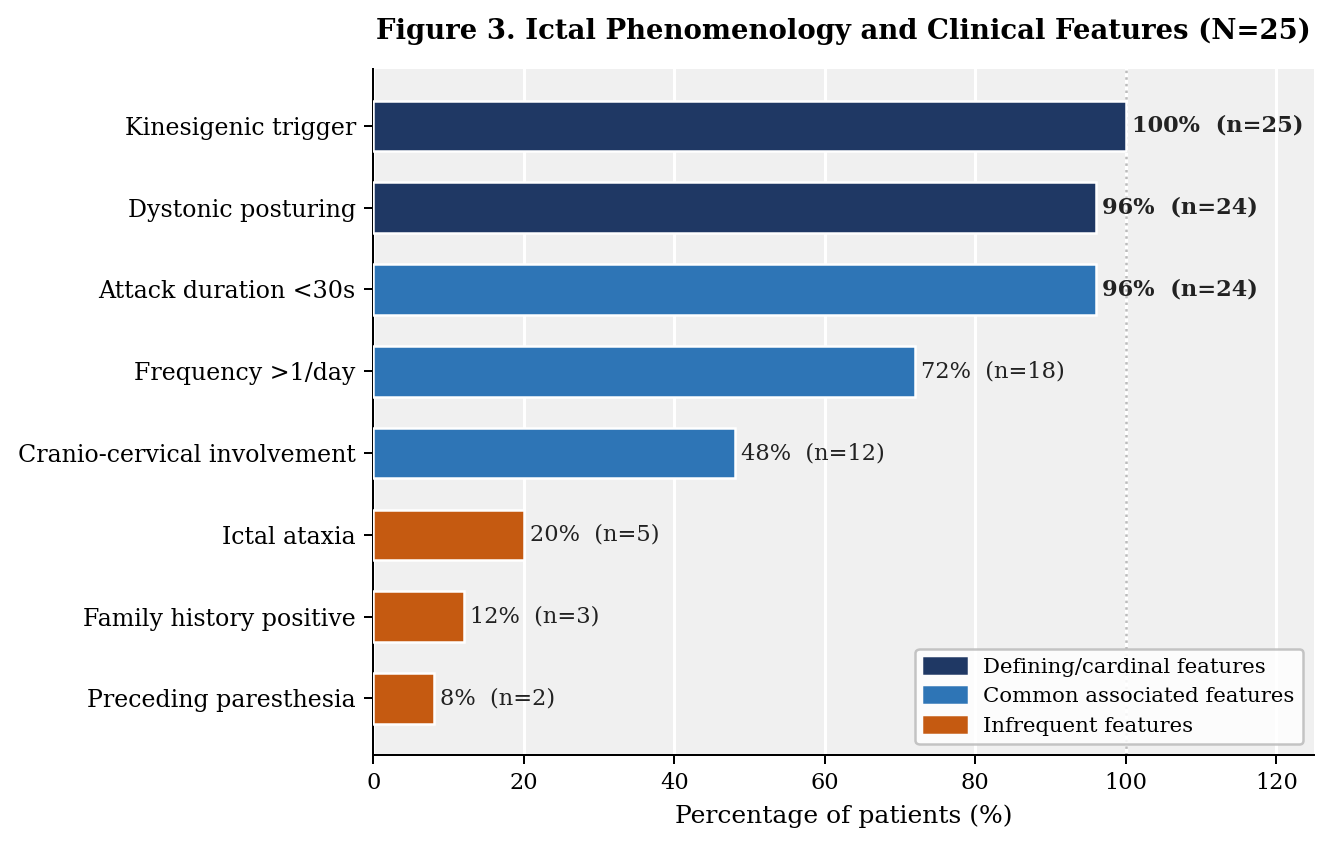
FIGURE 3 PHENOTYPE
References: 1. Bruno MK, et al. Clinical evaluation of idiopathic paroxysmal kinesigenic dyskinesia: new diagnostic criteria. Neurology. 2044; 63:2280-2287.
2. Wang JL, et al. Identification of PRRT2 as the causative gene of paroxysmal kinesigenic dyskinesia. Brain. 2011;134:3493-3501.
3. Huang XJ et al. Paroxysmal kinesigenic dyskinesia: clinical and genetic analyses of 110 patients. Neurology. 205; 85:1546-1553.
4. Erro R, et al. Paroxysmal dyskinesias revisited: a review of 500 genetically proven cases and a new classification. Mov Disorders 2014;29:1108-1116.
5. BHATIA KP. Paroxysmal dyskinesias. Mov Disorder 2011; 26:1157-1165.
To cite this abstract in AMA style:
R. Bansal, A. Bansal. Unmasking the Masquerader: Paroxysmal Kinesigenic Dyskinesia (PKD) Misdiagnosed as Epilepsy for Nearly a decade: Time to Act (Consecutive Cohort of 25 patients) [abstract]. Mov Disord. 2026; 41 (suppl 1). https://www.mdsabstracts.org/abstract/unmasking-the-masquerader-paroxysmal-kinesigenic-dyskinesia-pkd-misdiagnosed-as-epilepsy-for-nearly-a-decade-time-to-act-consecutive-cohort-of-25-patients/. Accessed October 1, 2026.« Back to 2026 International Congress
MDS Abstracts - https://www.mdsabstracts.org/abstract/unmasking-the-masquerader-paroxysmal-kinesigenic-dyskinesia-pkd-misdiagnosed-as-epilepsy-for-nearly-a-decade-time-to-act-consecutive-cohort-of-25-patients/