
Objective: To validate the feasibility and diagnostic potential of an offline, head-mounted augmented reality (AR) system for automated extraction of acoustic and temporal speech biomarkers in neurodegenerative disorders.
Background: Speech impairment is a prominent motor symptom of Parkinson’s Disease (PD) and atypical parkinsonian syndromes, including hypokinetic dysarthria and cognitive-linguistic deficits. Standard clinical assessment is largely subjective, limiting sensitivity to subtle changes and longitudinal monitoring.
Method: 180 participants (90 patients, 90 healthy control) completed a self-guided voice assessment using an AR headset with integrated microphone array. The protocol included sustained vowel phonation, diadochokinesis, picture and daily-life description, and spontaneous narrative. Extracted features comprised 600 acoustic parameters including fundamental frequency variability, spectral descriptors, perturbation measures and formant stability. Temporal speech organization was quantified using voice activity detection to derive pause density, articulatory rate, and regularity metrics.
Results: Mean usability reached a System Usability Scale (SUS) score of 78.4 (SD = 9.6), indicating high patient acceptance. Significant group differences were observed in phonatory stability, diadochokinetic rate and regularity, and pause structure. Patient speech showed lower phonatory stability, slower and less regular syllable repetition, higher pause density, and reduced formant stability. Pause density, formant stability, and temporal regularity were the strongest discriminative features, correlating with clinical motor and speech impairment scores. Linguistic analysis revealed reduced fluency and weaker discourse organization. As shown in Table 1, narrative and descriptive tasks demonstrated the highest discriminative power, yielding the largest number of significant features and strongest effect sizes.
Conclusion: Offline AR-based voice analysis enables objective capture of clinically relevant acoustic, temporal, and linguistic speech biomarkers, supporting standardized detection and monitoring of disease-related speech abnormalities.
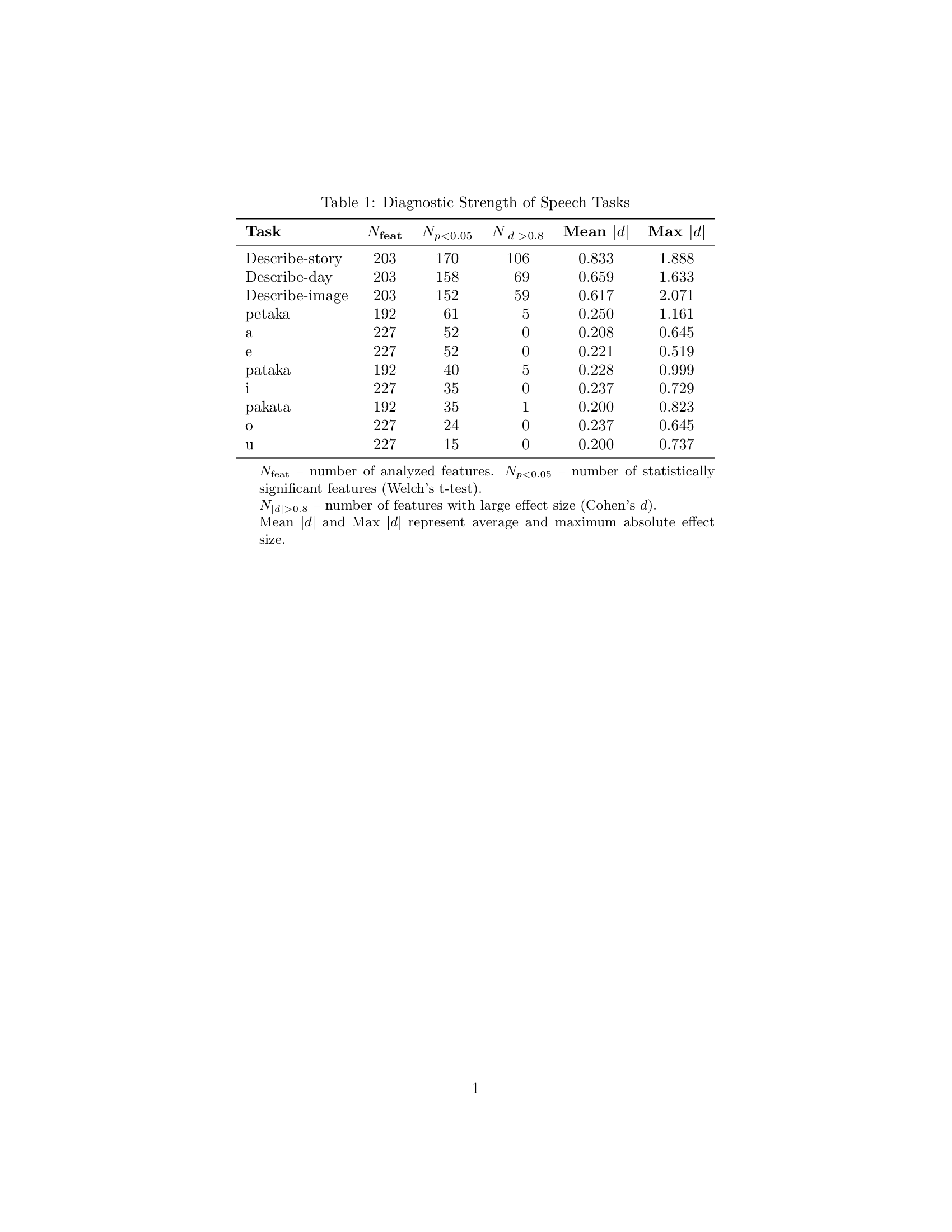
Table 1: Diagnostic Strength of Speech Tasks
References: The project was funded by The National Centre for Research and Development, Poland under Lider Grant no: LIDER/6/0049/L-12/20/NCBIR/2021.
To cite this abstract in AMA style:
M. Baran, W. Szecówka, J. Stępień, N. Bozetine, M. Dudek, J. Krzywdziak, M. Zbik, D. Hemmerling, M. Wojcik-Pedziwiatr, M. Rudzińska-Bar. Validation of Augmented Reality–Based Speech Biomarkers for Objective Detection and Monitoring of Parkinson’s Disease and Atypical Parkinsonian Syndromes [abstract]. Mov Disord. 2026; 41 (suppl 1). https://www.mdsabstracts.org/abstract/validation-of-augmented-reality-based-speech-biomarkers-for-objective-detection-and-monitoring-of-parkinsons-disease-and-atypical-parkinsonian-syndromes/. Accessed October 1, 2026.« Back to 2026 International Congress
MDS Abstracts - https://www.mdsabstracts.org/abstract/validation-of-augmented-reality-based-speech-biomarkers-for-objective-detection-and-monitoring-of-parkinsons-disease-and-atypical-parkinsonian-syndromes/