
Session Information
Date: Saturday, October 6, 2018
Session Title: Surgical Therapy: Parkinson's Disease
Session Time: 1:45pm-3:15pm
Location: Hall 3FG
Objective: To establish the association between the distance of subthalamic nucleus (STN) deep brain stimulation (DBS) electrode contact points to relevant white matter tracts and clinical outcome of tremor, dysarthria and non-motor symptoms in Parkinson’s disease (PD).
Background: DBS of the STN is effective in the treatment of motor symptoms in advanced PD. Among PD motor symptoms, the role of the STN in tremor is less well understood than its involvement in bradykinesia and rigidity. Stimulation of nearby white matter tracts, including the dentatorubrothalamic tract (DRT), might contribute to the effects of DBS on tremor. Similarly, (unwanted) stimulation of white matter tracts in proximity of the STN might underlie negative effects of STN-DBS including dysarthria and non-motor dysfunction.
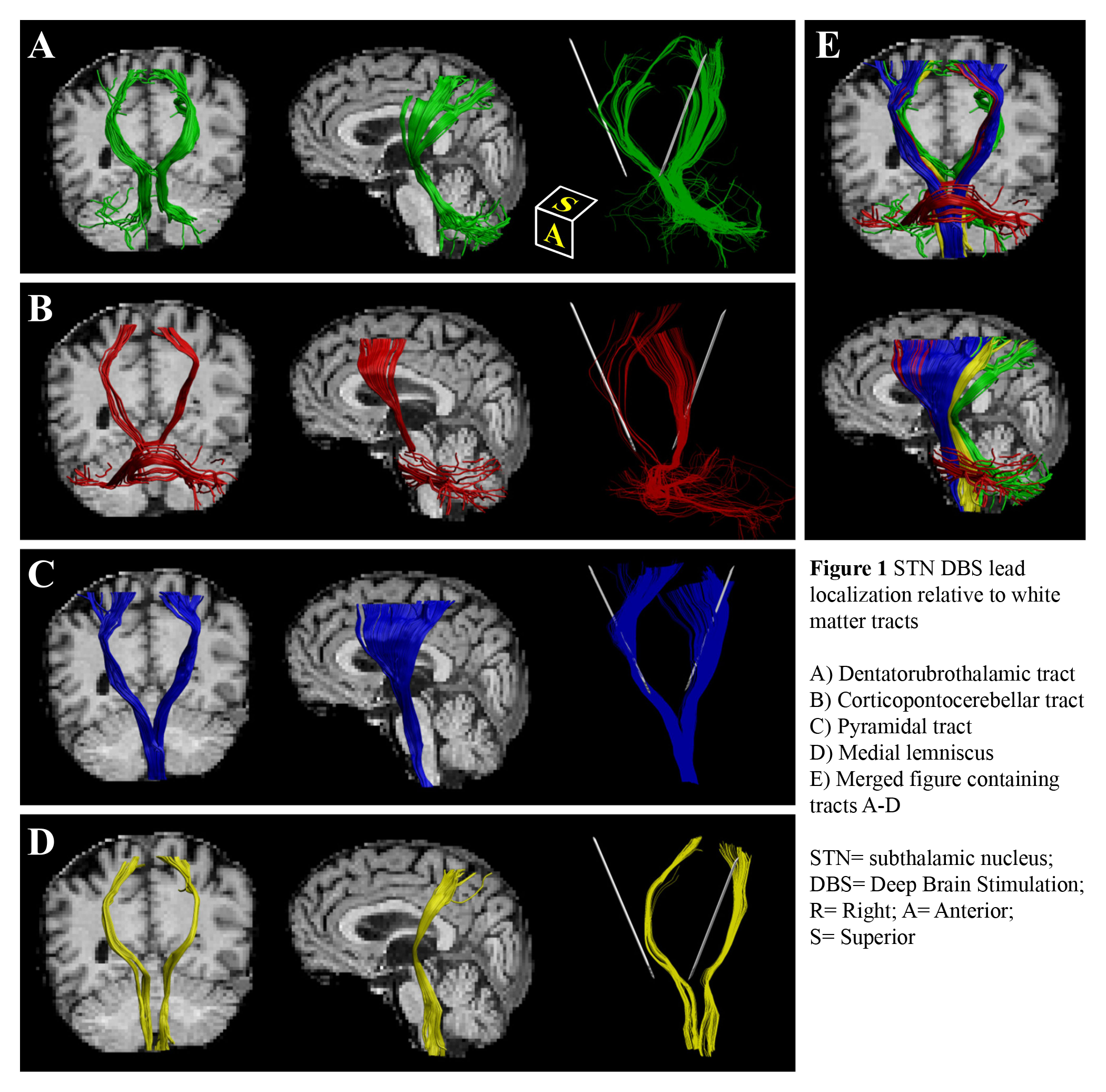
Methods: Using diffusion tensor imaging data of 35 PD patients with bilateral STN DBS we quantified the distance from each contact point to the center of the DRT, corticopontocerebellar tract, pyramidal tract (PT) and medial lemniscus [figure1]. Clinical information on rest tremor and dysarthria was collected in the DBS-OFF state and for each contact point when stimulated individually (DBS-ON). In addition, before and after DBS placement, psychiatric and neuropsychological assessments took place for future associations between DBS-related non-motor side effects and proximity of contact points to frontal and limbic projections.
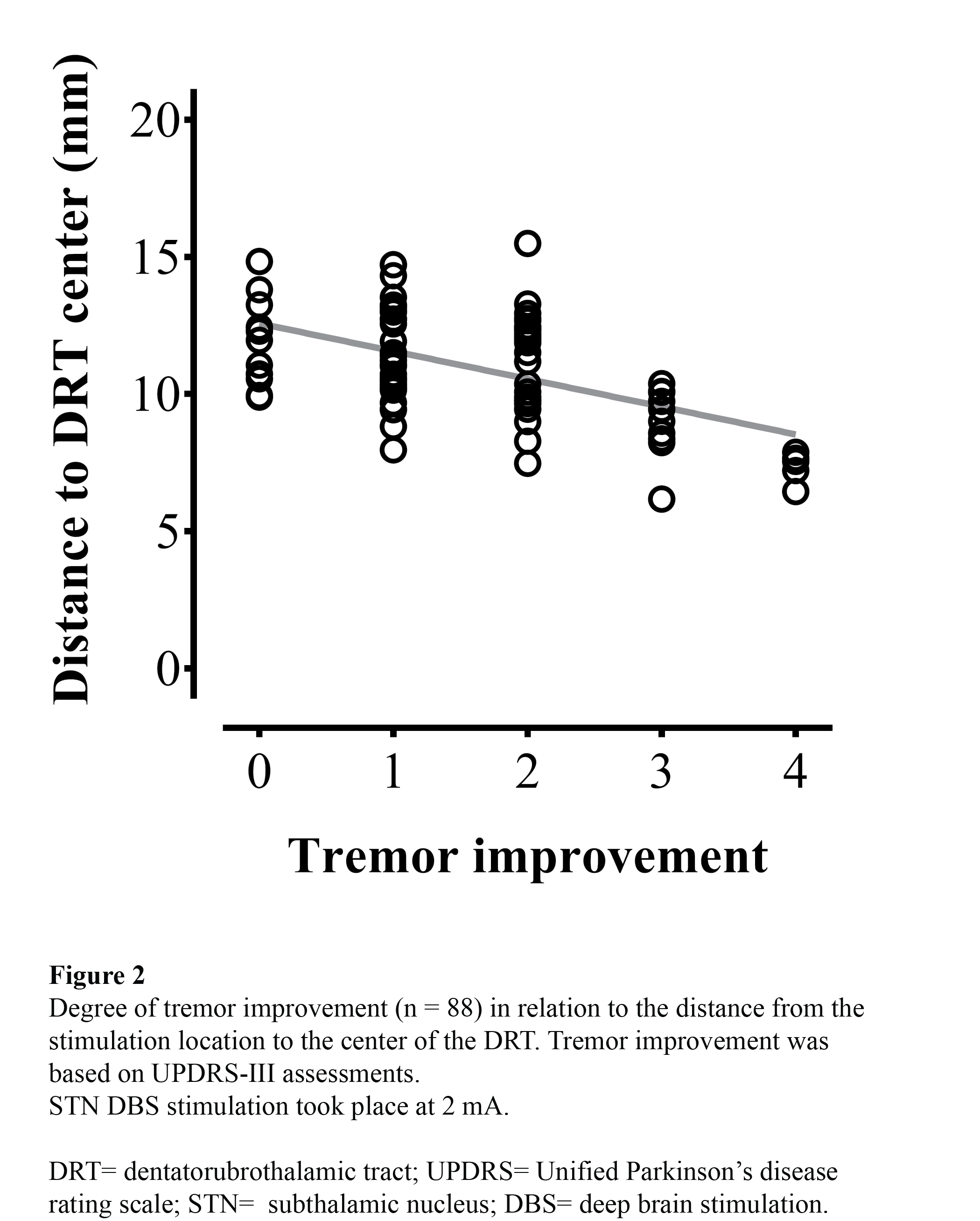
Results: Tremor suppression is more effective for DBS electrode contacts closer to the DRT (r = -0.459, p <0.01) [figure2]. Also, there is a trend towards more dysarthria for activated contact points closer to the PT (t(56) = 3.29, p = 0.02 ; after correction for dependency between contact points Wald X^2= 3.53, p > 0.05). Non-motor effects are currently being investigated and will also be presented.
Conclusions: Proximity of white matter tracts are relevant to DBS effects on tremor outcome and side effects (dysarthria). Therefore, white matter tract visualization may help in the planning of DBS treatment to improve overall clinical outcome.
To cite this abstract in AMA style:
L. Boon, N. Prent, W. Potters, M. Caan, H. Berendse, R. de Bie, P. vd Munckhof, P. Schuurman, A. van Rootselaar. Distance to white matter tracts predicts STN deep brain stimulation outcome of tremor and dysarthria in Parkinson’s disease [abstract]. Mov Disord. 2018; 33 (suppl 2). https://www.mdsabstracts.org/abstract/distance-to-white-matter-tracts-predicts-stn-deep-brain-stimulation-outcome-of-tremor-and-dysarthria-in-parkinsons-disease/. Accessed October 12, 2026.« Back to 2018 International Congress
MDS Abstracts - https://www.mdsabstracts.org/abstract/distance-to-white-matter-tracts-predicts-stn-deep-brain-stimulation-outcome-of-tremor-and-dysarthria-in-parkinsons-disease/