
Session Information
Date: Thursday, June 23, 2016
Session Title: Pharmacology
Session Time: 12:00pm-1:30pm
Objective: To evaluate the role of the atypical vesicular glutamate transporter 3 (VGLUT3) and the vesicular acetylcholine transporter (VAChT) in L-DOPA-induced dyskinesia.
Background: Parkinson’s disease (PD) is characterized by the degeneration of dopaminergic neurons. The gold standard therapy relies on dopamine (DA) replacement by the administration of levodopa (l-DOPA). However, with time l-DOPA treatment induces severe motor side effects characterized by abnormal and involuntary movements, or dyskinesia. Although earlier studies point to a role of striatal cholinergic interneurons, also known as striatal tonically active neurons (TANs), in l-DOPA-induced dyskinesia (LID), the underlying mechanisms remain to be fully characterized.
Methods: We used immunohistochemical (protein expression) and western blotting analyses (cell signaling cascades) as well as genetic (VGLUT3 KO and VAChT cKO mice) and behavioural approaches (motor learning and coordination, dyskinesia and cylinder test) in control, Parkinsonian and dyskinetic mice.
Results: Here, we report that DA depletion is accompanied by increased expression of choline acetyltransferase (ChAT), the vesicular acetylcholine transporter (VAChT) as well as the atypical vesicular glutamate transporter type 3 (VGLUT3). TANs number and soma size are not changed. In dyskinetic mice, the VAChT levels remain high whereas the expression of VGLUT3 decreases. LID is strongly attenuated in VGLUT3-deficient mice but not in mice bearing selective inactivation of VAChT in TANs. Finally, genetic ablation of VGLUT3 is accompanied by a reduction of l-DOPA-induced phosphorylation of ERK1/2, ribosomal subunit (rpS6) and GluA1. 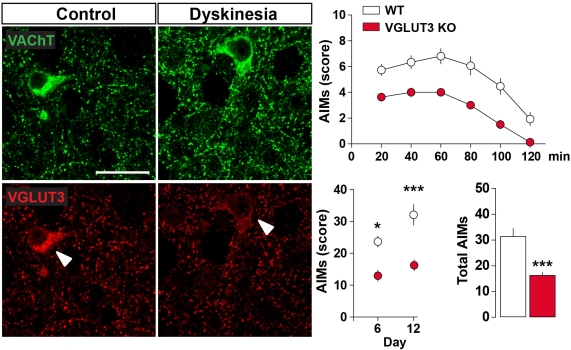
Conclusions: Our results reveal that VGLUT3 plays a crucial role in the development of LID and should be considered as a potential and promising therapeutic target for prevention of LID.
To cite this abstract in AMA style:
G. Gangarossa, M. Guzman, V. Prado, M. Prado, S. Daumas, S. El Mestikawy, E. Valjent. Role of the atypical vesicular glutamate transporter VGLUT3 in l-DOPA-induced dyskinesia [abstract]. Mov Disord. 2016; 31 (suppl 2). https://www.mdsabstracts.org/abstract/role-of-the-atypical-vesicular-glutamate-transporter-vglut3-in-l-dopa-induced-dyskinesia/. Accessed October 23, 2026.« Back to 2016 International Congress
MDS Abstracts - https://www.mdsabstracts.org/abstract/role-of-the-atypical-vesicular-glutamate-transporter-vglut3-in-l-dopa-induced-dyskinesia/