
Objective: To investigate whether an RGB camera-based system with AI-driven analysis, the posture-analyzing and virtual reconstructing system (PAViR), can effectively assess postural abnormalities in early-stage Parkinson’s disease (EPD) and explore its correlation with gait metrics.
Background: Postural instability is a key feature of Parkinson’s disease, but clinically evident abnormalities typically appear in later stages. Subtle trunk alignment changes may already be present in early-stage disease (Hoehn and Yahr ≤2), yet remain difficult to detect using conventional clinical scales. RGB camera-based motion capture may enable easy and objective identification of these early postural changes.
Method: We recruited participants in two group: old healthy adults (OH, n = 36, age ≥ 65, 19 males) and Patients with EPD (disease duration ≤5 years, Hoehn and Yahr stage ≤2, n=35, age 71.8 ± 9.0 years, 24 males). Participants were recorded from the front, lateral, and back using an RGB-D camera. Body parts were identified in real time using an image-processing algorithm based on super-pixel segmentation, and posture was calculated using a human pose estimation algorithm (Figure 1). The extracted parameters included forward head posture angle, thoracic tilt, pelvic shift, knee translation, shoulder height asymmetry angle(front/back), pelvic tilt, pelvic rotation angle, and left/right Q angle. Group comparisons were performed using independent t test. Correlations between postural and gait parameters derived from the sensor-based insole system. A p-value < 0.05 was considered statistically significant.
Results: Several parameters differed significantly between groups (Table 1). Patients with EPD showed greater forward head posture and thoracic tilt, reduced posterior pelvic shift, decreased left Q angle, and increased leftward pelvic rotation. Thoracic tilt showed correlations with the left swing, heel contact and mid‑foot contact ratios. In front, shoulder asymmetry was correlated with cadence, left swing, heel contact ratios, and bilateral stride times (Figure 2).
Conclusion: This study suggests that the PAViR system aids in assessing postural abnormalities and gait metrics in Parkinson’s disease. Further research is needed to clarify the role of real-time postural feedback in motor rehabilitation for PD and to evaluate its applicability to atypical parkinsonian disorders.
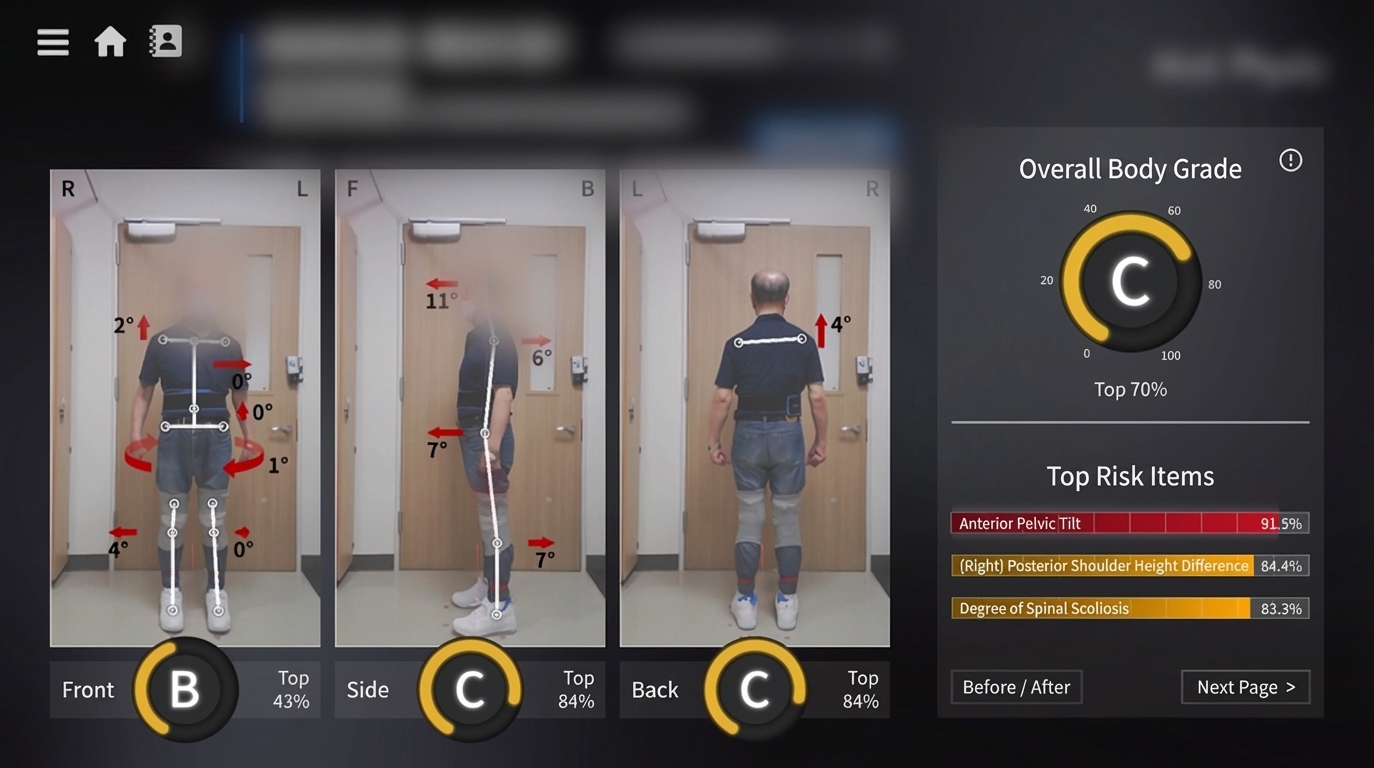
Film of the PAViR report page
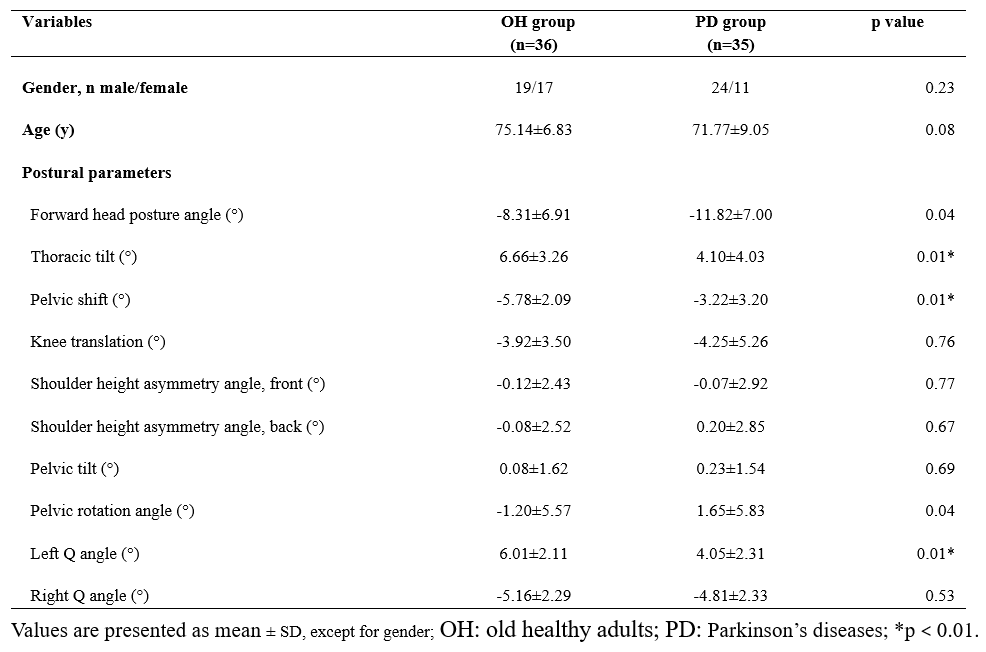
Group comparisons of postural parameters
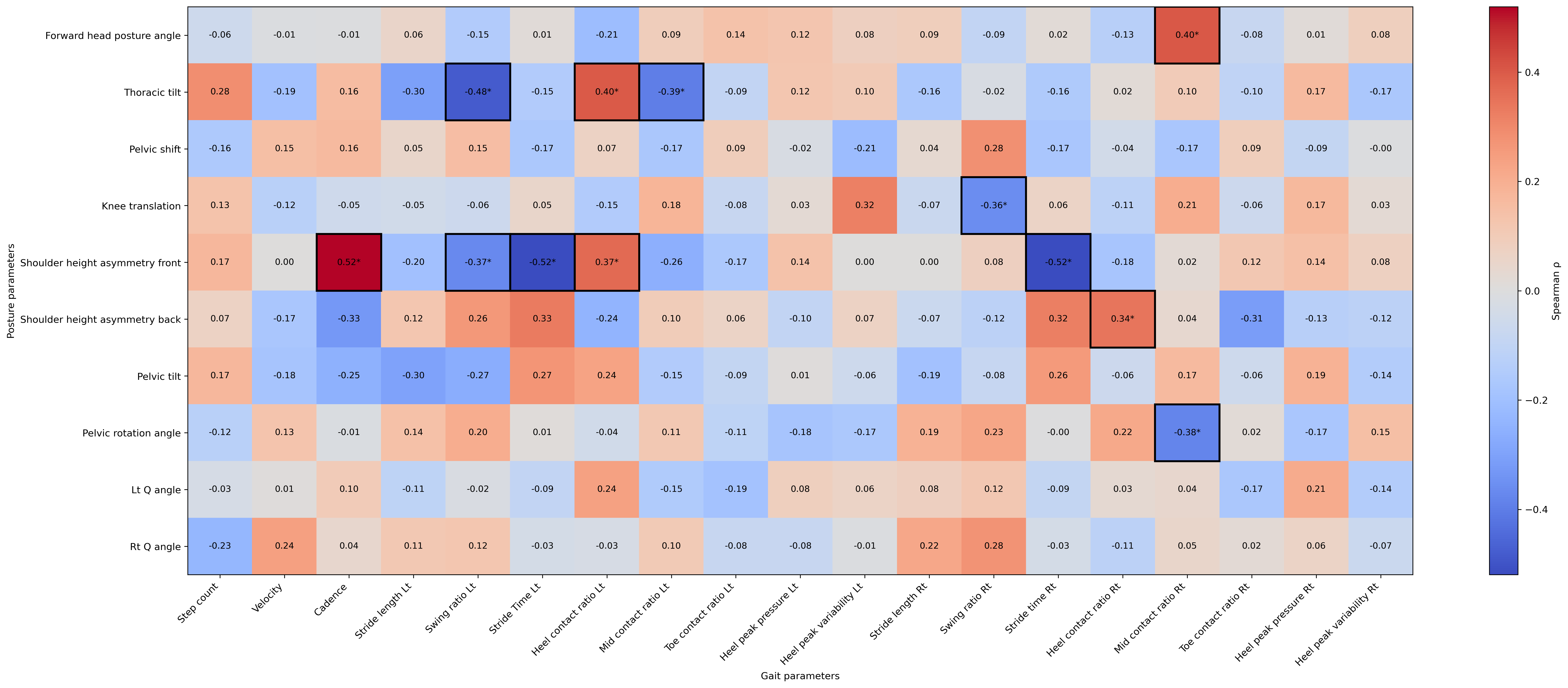
Correlation of postural and gait parameters
To cite this abstract in AMA style:
HW. Yang, SI. Choi, WH. Lee, NY. Kim. Assessment of Postural abnormalities in Early-stage Parkinson’s Disease Using a Posture Analyzing and Virtual Reconstruction Device [abstract]. Mov Disord. 2026; 41 (suppl 1). https://www.mdsabstracts.org/abstract/assessment-of-postural-abnormalities-in-early-stage-parkinsons-disease-using-a-posture-analyzing-and-virtual-reconstruction-device/. Accessed October 1, 2026.« Back to 2026 International Congress
MDS Abstracts - https://www.mdsabstracts.org/abstract/assessment-of-postural-abnormalities-in-early-stage-parkinsons-disease-using-a-posture-analyzing-and-virtual-reconstruction-device/