
Category: Parkinson's disease: Neuroimaging
Objective: To compare the rate of global brain structural degeneration between healthy controls (HC) and patients with Parkinson’s disease (PD).
Background: Normal aging is accompanied by progressive structural brain changes. Increasing evidence suggests that neurodegenerative disorders such as PD may accelerate these changes beyond normative aging trajectories. Brain age gap (BAG), defined as the difference between predicted brain age and chronological age, has emerged as an integrative biomarker reflecting overall brain health. However, few studies have applied robust machine learning frameworks to quantify overall structural degeneration in PD. We therefore aimed to use a machine learning–based brain age model to quantify BAG and directly compare structural brain aging between PD patients and HCs. We hypothesized that PD patients would exhibit a significantly higher BAG than HCs.
Method: Using T1-weighted MRI data from the UK Biobank, we constructed a brain age prediction model based on 1,436 imaging-derived phenotypes (IDPs). Through Elastic Net (EN) combined with Stability Selection (SS), 465 IDPs, including grey matter volumes, cortical thickness and surface area of individual brain regions were select as robust features. The model was trained in HCs with correction for chronological age and achieved a mean absolute error (MAE) of 3.72 years in the test set. The trained model was then applied to 59 PD patients and 6,959 HCs to estimate BAG. To control for potential confounding by age distribution differences between groups, analysis of covariance (ANCOVA) was performed with chronological age as a covariate.
Results: The HC group exhibited a mean BAG of −0.04 ± 4.68 years, whereas the PD group showed a mean BAG of 1.73 ± 5.77 years. After adjustment for chronological age, PD patients demonstrated a significantly higher BAG than HCs, with an adjusted mean difference of 1.84 years (p = 0.0028).
Conclusion: PD patients show significantly advanced structural brain aging, equivalent to 1.84 additional years beyond normative aging. Our findings support the utility of BAG as a biomarker of neurodegeneration in PD and suggest that accelerated brain aging in PD is independent of chronological age differences.
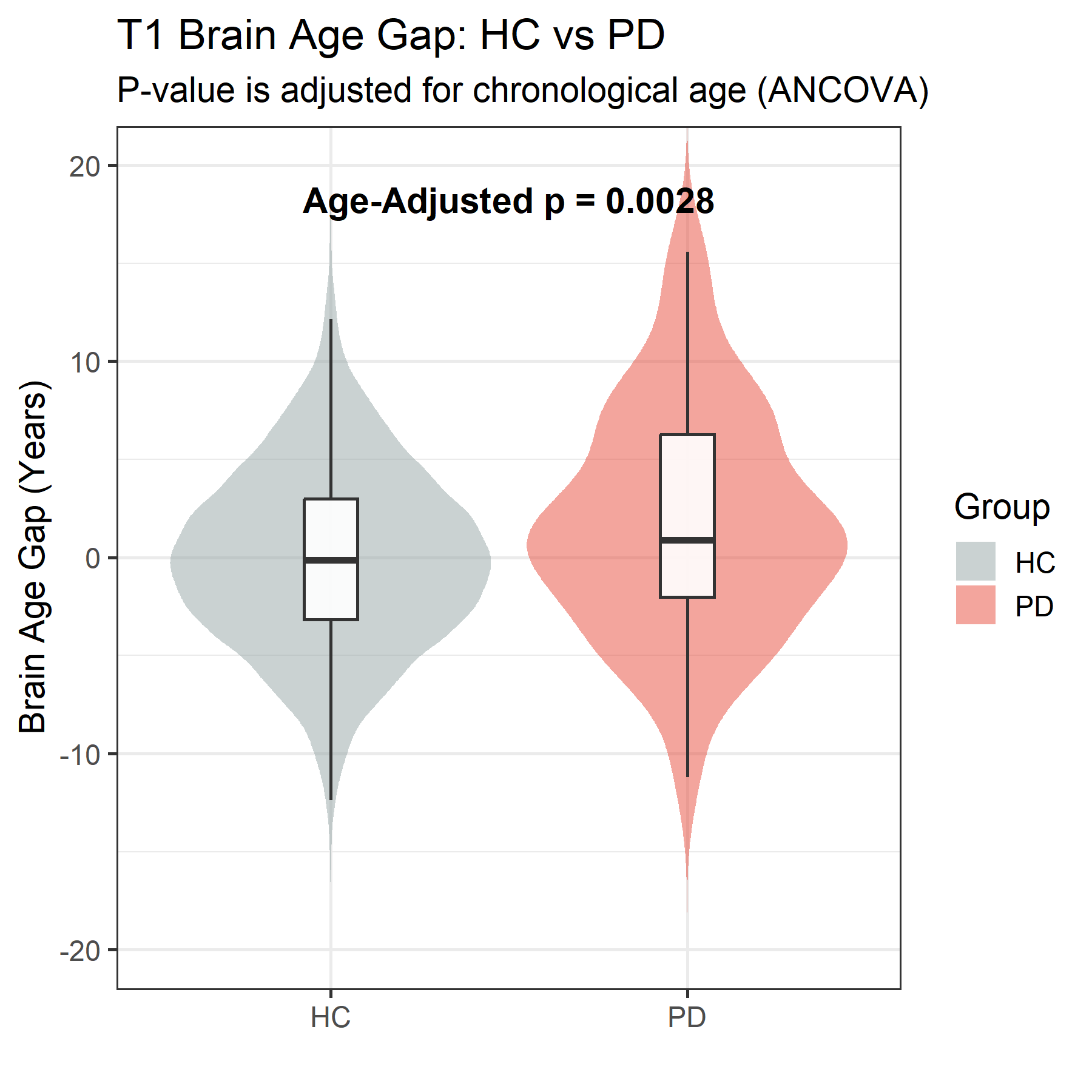
T1 Brain Age Gap: HC vs PD
To cite this abstract in AMA style:
ZK. Liu, BX. Liu, MJ. Fang, N. Zhou, RT. Li, LC. He, ZT. Hu, WH. Li. Machine Learning–Based Brain Age Modeling Reveals Accelerated Structural Degeneration in Parkinson’s Disease [abstract]. Mov Disord. 2026; 41 (suppl 1). https://www.mdsabstracts.org/abstract/machine-learning-based-brain-age-modeling-reveals-accelerated-structural-degeneration-in-parkinsons-disease/. Accessed October 1, 2026.« Back to 2026 International Congress
MDS Abstracts - https://www.mdsabstracts.org/abstract/machine-learning-based-brain-age-modeling-reveals-accelerated-structural-degeneration-in-parkinsons-disease/