
Objective: To investigate whether the subthalamic nucleus (STN) supports sleep-dependent memory consolidation through hierarchical oscillatory coupling, and whether this mechanism is disrupted in Parkinson’s disease (PD).
Background: Sleep disturbance accelerates motor and cognitive decline in PD, yet the underlying neural mechanism remains unclear. Sleep-dependent memory consolidation in the hippocampal-cortical system relies on hierarchical slow wave-spindle-ripple phase-amplitude coupling (PAC), but whether an analogous mechanism exists in the basal ganglia is unknown.
Method: PD patients and dystonia patients implanted with STN-DBS electrodes underwent overnight polysomnography with simultaneous STN local field potential and scalp EEG recordings, with dystonia serving as a disease control group. PAC among slow waves, spindles, and ripples was quantified within STN and across STN-cortical circuits and correlated with cognitive and motor measures. Targeted memory reactivation (TMR) and phase-locked STN stimulation were applied to probe functional relevance and causal modulation.
Results: In 10 PD patients and 10 dystonia controls, simultaneous STN local field potential and scalp EEG recordings revealed robust slow waves, spindles, and ripples in the STN during NREM sleep, with scalp slow waves leading STN but STN spindles leading scalp. Hierarchical PAC was significantly attenuated in PD across all three coupling levels (all p<0.05), and STN-cortex PAC correlated positively with MoCA score (r=0.57, p=0.008) and negatively with motor severity (figure1). In a TMR cohort (n=6), auditory cue re-presentation during NREM enhanced STN PAC and improved post-sleep motor learning (18.3% vs. 7.2%, p<0.05) and spatial memory (23.6% error reduction, p<0.05). Phase-locked STN stimulation (n=3) further augmented PAC and spindle-band power relative to sham (p<0.01).
Conclusion: These preliminary findings suggest the STN harbors a sleep oscillatory architecture functionally linked to memory consolidation that is impaired in PD proportional to disease burden. Phase-locked STN-DBS during sleep represents a promising strategy to restore sleep-dependent consolidation and potentially slow disease progression.
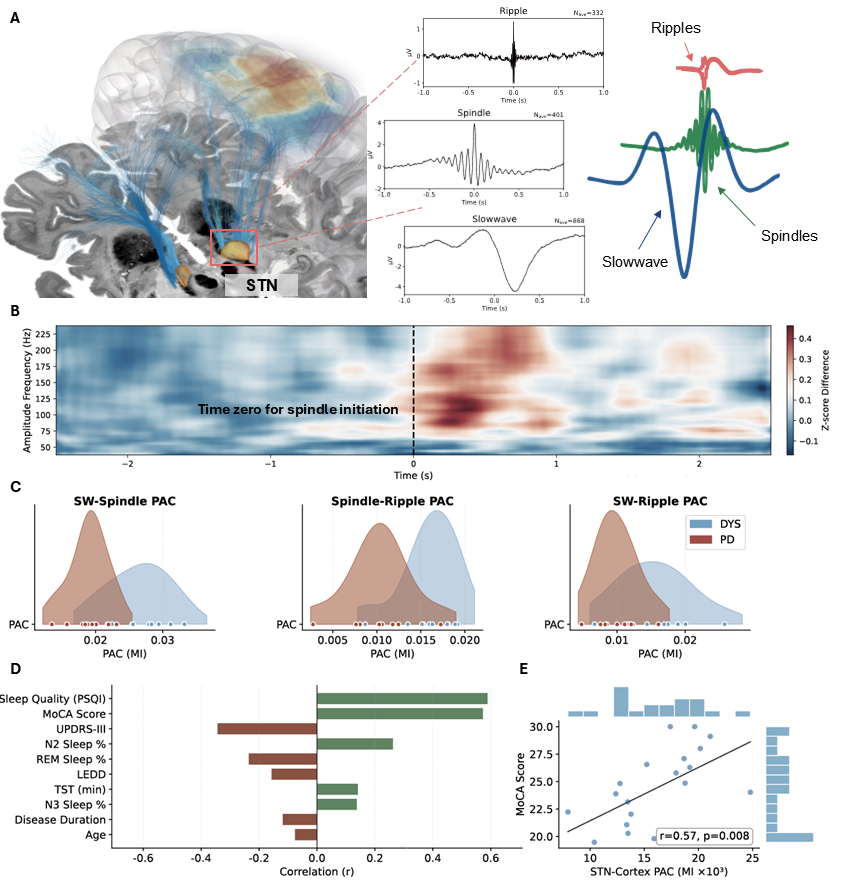
figure1
To cite this abstract in AMA style:
ZX. Yin, HL. Tan, JG. Zhang. Subthalamic Nucleus Oscillatory Coupling During Sleep is Impaired in Parkinson’s Disease and Associated with Memory Consolidation [abstract]. Mov Disord. 2026; 41 (suppl 1). https://www.mdsabstracts.org/abstract/subthalamic-nucleus-oscillatory-coupling-during-sleep-is-impaired-in-parkinsons-disease-and-associated-with-memory-consolidation/. Accessed October 1, 2026.« Back to 2026 International Congress
MDS Abstracts - https://www.mdsabstracts.org/abstract/subthalamic-nucleus-oscillatory-coupling-during-sleep-is-impaired-in-parkinsons-disease-and-associated-with-memory-consolidation/