
Category: Parkinson's Disease: Surgical Therapy
Objective: To develop and validate a deep learning framework for reconstructing subcortical neural activity from cortical electrocorticography (ECoG), enabling continuous deep brain biomarker inference without direct subcortical sensing.
Background: Closed-loop deep brain stimulation (DBS) relies on continuous subcortical biomarker sensing, yet clinical utility is frequently limited by stimulation artifacts, signal dropout, and hardware constraints. Whether cortical signals can reliably substitute for direct deep brain recordings across diverse clinical conditions remains unknown.
Method: We analyzed 723 hours of simultaneous cortico-subcortical recordings from 49 patients with movement disorders across three international centers (Berlin, Beijing, San Francisco) (figure1). Convolutional neural networks (CtxNet) and denoising diffusion probabilistic models (DDPM) were developed to decode subthalamic nucleus (STN) beta activity and reconstruct raw deep brain signals from ECoG. Decoding performance was evaluated across behavioral states, therapeutic conditions, subcortical targets, and disease entities.
Results: CtxNet outperformed conventional spectral feature approaches by approximately 40% in decoding STN beta activity, with robust performance across rest and movement, sleep and wakefulness, and medication and stimulation conditions. Decoding generalized to globus pallidus, centromedian thalamus, dystonia, and Tourette syndrome (figure2). DDPM achieved full-spectrum raw signal reconstruction preserving clinically relevant neural features, with reconstructed signals predicting motor symptom severity (UPDRS-III R²=0.70). Critically, ECoG-imputed STN signals significantly improved sleep state classification and movement detection during recording failures (figure3).
Conclusion: Cortical signals contain rich information about subcortical dynamics that can be reliably decoded using deep learning, offering a scalable framework to augment or rescue adaptive DBS sensing and enabling future non-invasive closed-loop neuromodulation strategies.
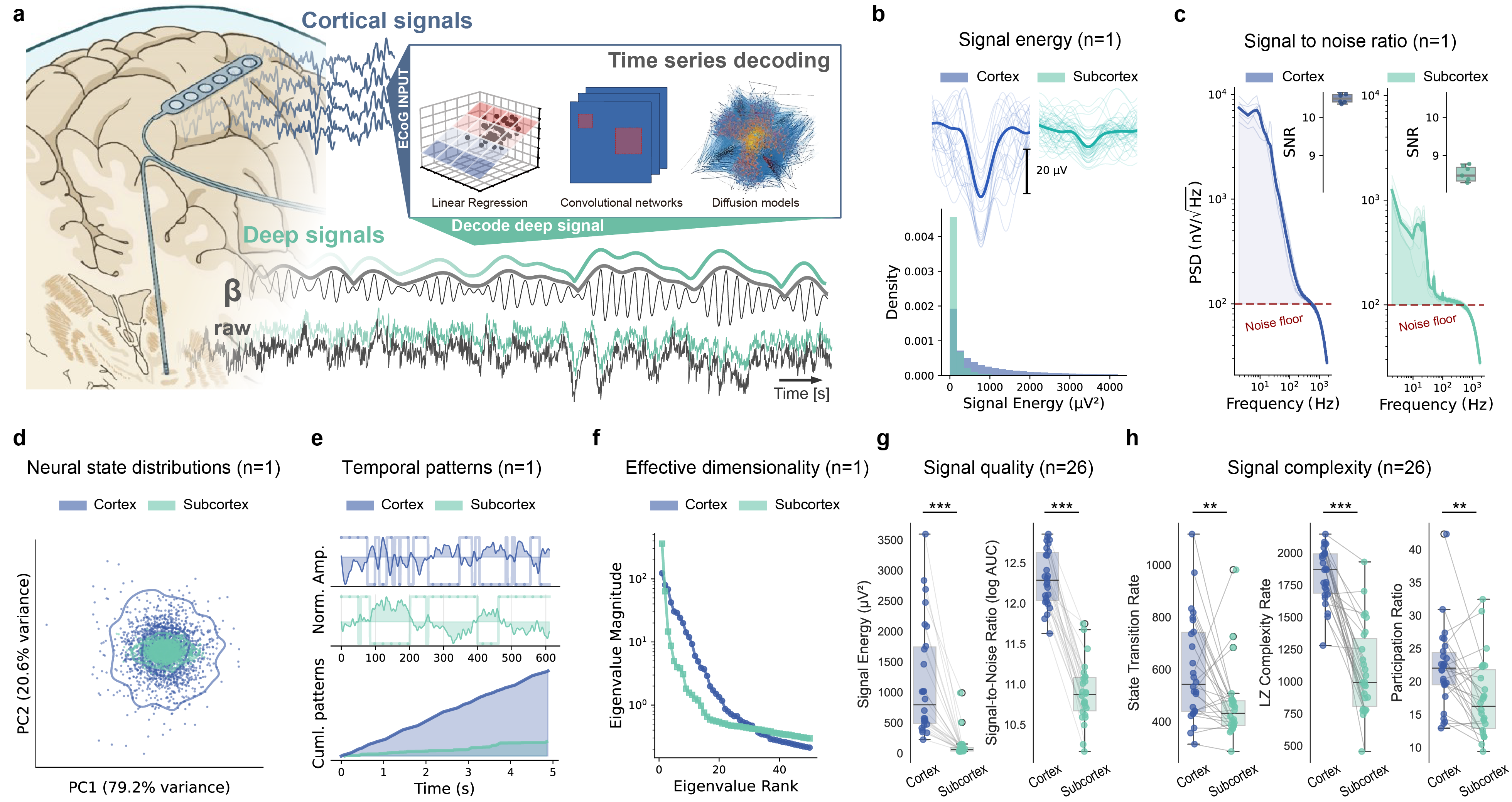
figure1
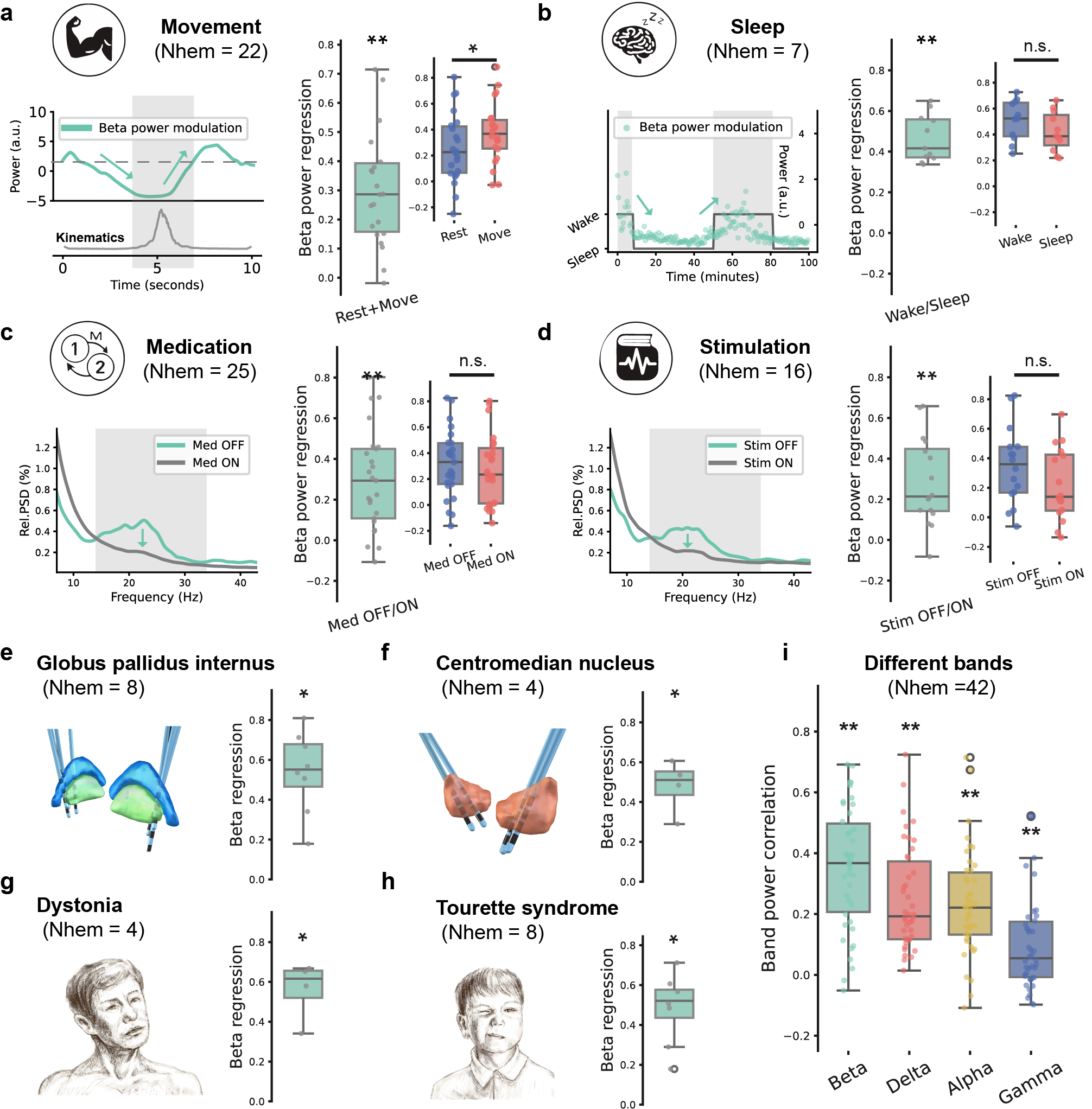
figure2
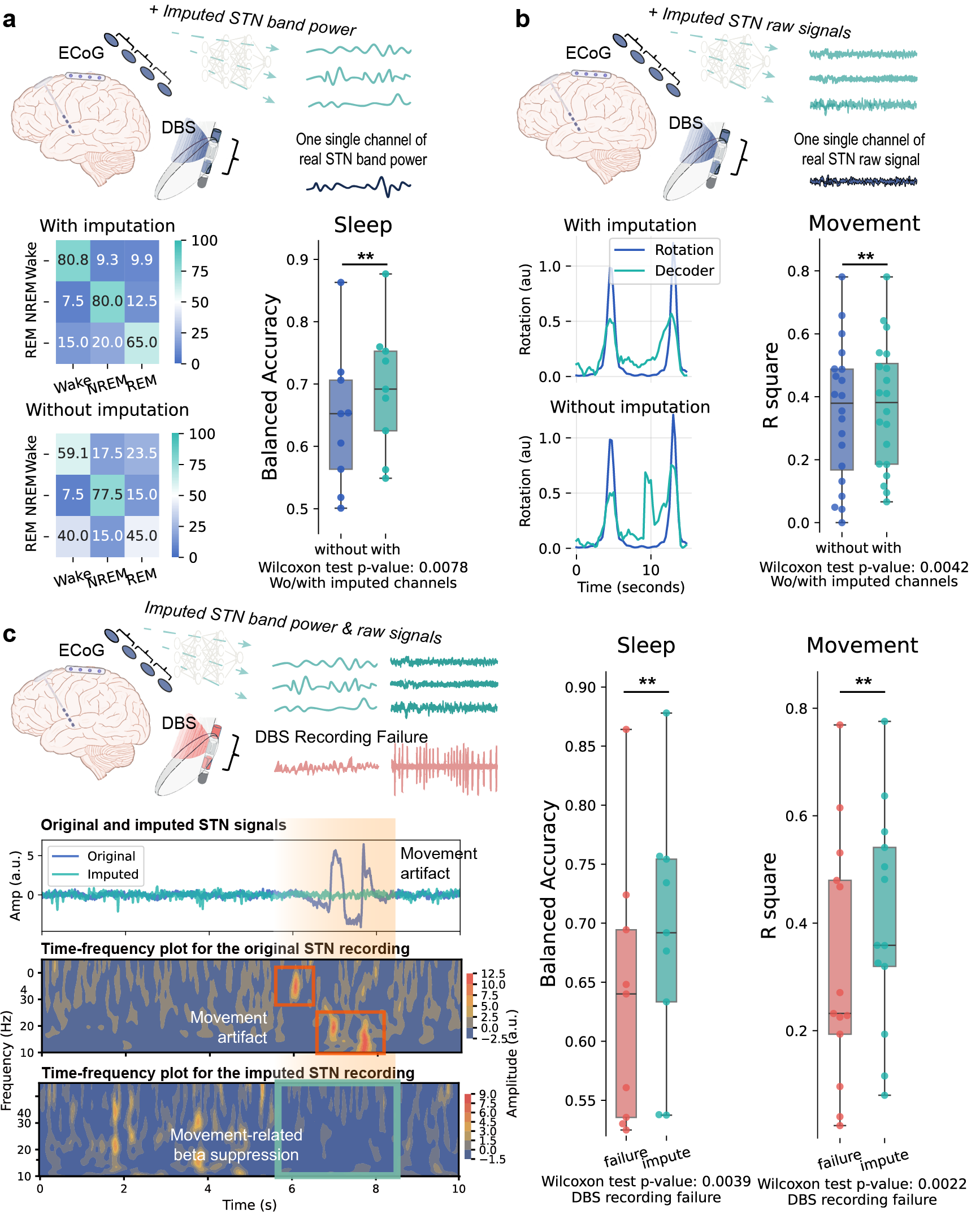
figure3
To cite this abstract in AMA style:
ZX. Yin, WJ. Neumann, JG. Zhang. Decoding Deep Brain Activity from Cortical Signals using Deep Learning across Movement Disorders [abstract]. Mov Disord. 2026; 41 (suppl 1). https://www.mdsabstracts.org/abstract/decoding-deep-brain-activity-from-cortical-signals-using-deep-learning-across-movement-disorders/. Accessed October 1, 2026.« Back to 2026 International Congress
MDS Abstracts - https://www.mdsabstracts.org/abstract/decoding-deep-brain-activity-from-cortical-signals-using-deep-learning-across-movement-disorders/