
Category: Parkinson's Disease: Genetics
Objective: To compare gut microbiome profiles of manifesting LRRK2 p.G2385R or p.R1628P carriers (LRRK2-PD) and idiopathic Parkinson’s disease patients (iPD).
Background: Leucine-rich repeat kinase 2 (LRRK2) is increasingly implicated in the microbiome-gut-brain axis in Parkinson’s disease (PD), especially given its association with Crohn’s disease and epidemiological links between inflammatory bowel disease and increased PD risk [1]. Despite growing interest in gene-microbiome interactions [2,3], the impact of the Asian-prevalent LRRK2 risk variants p.G2385R and p.R1628P, each affecting 5-10% of Asian PD patients [4], remains unexplored.
Method: 158 Malaysian and Taiwanese patients were recruited: LRRK2-PD (n=48) and iPD (n=110). Detailed clinico-demographic data were collected. Faecal samples were collected for gut microbiome metagenomics and calprotectin quantification via enzyme-linked immunosorbent assay. Monocyte LRRK2 kinase activity was assessed by pRab10Thr73 levels using quantitative immunoblotting. Between-group differences were evaluated using multivariate statistics with false discovery rate correction.
Results: Gut microbial composition differed significantly between LRRK2-PD and iPD (Fig. 1). LRRK2-PD showed higher abundances of potentially beneficial bacteria, including anti-inflammatory Bifidobacterium pseudocatenulatum and short-chain fatty acid-producing Gemmiger formicilis, and lower levels of potentially pathogenic bacteria, such as biofilm-producing Enterocloster citroniae and proinflammatory Phocea massiliensis, than iPD. Gene enrichment analysis revealed alterations in metabolic pathways (amino acid, energy, nucleotide, and cofactors/vitamins metabolism) and cellular processes including quorum sensing and biofilm formation in LRRK2-PD. Within LRRK2-PD, higher Bifidobacterium bifidum and lower Escherichia coli correlated with increased LRRK2 kinase activity, while reduced Bacteroides ovatus correlated with elevated faecal calprotectin levels. After adjusting for age and disease duration, increased Faecalicatena contorta correlated with worse motor function.
Conclusion: LRRK2-PD exhibit distinct gut microbiome and functional profiles compared to iPD. Associations with LRRK2 kinase activity, gut inflammation, and motor severity suggest a potential role of the gut microbiome in LRRK2-PD and warrant further investigation of gene-microbiome interactions in PD-gene carriers.
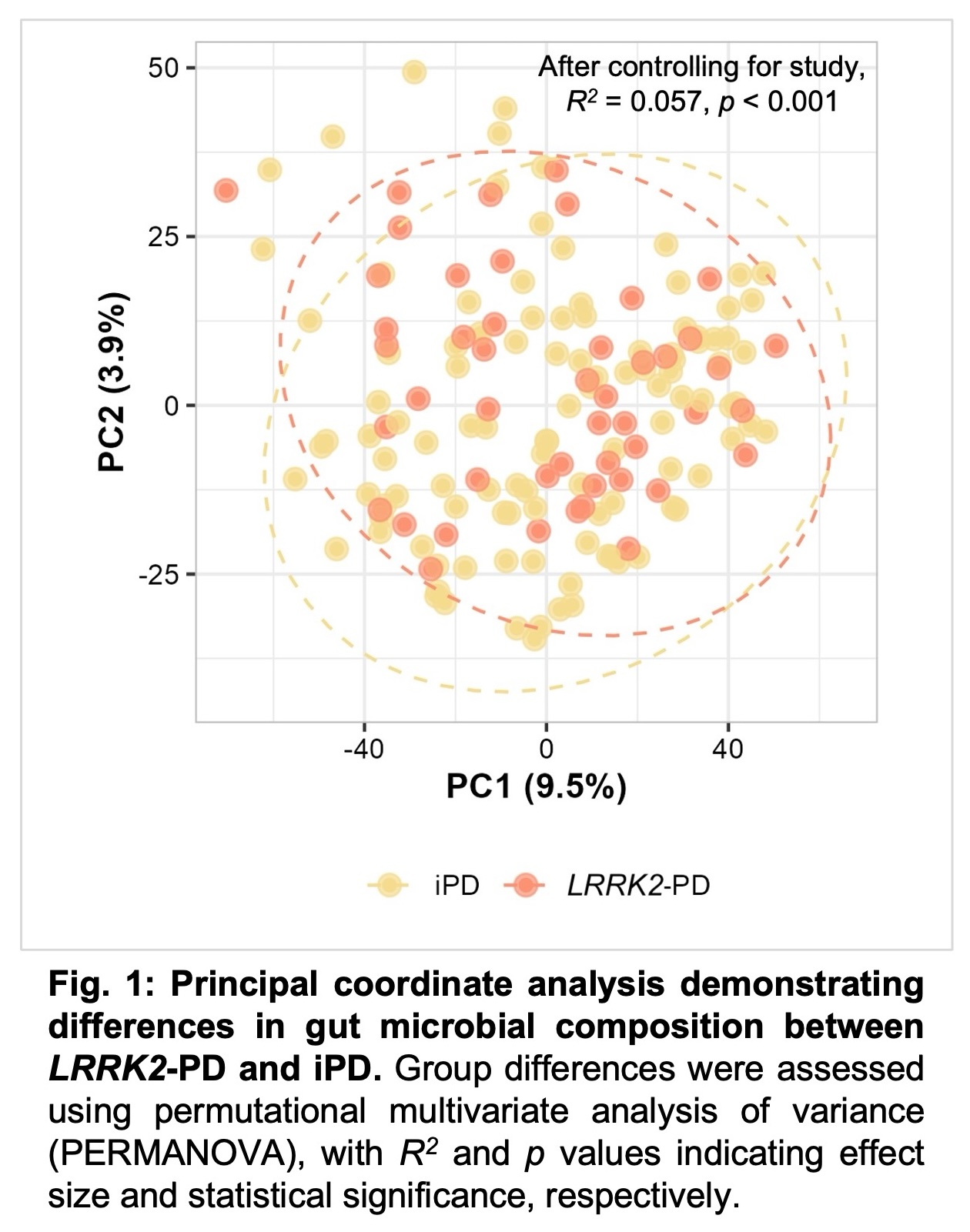
Fig. 1
References: [1] Herrick, M. K., & Tansey, M. G. (2021). Is LRRK2 the missing link between inflammatory bowel disease and Parkinson’s disease? NPJ Parkinson’s Disease, 7(1), 26.
[2] Tan, A. H., Lim, S. Y., & Lang, A. E. (2022). The microbiome–gut–brain axis in Parkinson disease—from basic research to the clinic. Nature Reviews Neurology, 18(8), 476-495.
[3] Matheoud, D., Cannon, T., Voisin, A., Penttinen, A. M., Ramet, L., Fahmy, A. M., … & Desjardins, M. (2019). Intestinal infection triggers Parkinson’s disease-like symptoms in Pink1−/− mice. Nature, 571(7766), 565-569.
[4] Goh, J. W., Lim, J. L., Toh, T. S., Ong, R. Y., Yong, Q. H., Lew, C. C. Y., … & Tan, A. H. (2025). LRRK2 p. G2385R and p. R1628P variants in a multi-ethnic Asian Parkinson’s Cohort: epidemiology and clinical insights. npj Parkinson’s Disease, 11(1), 320.
To cite this abstract in AMA style:
TS. Toh, JW. Hor, CH. Lin, J. Tee, Z. Pan, AK. Ng, V. Balakrishnan, AN. Khairul Anuar, LC. Lit, CW. Chong, SY. Lim, AH. Tan. Gut Microbiome Metagenomics in Parkinson’s Disease Stratified by the Asian-Prevalent LRRK2 Variants p.G2385R and p.R1628P [abstract]. Mov Disord. 2026; 41 (suppl 1). https://www.mdsabstracts.org/abstract/gut-microbiome-metagenomics-in-parkinsons-disease-stratified-by-the-asian-prevalent-lrrk2-variants-p-g2385r-and-p-r1628p/. Accessed October 1, 2026.« Back to 2026 International Congress
MDS Abstracts - https://www.mdsabstracts.org/abstract/gut-microbiome-metagenomics-in-parkinsons-disease-stratified-by-the-asian-prevalent-lrrk2-variants-p-g2385r-and-p-r1628p/