
Objective: To investigate whether wearable-derived gait biomarkers predict disease severity and health-related quality of life in Parkinson’s disease (PD) and to examine the mediating role of motor and non-motor symptoms.
Background: Wearable sensors provide objective measures of gait in PD, but the mechanisms linking gait impairment to clinical outcomes remain incompletely understood.
Method: We analyzed 276 PD patients, assessing gait features from wearable sensors, disease severity (MDS‑UPDRS), quality of life (PDQ‑39), and non-motor symptoms including cognition, mood, and sleep. Partial correlations, principal component analysis (PCA), and mediation analyses were conducted to investigate relationships between gait characteristics and clinical outcomes. Machine-learning models were applied to predict MDS‑UPDRS and PDQ‑39 from gait features.
Results: Among the patients, 46.0% were female. The mean age at onset and disease duration was 54.26 years and 7.52 years. Multiple gait variables derived from wearable sensors were significantly associated with both MDS‑UPDRS and PDQ‑39. PCA identified a primary gait component (PC1), accounting for 40.8% of the variance in MDS-UPDRS and 47.7% in PDQ-39, reflecting spatiotemporal slowing, impaired posture transitions, and asymmetry. Mediation analyses revealed that motor severity (UPDRS‑III) accounted for 73.2% of the association between gait and MDS‑UPDRS and 44.2% of the association with PDQ‑39. Non-motor symptoms also contributed significantly: mood (HAMD/HAMA) mediated 12–15% of the effect on MDS‑UPDRS and 25–27% on PDQ‑39; PDSS-2 and cognition (MoCA/FAB) mediated 16.2% and 12–18% of the effect on PDQ-39, respectively, whereas fatigue was non-significant. Machine-learning models using gait features predicted MDS‑UPDRS (R² = 0.869) and PDQ‑39 (R² = 0.842), with limb movement amplitude, trunk and lumbar angular velocities, and symmetry indices among the most influential predictors.
Conclusion: Gait impairment in PD affects disease severity and quality of life primarily through motor deficits, however, non-motor symptoms, particularly mood, sleep, and cognition, are important mediators. These findings highlight the clinical relevance of assessing non-motor symptoms alongside gait metrics and support the digital biomarkers for comprehensive monitoring and personalized management in PD.
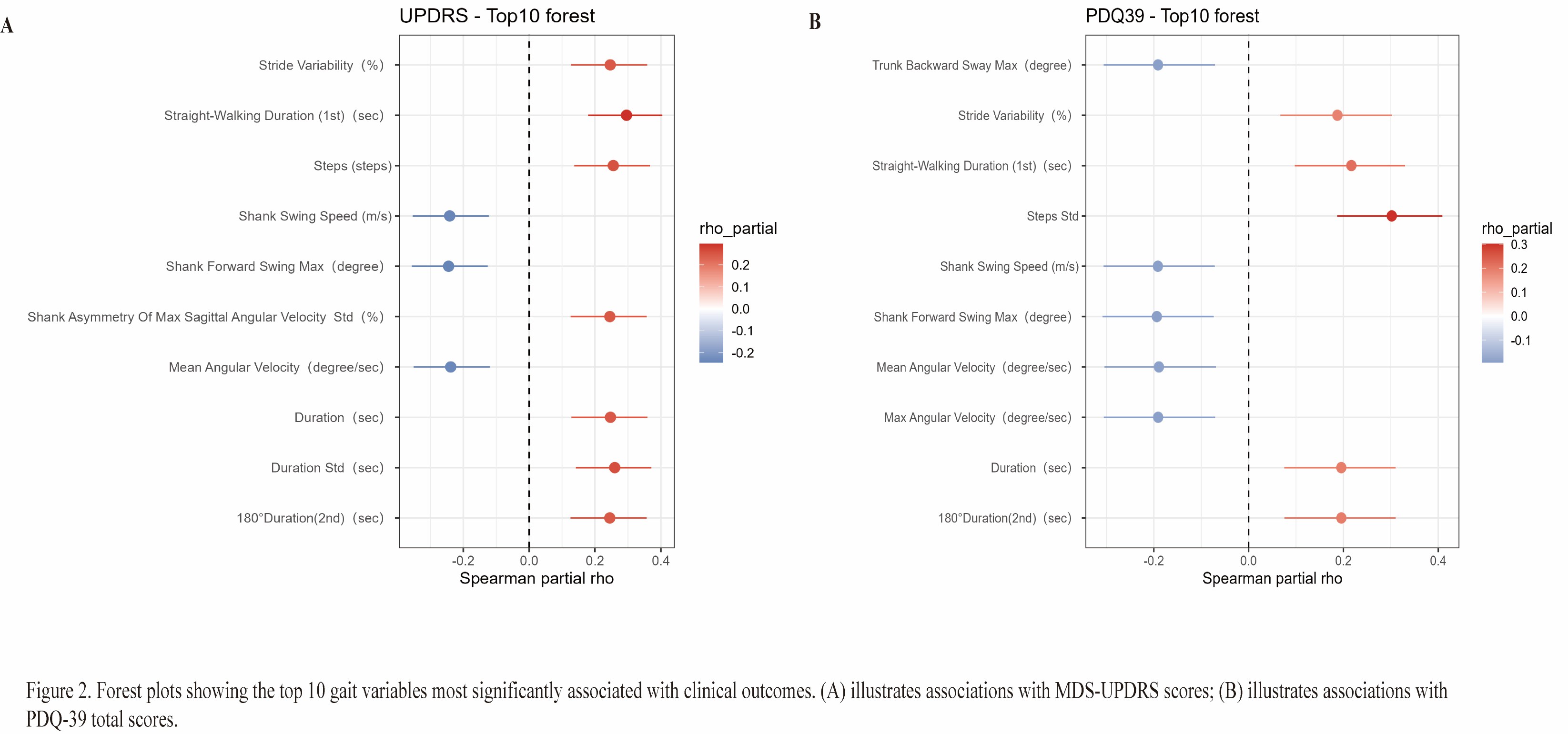
Fig 2
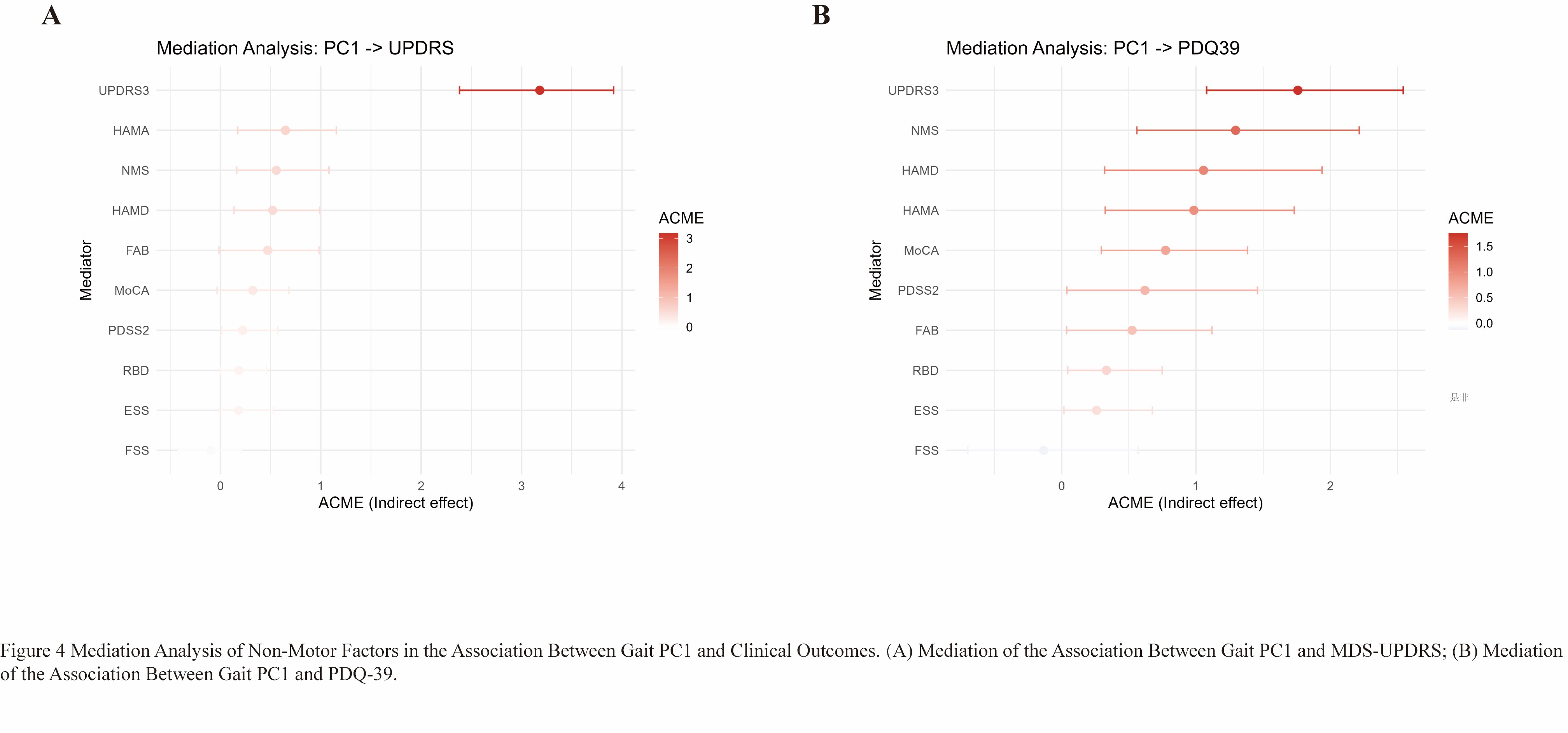
Fig 4
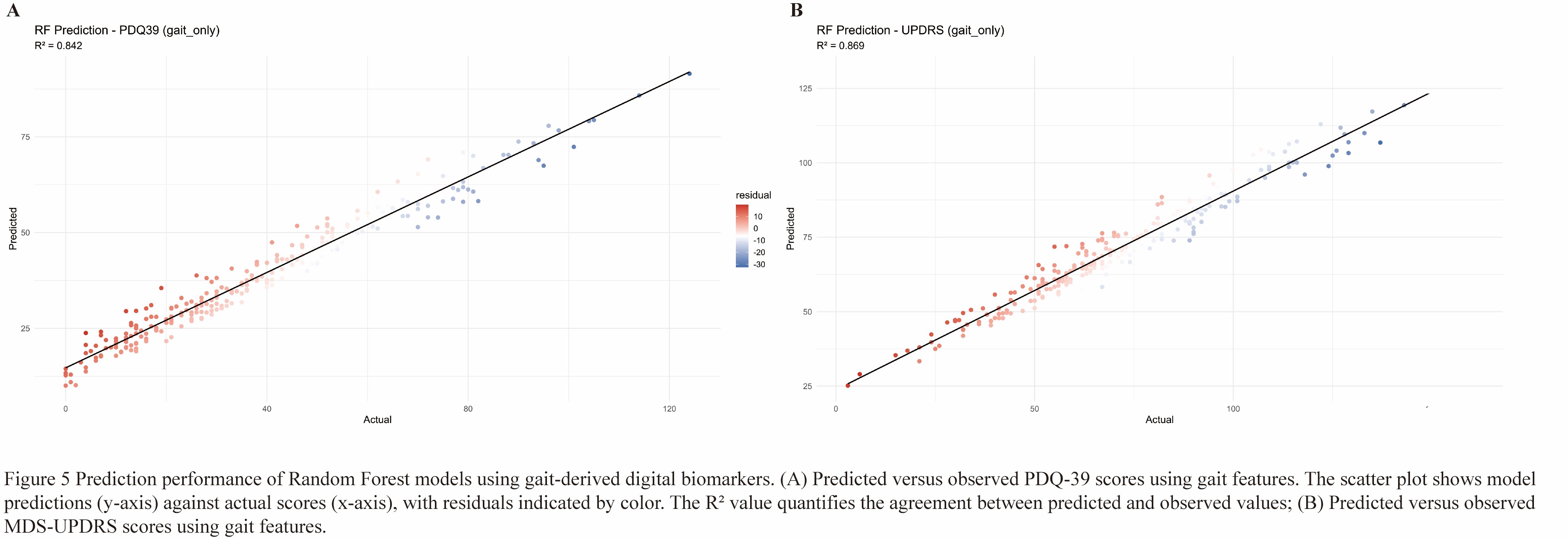
Fig 5
To cite this abstract in AMA style:
J. Jiang, W. Wang, W. Wei, L. Li, O. Ou, Z. Zhang, H. Hou, Y. Yang, X. Xiao, L. Lin, L. Liu, S. Shang. Wearable-Derived Gait Biomarkers Predict Disease Severity and Quality of Life in Parkinson’s Disease: A Machine Learning and Mediation Analysis [abstract]. Mov Disord. 2026; 41 (suppl 1). https://www.mdsabstracts.org/abstract/wearable-derived-gait-biomarkers-predict-disease-severity-and-quality-of-life-in-parkinsons-disease-a-machine-learning-and-mediation-analysis/. Accessed October 1, 2026.« Back to 2026 International Congress
MDS Abstracts - https://www.mdsabstracts.org/abstract/wearable-derived-gait-biomarkers-predict-disease-severity-and-quality-of-life-in-parkinsons-disease-a-machine-learning-and-mediation-analysis/