
Objective: This study aimed to analyze constipation symptoms and blood, CSF and fecal biomarkers, including a High-plex Profiling of Inflammatory Proteins (NULISA) in a de novo PD cohort.
Background: Parkinson’s disease (PD) is a growing neurodegenerative disorder, including significant gastrointestinal dysfunction (GI), particularly in early stages.
Method: Demographics, Unified Parkinson’s Disease Rating Scale, UPSIT test, Montreal Cognitive Assessment, SCOPA-AUT and Bristol scale were assessed. Calprotectin (inflammation), zonulin (permeability), alfa-syn total and aggregated in blood and stools were measured. 85 fecal samples were analyzed using the NULISAseq Inflammation panel 250 targeting immune response-related cytokines. Data was analyzed using R.
Results: 148 patients were included: 30 healthy controls, 92 de novo PD, 11 PD treated and 15 RBD. A total of 44.6% women, mean age in PD was 57 (±2.9). More than 50% of PD patients presented brain-first characteristics. Constipation (Bristol <=2) was more frequent in de novo PD patients than in controls (23% vs 10%), not significantly (OR 2.66, 95% CI 0.74–9.5, p=0.12). SCOPA-AUT constipation score tended to be higher in PD treated compared with de novo PD (median 10 [IQR 14.5] vs 7 [IQR 8]), (p = 0.204). Biomarkers and clinical scales were correlated as shown in figure 1. Stool calprotectin levels were slightly higher in de novo PD compared with control (p = 0.447). In contrast, stool zonulin differed significantly across cohorts (p = 0.006). Stool aggregated α-synuclein levels did not differ significantly between groups (χ² = 1.81, p = 0.614) but some subgroups had higher levels (potential stratification biomarker). From 250 inflammatory factors, 36 (14.6%) targets are detectable in fecal samples, within the expected range on historical data. Intra-plate CV median = 4.36% is within expected range (< 10%). CXADR, CXCL8 and TNFSF13 were higher in PD de novo (p<0.05 unadjusted) (Fig. 2).
Conclusion: This study highlights the relevance of GI dysfunction in de novo PD. Innovative and less invasive biomarkers in stool could aid in early diagnosis and classify clinical subgroups and explore therapeutic implications.
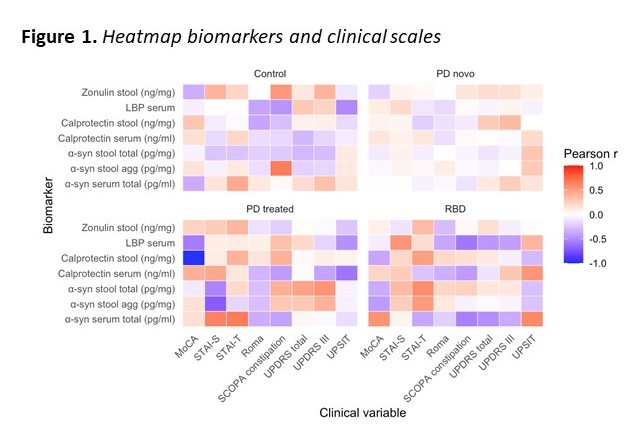
Figure 1. Heatmap
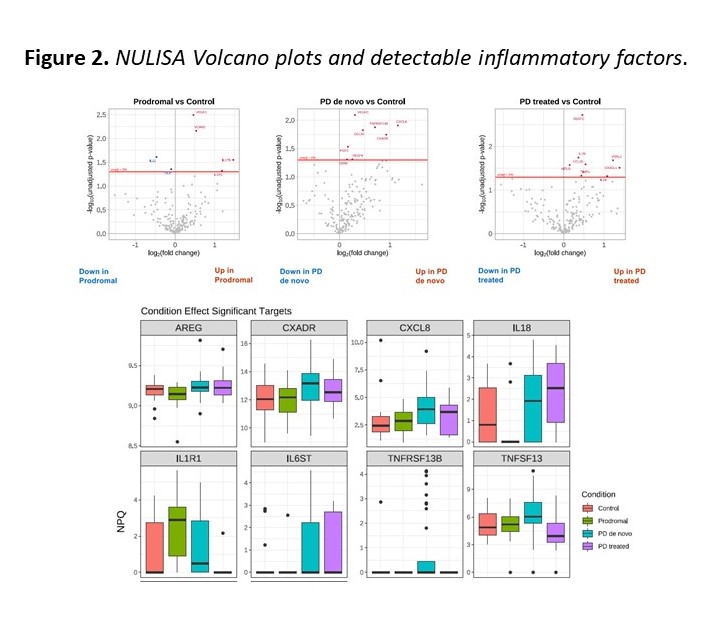
Figure 2. NULISA volcano plots
References: Fasano A, Visanji NP, Liu LW, Lang AE, Pfeiffer RF. Gastrointestinal dysfunction in Parkinson’s disease. Lancet Neurol. 2015 Jun;14(6):625-39.
Schaffrath A, Schleyken S, Seger A, Jergas H, Özdüzenciler P et al. Patients with isolated REM-sleep behavior disorder have elevated levels of alpha-synuclein aggregates in stool. NPJ Parkinsons Dis. 2023 Feb 2;9(1):14.
Yu, QJ., Yu, SY., Zuo, LJ. et al. Parkinson disease with constipation: clinical features and relevant factors. Sci Rep 8, 567 (2018).
Knudsen, K., Krogh, K., Østergaard, K. and Borghammer, P. (2017), Constipation in parkinson’s disease: Subjective symptoms, objective markers, and new perspectives. Mov Disord., 32: 94-105.
To cite this abstract in AMA style:
S. Enriquez Calzada, M. Miret Milian, L. Melgarejo, M. Arrué, A. López, S. Belmonte, M. Martinez-Vicente, J. Hernandez-Vara, A. Laguna. The enteric footprint of de novo parkinson’s disease cohort: constipation, inflammation, and nulisa biomarker profiling. [abstract]. Mov Disord. 2026; 41 (suppl 1). https://www.mdsabstracts.org/abstract/the-enteric-footprint-of-de-novo-parkinsons-disease-cohort-constipation-inflammation-and-nulisa-biomarker-profiling/. Accessed October 1, 2026.« Back to 2026 International Congress
MDS Abstracts - https://www.mdsabstracts.org/abstract/the-enteric-footprint-of-de-novo-parkinsons-disease-cohort-constipation-inflammation-and-nulisa-biomarker-profiling/