
Category: Parkinson's Disease (Other)
Objective: To investigate whether automated video-based analysis of lip articulation can capture speech-relevant changes in the orofacial system in Parkinson’s disease (PD) and to determine its correspondence with speech intelligibility derived from the acoustic signal.
Background: Speech motor impairment is a common and burdensome symptom of PD that can substantially affect communication and quality of life. Clinical assessment is largely auditory and subjective, while acoustic analysis enables more objective quantification. Complementary video-based analysis of lip movements may provide additional insights into speech motor dynamics.
Method: We enrolled 25 individuals with PD and 20 age-matched healthy controls (HC). All participants performed standardized speech tasks in a soundproof booth. Video recordings were acquired using a high-resolution webcam (1280 × 720 px, 60 fps) synchronized with an external head-mounted microphone. Using the open-source software MediaPipe Face Detection (Google), lip movement patterns were automatically segmented during an oral diadochokinesis task (DDK) and sustained vowel phonation. As primary outcome parameters for the lip opening movement, maximum speed and maximum amplitude (displacement) were calculated for each syllable cycle. Auditory speech production was quantified using the root mean square (RMS) amplitude of the audio signal. Temporal changes in both variables were statistically modeled using a linear mixed-effects model (LME).
Results: In a proof of concept, we show that lip kinematics strongly correlate with the acoustic signal (mean cross-correlation: 0.73). The movement patterns reveal the expected spatial reduction of lip opening over time in both groups. In contrast, maximum speed of lip opening cycles significantly decreased over time in the PD group, whereas no relevant decline was observed in HC (LME: R² = 0.65, β = 1.49, 95% CI [0.03, 2.85], p < 0.045).
Conclusion: Automated video-based analysis of lip articulation provides a feasible approach for detecting disease-related changes in speech motor control in PD. This method may complement acoustic analyses and clinical assessments, offering a scalable tool for monitoring speech impairment and disease-related motor changes.
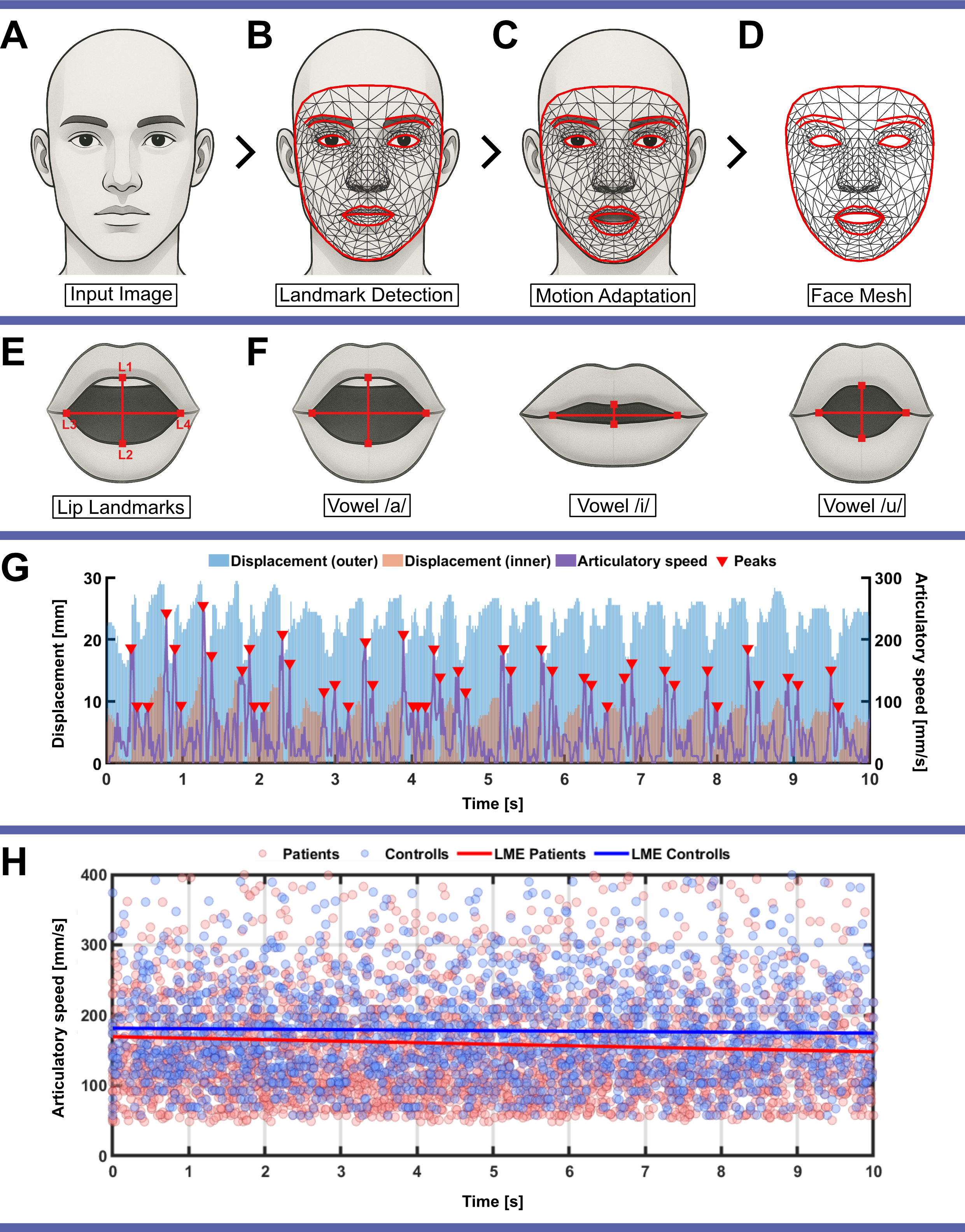
Figure 1: Video-Based Assessment
To cite this abstract in AMA style:
J. Strelow, T. Thies, I. Rubi-Fessen, M. Barbe, D. Mücke. Automated Video-Based Assessment of Lip Articulation in Parkinson’s Disease [abstract]. Mov Disord. 2026; 41 (suppl 1). https://www.mdsabstracts.org/abstract/automated-video-based-assessment-of-lip-articulation-in-parkinsons-disease/. Accessed October 1, 2026.« Back to 2026 International Congress
MDS Abstracts - https://www.mdsabstracts.org/abstract/automated-video-based-assessment-of-lip-articulation-in-parkinsons-disease/