
Objective: To evaluate the clinical relevance of oral health assessment in Parkinson’s disease (PD) by determining whether oral inflammatory, microbial, and periodontal alterations are associated with disease severity.
Background: PD is a progressive neurodegenerative disorder associated with systemic and peripheral inflammatory changes beyond the central nervous system[1]. Increasing evidence suggests that oral inflammation may reflect disease-related immune dysregulation and serve as a robust, noninvasive tool for monitoring disease status[2]. However, oral health measures are not routinely incorporated into PD assessment.
Method: In this case-control study, 16 patients with mild to moderate PD and 16 matched household spousal controls were recruited from the University of Illinois Chicago College of Dentistry and Rush University Medical Center. PD participants with preserved motor function (Hoehn and Yahr stages I-II) were enrolled to limit the impact of motor disability, and all met minimum American Dental Association oral hygiene standards. Oral examinations were performed, and oral mucosal brushings, saliva, and gingival crevicular fluid (GCF) were collected. Clinical examiners and laboratory personnel were blinded to group assignments.
Results: Compared with spouses, patients with PD showed significantly worse periodontal parameters, including higher plaque index (p=0.049), gingival index (p=0.010), and recession (p=0.008). Dexterity did not differ between groups. GCF levels of IL-1β and IL-8 were significantly elevated in PD (both p<0.01), while IL-6 and TNF-α showed nonsignificant upward trends (p<0.07). Salivary analysis in PD further demonstrated higher expression of neuroinflammatory and host-response markers HGF, CD14, NfL, but lower expression of FMO [Figure1]. Microbial communities across oral sampling sites formed distinct niches according to PD status and disease severity. PD saliva showed increased virulence-associated factors of Porphyromonas gingivalis RgpA and Aggregatibacter actinomycetemcomitans RPL2 [Figure1]. Several salivary biomarkers also distinguished mild from moderate PD.
Conclusion: Oral inflammatory, microbial, and periodontal alterations are associated with PD severity. These findings support the development of standardized oral health assessments as noninvasive adjuncts for monitoring disease progression and improving risk stratification in PD.
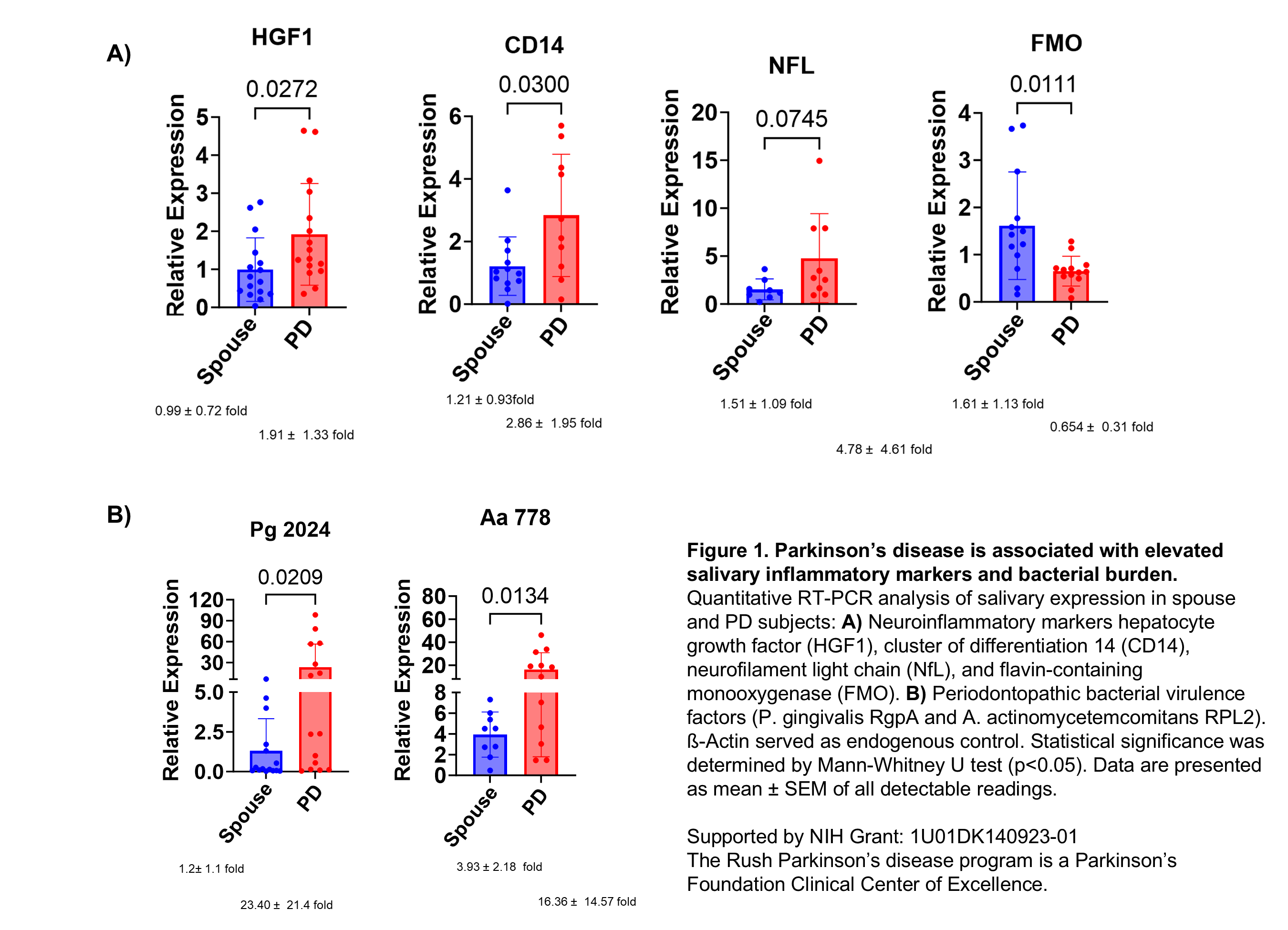
Salivary Inflammation and Bacterial Load in PD
References: 1 Williams, G. P., Schonhoff, A. M., Sette, A. & Lindestam Arlehamn, C. S. Central and Peripheral Inflammation: Connecting the Immune Responses of Parkinson’s Disease. J Parkinsons Dis 12, S129-S136, doi:10.3233/JPD-223241 (2022).
2 Saenz-Ravello, G., Hernandez, M., Baeza, M. & Hernandez-Rios, P. The Role of Oral Biomarkers in the Assessment of Noncommunicable Diseases. Diagnostics (Basel) 15, doi:10.3390/diagnostics15010078 (2024).
To cite this abstract in AMA style:
R. Naqvi, V. Ha, S. Elshourbagy, A. Valverde, S. Tomar, J. Schwartz, A. Naqvi, P. Engen, M. Shaikh, C. Neumann, M. Villanueva, D. Sanchez-Bass, L. Dibenedetto, R. Voigt, C. Goetz, A. Keshavarzian. Clinical Relevance of Oral Health Assessment in Parkinson’s Disease Monitoring [abstract]. Mov Disord. 2026; 41 (suppl 1). https://www.mdsabstracts.org/abstract/clinical-relevance-of-oral-health-assessment-in-parkinsons-disease-monitoring/. Accessed October 1, 2026.« Back to 2026 International Congress
MDS Abstracts - https://www.mdsabstracts.org/abstract/clinical-relevance-of-oral-health-assessment-in-parkinsons-disease-monitoring/