
Category: Parkinson's Disease: Surgical Therapy
Objective: We conducted a systematic review and meta-analysis (SRMA) to evaluate the efficacy of adaptive Deep Brain Stimulation (aDBS) compared to conventional Deep Brain Stimulation (cDBS), to improve motor fluctuation in parkinson’s
Background: Parkinson’s disease (PD), has a prevalence of nearly 1% of population over 65. While cDBS sends unmodulated stimulation that fails to account for dynamic physiological brain states, aDBS have an advancement by utilising AI-driven sensors to detect neural biomarkers. aDBS adapts to provide personalized therapy, demonstrating better acute management of motor fluctuations signified by improved Unified Parkinson’s disease rating scale (UPDRS-III) scores.
Method: This SRMA is conducted in respect with PRISMA guidelines and is registered in PROSPERO under registration number CRD420261333851. We systematically searched databases including PubMed and Cochrane as in Figure 1 to identify trials comparing the efficacy of aDBS with cDBS in improving motor fluctuations in PD. Meta-analyses were performed using a random-effects model to account for inter-study heterogeneity. The primary outcome to analyse the efficacy of cDBS and aDBS for improving motor fluctuations was assessed by using Mean difference (MD).
Results: 11 studies were identified of which 4 provided data for meta-analysis. A pooled analysis of 4 studies comparing aDBS with cDBS in PD. The primary pooled outcome of assessing the efficacy of both modalities came as an overall MD of −2.15 (95% CI: −5.21 – 0.92) shown in Figure 2, indicating a trend toward improved motor outcomes with aDBS compared with cDBS. A secondary analysis restricted to acute stimulation showed a pooled MD of −3.91 (95% CI: −10.41 – 2.59) shown in Figure 3 again favoring aDBS in case of acute stimulation but without statistical significance.
Conclusion: This study indicates that aDBS may offer better outcomes compared with cDBS in case of PD, as indicated by consistently negative pooled MD across studies. Although the pooled analysis was not of statistical significance, the direction of effect favored aDBS. Our findings underscores the potential of aDBS as a more responsive neuromodulation strategy and emphasis the need of larger trials in future in this field to establish and confirm the clinical benefits of aDBS over cDBS.
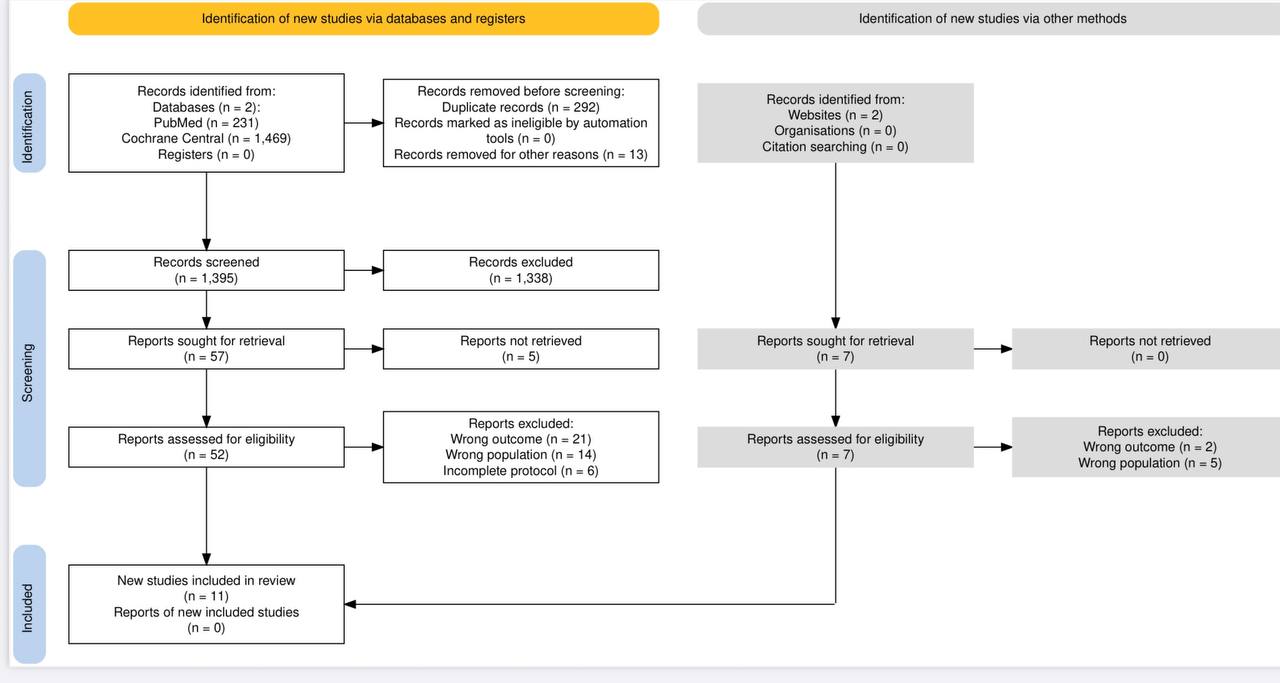
Figure 1
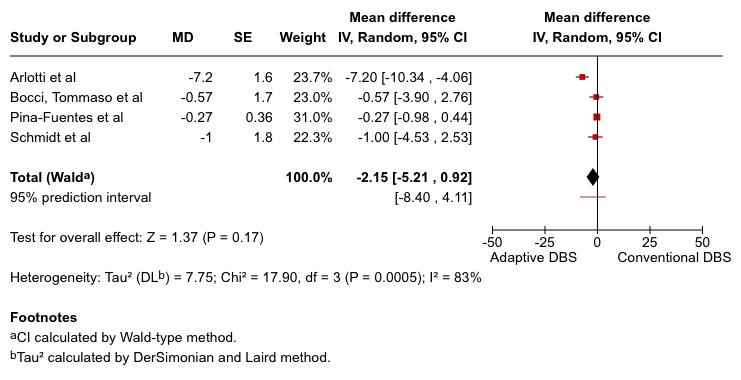
Figure 2
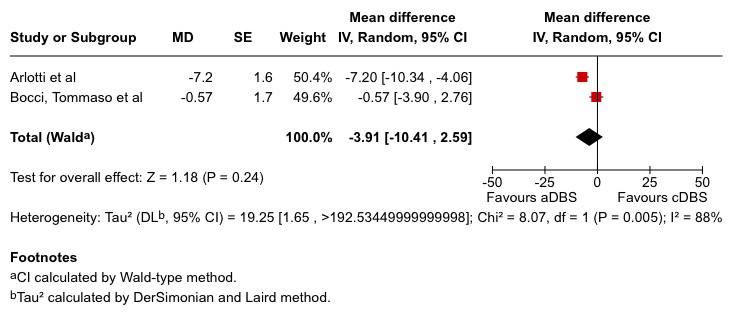
Figure 3
References: 1. Sarikhani P, Ferleger B, Mitchell K, Ostrem J, Herron J, Mahmoudi B, Miocinovic S.
Automated deep brain stimulation programming with safety constraints for tremor
suppression in patients with Parkinson’s disease and essential tremor. J Neural Eng. 2022
Aug 18;19(4):10.1088/1741-2552/ac86a2. doi: 10.1088/1741-2552/ac86a2. PMID:
35921806; PMCID: PMC9614806.
2. Little S, Beudel M, Zrinzo L, Foltynie T, Limousin P, Hariz M, Neal S, Cheeran B,
Cagnan H, Gratwicke J, Aziz TZ, Pogosyan A, Brown P. Bilateral adaptive deep brain
stimulation is effective in Parkinson’s disease. J Neurol Neurosurg Psychiatry. 2016
Jul;87(7):717-21. doi: 10.1136/jnnp-2015-310972. Epub 2015 Sep 30. PMID: 26424898;
PMCID: PMC4941128.
3. Busch JL, Kaplan J, Behnke JK, Witzig VS, Drescher L, Habets JGV, Kühn AA. Chronic
adaptive deep brain stimulation for Parkinson’s disease: clinical outcomes and
programming strategies. NPJ Parkinsons Dis. 2025 Aug 29;11(1):264. doi:
10.1038/s41531-025-01124-7. PMID: 40883328; PMCID: PMC12397205.
4. Cascino, S., Luiso, F., Caffi, L. et al. Chronic adaptive deep brain stimulation in
Parkinson’s disease: ADAPT-START findings and programming principles. npj
Parkinsons Dis. (2026). https:// doi.org/10.1038/s41531-026-01269-z
5. Arlotti M, Marceglia S, Foffani G, Volkmann J, Lozano AM, Moro E, Cogiamanian F,
Prenassi M, Bocci T, Cortese F, Rampini P, Barbieri S, Priori A. Eight-hours adaptive
deep brain stimulation in patients with Parkinson disease. Neurology. 2018 Mar
13;90(11):e971-e976. doi: 10.1212/WNL.0000000000005121. Epub 2018 Feb 14. PMID:
29444973; PMCID: PMC5858949.
6. Yin Z, Yu H, Yuan T, Smyth C, Anjum MF, Zhu G, Ma R, Xu Y, An Q, Gan Y, Merk T,
Qin G, Xie H, Zhang N, Wang C, Jiang Y, Meng F, Yang A, Neumann WJ, Starr P, Little
S, Li L, Zhang J. Generalized sleep decoding with basal ganglia signals in multiple
movement disorders. NPJ Digit Med. 2024 May 10;7(1):122. doi:
10.1038/s41746-024-01115-7. PMID: 38729977; PMCID: PMC11087561.
7. Bronte-Stewart HM, Beudel M, Ostrem JL, Little S, Almeida L, Ramirez-Zamora A,
Fasano A, Hassell T, Mitchell KT, Moro E, Gostkowski M, Chattree G, de Bie RMA, de
Neeling M, Piña-Fuentes D, Swinnen B, Starr PA, Hammer LH, Foote KD, Richardson
RM, Flaherty A, Boogers A, Sa’di Q, Meoni S, Castrioto A, Stanslaski S, Summers RLS,
Tonder L, Tan Y, Berrier H, Goble TJ, Raike RS, Herrington TM; ADAPT-PD
Investigators. Long-Term Personalized Adaptive Deep Brain Stimulation in Parkinson
Disease: A Nonrandomized Clinical Trial. JAMA Neurol. 2025 Nov 1;82(11):1171-1180.
doi: 10.1001/jamaneurol.2025.2781. PMID: 40982287; PMCID: PMC12455485.
8. Schmidt SL, Chowdhury AH, Mitchell KT, Peters JJ, Gao Q, Lee HJ, Genty K, Chow
SC, Grill WM, Pajic M, Turner DA. At home adaptive dual target deep brain stimulation
in Parkinson’s disease with proportional control. Brain. 2024 Mar 1;147(3):911-922. doi:
10.1093/brain/awad429. PMID: 38128546; PMCID: PMC10907084.
9. Oehrn CR, Cernera S, Hammer LH, Shcherbakova M, Yao J, Hahn A, Wang S, Ostrem
JL, Little S, Starr PA. Chronic adaptive deep brain stimulation versus conventional
stimulation in Parkinson’s disease: a blinded randomized feasibility trial. Nat Med. 2024
Nov;30(11):3345-3356. doi: 10.1038/s41591-024-03196-z. Epub 2024 Aug 19. PMID:
39160351; PMCID: PMC11826929.
10. Bocci T, Prenassi M, Arlotti M, Cogiamanian FM, Borellini L, Moro E, Lozano AM,
Volkmann J, Barbieri S, Priori A, Marceglia S. Eight-hours conventional versus adaptive
deep brain stimulation of the subthalamic nucleus in Parkinson’s disease. NPJ Parkinsons
Dis. 2021 Sep 28;7(1):88. doi: 10.1038/s41531-021-00229-z. Erratum in: NPJ Parkinsons
Dis. 2022 Feb 15;8(1):18. doi: 10.1038/s41531-022-00281-3. PMID: 34584095; PMCID:
PMC8478873.
11. Piña-Fuentes D, van Dijk JMC, van Zijl JC, Moes HR, van Laar T, Oterdoom DLM, et al.
Acute effects of adaptive deep brain stimulation in Parkinson’s disease. Brain Stimul.
2020;13(6):1507-1516. doi:10.1016/j.brs.2020.07.016.
To cite this abstract in AMA style:
A. Gunasekar, M. Ahmad, M. Thavasi, P. Subburaj, M. Venkastesan, S. Sv, A. Soroush, K. Prakash Meena, R. Ramananthan, R. Vignesh, J. Srirangaramasamy, B. Kamaraj. Automated Closed-Loop DBS Using AI Decoding in Parkinson’s Disease: A Systematic Review and Meta-Analysis of UPDRS-III Improvements in tremor, bradykinesia and Motor Fluctuations. [abstract]. Mov Disord. 2026; 41 (suppl 1). https://www.mdsabstracts.org/abstract/automated-closed-loop-dbs-using-ai-decoding-in-parkinsons-disease-a-systematic-review-and-meta-analysis-of-updrs-iii-improvements-in-tremor-bradykinesia-and-motor-fluctuations/. Accessed October 1, 2026.« Back to 2026 International Congress
MDS Abstracts - https://www.mdsabstracts.org/abstract/automated-closed-loop-dbs-using-ai-decoding-in-parkinsons-disease-a-systematic-review-and-meta-analysis-of-updrs-iii-improvements-in-tremor-bradykinesia-and-motor-fluctuations/