
Category: MSA, PSP, CBS: Neuroimaging
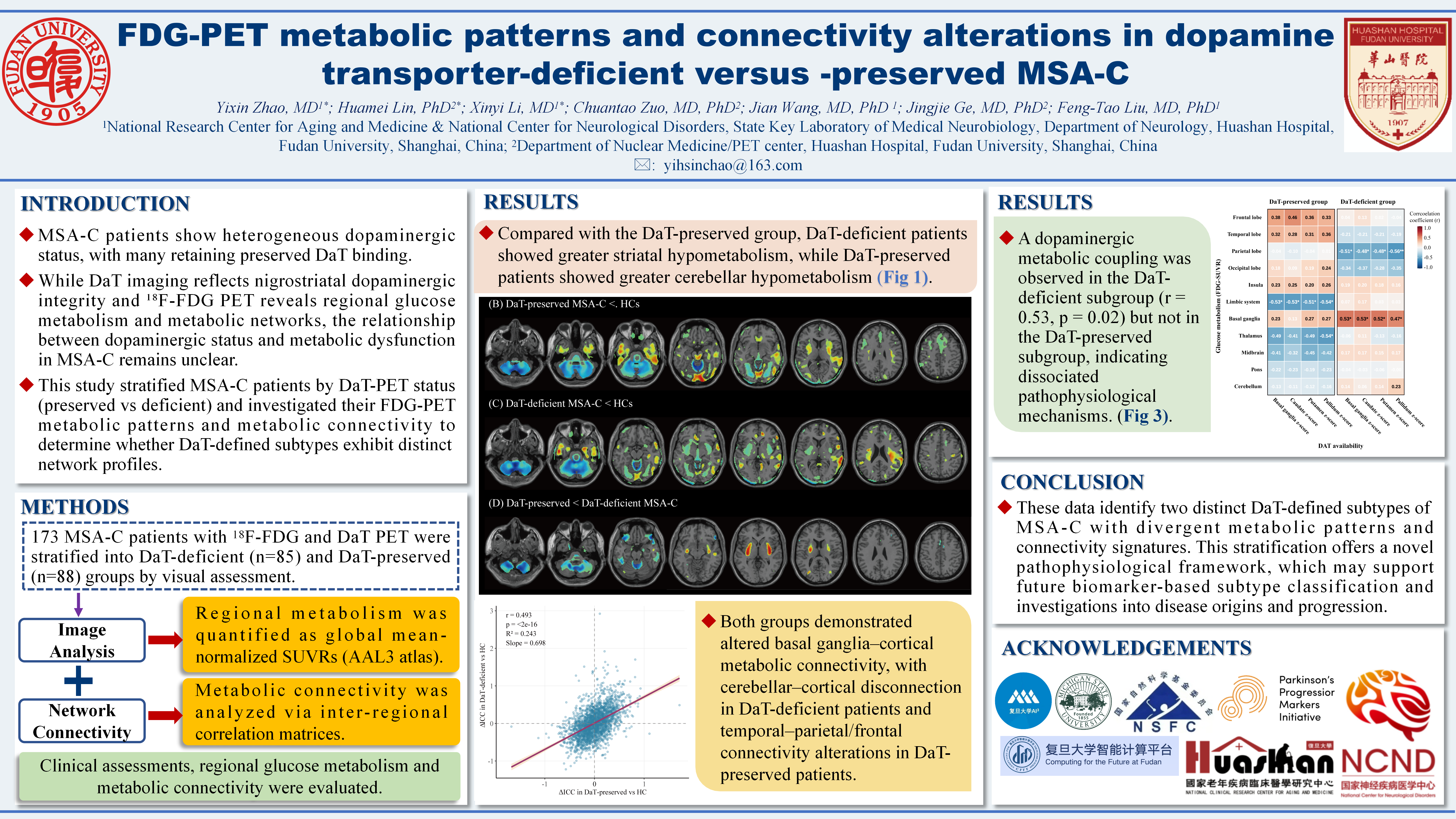
Objective: In this study, we stratified MSA-C patients by DaT-PET binding status (preserved vs deficient) and compared their 18F-FDG PET metabolic patterns and inter-regional metabolic connectivity. We aimed to test whether DaT-defined MSA-C subtypes exhibit distinct metabolic and network profiles, which could support a refined, biomarker-based subtype classification and improve diagnostic precision.
Background: Multiple system atrophy cerebellar type (MSA-C) is defined by progressive ataxia, yet a substantial proportion of patients present with parkinsonism despite preserved dopaminergic integrity, suggesting underlying pathophysiological diversity that remains poorly characterized.
Method: We retrospectively analyzed 173 MSA-C patients who underwent both 18F-fluorodeoxyglucose (18F-FDG) and dopamine transporter (DaT) PET imaging. Based on visual DaT assessment, patients were categorized into DaT-deficient (n=85) and DaT-preserved (n=88) subgroups. Clinical assessments, regional glucose metabolism and metabolic connectivity were evaluated.
Results: ur results revealed two distinct MSA-C subtypes: DaT-preserved patients showed more pronounced cerebellar hypometabolism, whereas DaT-deficient patients exhibited more severe striatal hypometabolism. A critical dissociation was observed in the correlation between dopaminergic and metabolic integrity: a positive coupling in the DaT-deficient subgroup (r=0.53, p=0.02) was absent in the DaT-preserved subgroup. Both subgroups showed altered basal ganglia-cortical metabolic connectivity, with DaT-deficient patients exhibiting cerebellar-cortical disconnection and DaT-preserved patients showing selective temporal-parietal and temporal-frontal connectivity changes.
Conclusion: These data identify two distinct DaT-defined subtypes of MSA-C with divergent metabolic patterns and connectivity signatures. This stratification offers a novel pathophysiological framework, which may support future biomarker-based subtype classification and investigations into disease origins and progression.
EPOSTER
References: References
1. Stefanova N, Bücke P, Duerr S, Wenning GK. Multiple system atrophy: an update. Lancet Neurol 2009;8(12):1172-1178.
2. Poewe W, Stankovic I, Halliday G, et al. Multiple system atrophy. Nat Rev Dis Primers 2022;8(1):56.
3. Miki Y, Foti SC, Asi YT, et al. Improving diagnostic accuracy of multiple system atrophy: a clinicopathological study. Brain 2019;142(9):2813-2827.
4. McKinley J, O’Connell M, Farrell M, Lynch T. Normal dopamine transporter imaging does not exclude multiple system atrophy. Parkinsonism Relat Disord 2014;20(8):933-934.
5. Yang YJ, Zhao YX, Li XY, Zuo CT. New Targets for Positron Emission Tomography Imaging in Parkinson’s Disease. Semin Nucl Med 2025;55(5):9.
6. Shen B, Wei S, Ge J, et al. Reproducible metabolic topographies associated with multiple system atrophy: Network and regional analyses in Chinese and American patient cohorts. Neuroimage Clin 2020;28:102416.
7. Tomše P, Rebec E, Studen A, et al. Abnormal metabolic covariance patterns associated with multiple system atrophy and progressive supranuclear palsy. Phys Med 2022;98:131-138.
8. Lee PH, An Y-S, Yong SW, Yoon SN. Cortical metabolic changes in the cerebellar variant of multiple system atrophy: a voxel-based FDG-PET study in 41 patients. Neuroimage 2008;40(2):796-801.
9. Lyoo CH, Jeong Y, Ryu YH, et al. Effects of disease duration on the clinical features and brain glucose metabolism in patients with mixed type multiple system atrophy. Brain 2008;131(Pt 2):438-446.
10. Ghaemi M, Hilker R, Rudolf J, Sobesky J, Heiss WD. Differentiating multiple system atrophy from Parkinson’s disease: contribution of striatal and midbrain MRI volumetry and multi-tracer PET imaging. J Neurol Neurosurg Psychiatry 2002;73(5):517-523.
11. Kim HW, Kim JS, Oh M, et al. Different loss of dopamine transporter according to subtype of multiple system atrophy. Eur J Nucl Med Mol Imaging 2016;43(3):517-525.
12. Stockbauer A, Beyer L, Huber M, et al. Metabolic network alterations as a supportive biomarker in dementia with Lewy bodies with preserved dopamine transmission. Eur J Nucl Med Mol Imaging 2024;51(4):1023-1034.
13. Muñoz E, Iranzo A, Rauek S, et al. Subclinical nigrostriatal dopaminergic denervation in the cerebellar subtype of multiple system atrophy (MSA-C). J Neurol 2011;258(12):2248-2253.
14. Ryu H-S, Oh M, Oh JS, et al. Distinct clinical features of predominant pre-synaptic and trans-synaptic nigrostriatal dysfunction in multiple system atrophy. J Neurol Sci 2019;402:100-106.
15. Ko JH, Lee CS, Eidelberg D. Metabolic network expression in parkinsonism: Clinical and dopaminergic correlations. J Cereb Blood Flow Metab 2017;37(2):683-693.
16. Schindlbeck KA, Eidelberg D. Network imaging biomarkers: insights and clinical applications in Parkinson’s disease. Lancet Neurol 2018;17(7):629-640.
17. Wenning GK, Stankovic I, Vignatelli L, et al. The Movement Disorder Society Criteria for the Diagnosis of Multiple System Atrophy. Mov Disord 2022;37(6):1131-1148.
18. Tian M, Zuo C, Cahid Civelek A, et al. International consensus on clinical use of presynaptic dopaminergic positron emission tomography imaging in parkinsonism. Eur J Nucl Med Mol Imaging 2023.
19. Julayanont P, Tangwongchai S, Hemrungrojn S, et al. The Montreal Cognitive Assessment-Basic: A Screening Tool for Mild Cognitive Impairment in Illiterate and Low-Educated Elderly Adults. J Am Geriatr Soc 2015;63(12):2550-2554.
20. Wenning GK, Tison F, Seppi K, et al. Development and validation of the Unified Multiple System Atrophy Rating Scale (UMSARS). Mov Disord 2004;19(12):1391-1402.
21. Wu L, Liu F-T, Ge J-J, et al. Clinical characteristics of cognitive impairment in patients with Parkinson’s disease and its related pattern in 18 F-FDG PET imaging. Hum Brain Mapp 2018;39(12):4652-4662.
22. Shen C, Chen Q-S, Zuo C-T, Liu F-T, Wang J. The Frontal and Cerebellar Metabolism Related to Cognitive Dysfunction in Multiple System Atrophy. Front Aging Neurosci 2022;14:788166.
23. Rolls ET, Huang C-C, Lin C-P, Feng J, Joliot M. Automated anatomical labelling atlas 3. Neuroimage 2020;206:116189.
24. Huber M, Beyer L, Prix C, et al. Metabolic Correlates of Dopaminergic Loss in Dementia with Lewy Bodies. Mov Disord 2020;35(4):595-605.
25. Vergnet S, Hives F, Foubert-Samier A, et al. Dopamine transporter imaging for the diagnosis of multiple system atrophy cerebellar type. Parkinsonism Relat Disord 2019;63:199-203.
26. Wenning GK, Jellinger KA. The role of alpha-synuclein in the pathogenesis of multiple system atrophy. Acta Neuropathol 2005;109(2):129-140.
27. Jost WH, Rau A, Brumberg J, Urbach H, Meyer PT, Schröter N. Neuroimaging in multiple system atrophy: clinical implications and novel developments. J Neural Transm (Vienna) 2025.
28. Kim HW, Kim JS, Oh M, et al. Different loss of dopamine transporter according to subtype of multiple system atrophy. Eur J Nucl Med Mol Imaging 2015;43(3):517-525.
29. Mak E, Przybelski SA, Wiste HJ, et al. Influence of alpha-synuclein on glucose metabolism in Alzheimer’s disease continuum: Analyses of α-synuclein seed amplification assay and FDG-PET. Alzheimers Dement 2025;21(2):e14571.
30. Brettschneider J, Suh E, Robinson JL, et al. Converging Patterns of α-Synuclein Pathology in Multiple System Atrophy. J Neuropathol Exp Neurol 2018;77(11):1005-1016.
31. Brettschneider J, Irwin DJ, Boluda S, et al. Progression of alpha-synuclein pathology in multiple system atrophy of the cerebellar type. Neuropathol Appl Neurobiol 2017;43(4):315-329.
32. Cykowski MD, Coon EA, Powell SZ, et al. Expanding the spectrum of neuronal pathology in multiple system atrophy. Brain 2015;138(Pt 8):2293-2309.
To cite this abstract in AMA style:
Y. Zhao, H. Lin, X. Li, J. Ge, F. Liu. Distinct FDG-PET metabolic patterns and connectivity alterations in dopamine transporter-deficient versus -preserved MSA-C [abstract]. Mov Disord. 2026; 41 (suppl 1). https://www.mdsabstracts.org/abstract/distinct-fdg-pet-metabolic-patterns-and-connectivity-alterations-in-dopamine-transporter-deficient-versus-preserved-msa-c/. Accessed October 1, 2026.« Back to 2026 International Congress
MDS Abstracts - https://www.mdsabstracts.org/abstract/distinct-fdg-pet-metabolic-patterns-and-connectivity-alterations-in-dopamine-transporter-deficient-versus-preserved-msa-c/