
Objective: We aimed to determine the prevalence of non-motor symptoms in people with Parkinson’s disease.
Background: Parkinson’s disease is the second most common neurodegenerative disease worldwide characterized by motor and non-motor symptoms [1]. Non-motor symptoms are less well described compared to motor symptoms. They include cognitive impairment, sleep problems, hyposmia/anosmia, behavior changes and autonomic dysfunction. They are a major cause of disability and hospital visits.
Method: We carried out a cross sectional study of 157 PwP in two referral hospitals in rural and urban Tanzania namely Kilimanjaro Christian Medical Center (KCMC) in Kilimanjaro Region and Muhimbili National Hospital (MNH) in Dar es Salaam Region respectively. Selection of these hospitals was based on a high number of People with Parkinson’s disease (PwP) who attend outpatient clinics regularly. KCMC recruitment included PwP attending neurology outpatient clinics and those identified from a prevalence study in Hai District, Kilimanjaro Region. We then analysed the magnitude of non-motor symptoms among people with Parkinson’s disease. Cognitive impairment was defined as MoCA <26, probable RBD as RBDSQ≥6, depression as HADS≥11 and anxiety as HADS≥11. Autonomic symptoms including constipation, hyposmia, urinary frequency and urgency were self-reported by patients as present or absent
Results: The analysis was based on data from 157 PwP. The most prevalent non-motor symptom was cognitive impairment (83.6%) and the least prevalent was hyposmia (31.8%). Autonomic dysfunction was the next most prevalent non-motor symptom with urinary frequency (58.1%), urinary urgency (53.2%) and constipation (51.9%) contributing between 50%-60% of the non-motor symptoms. Probable RBD (RBDSQ≥6) was found in half (51.6%) of PwP. Behavior changes comprised of 41.3% for depression and 35.5% for anxiety in PwP.
Conclusion: The prevalence of non-motor symptoms is high among PwP in Tanzania. This is in keeping with findings in other parts of Africa [2] and beyond Africa [3]. Addressing these symptoms when managing Parkinson’s disease would help reduce their severity and improve quality of life in people with these symptoms.
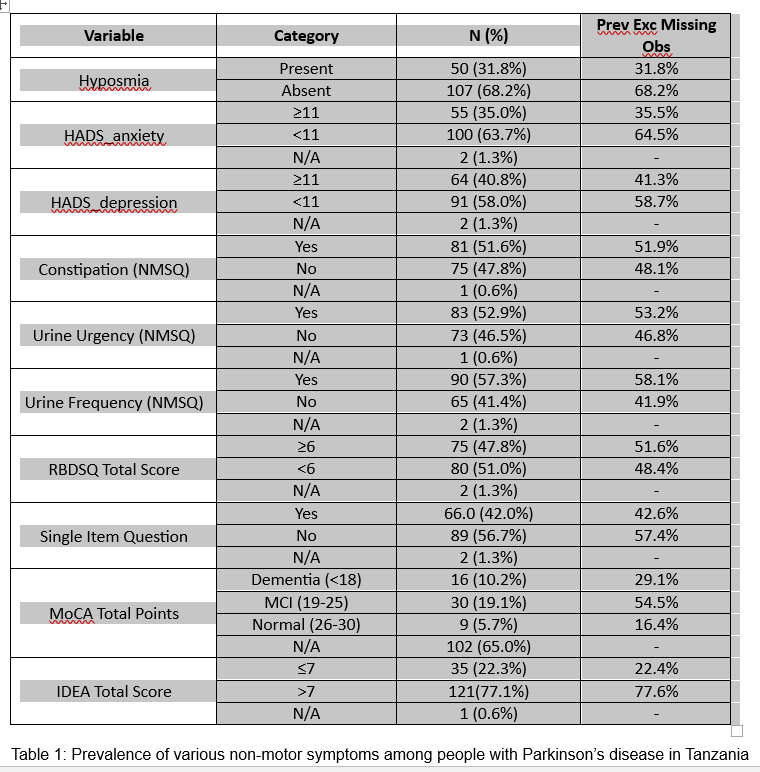
Table 1
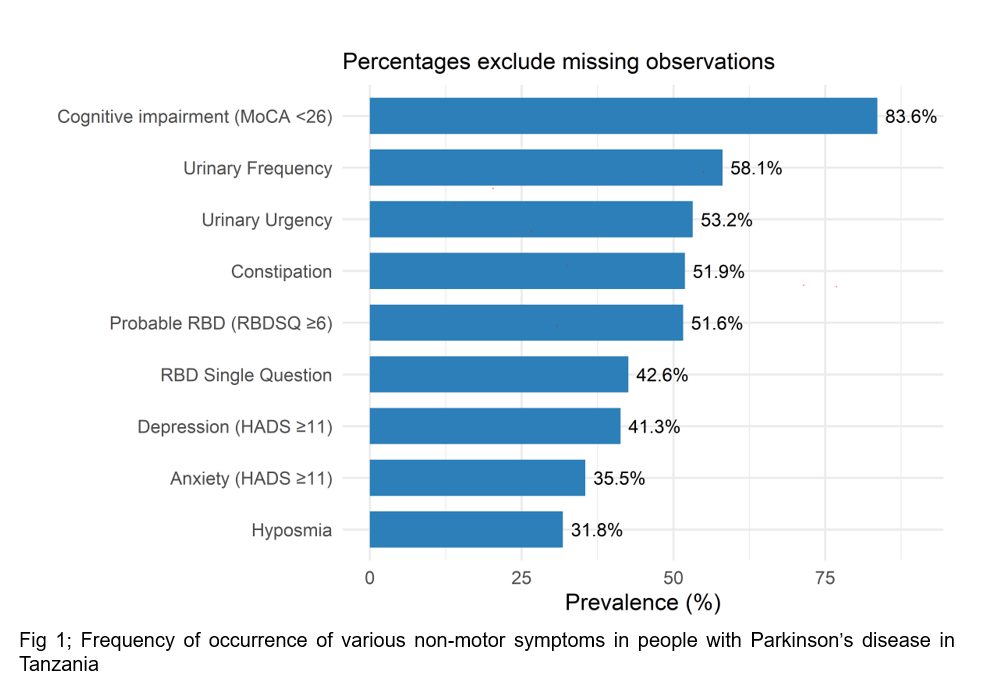
Figure 1
References: 1. Mhyre TR, Boyd JT, Hamill RW, Maguire-Zeiss KA. Parkinson’s disease. Subcell Biochem. 2012;65:389-455. doi: 10.1007/978-94-007-5416-4_16. PMID: 23225012; PMCID: PMC4372387.
2. Ayele BA, Zewde YZ, Tafesse A, Sultan A, Friedman JH, Bower JH. Non-Motor Symptoms and Associated Factors in Parkinson’s Disease Patients in Addis Ababa, Ethiopia: A Multicenter Cross-Sectional Study. Ethiop J Health Sci. 2021 Jul;31(4):837-846. doi: 10.4314/ejhs.v31i4.19. PMID: 34703184; PMCID: PMC8512934.
3. Karri M, Ramasamy B, Kalidoss R. Prevalence of Non-motor Symptoms in Parkinson’s Disease and Its Impact on Quality of Life in Tertiary Care Center in India. Ann Indian Acad Neurol. 2020 May-Jun;23(3):270-274. doi: 10.4103/aian.AIAN_10_19. Epub 2020 Jun 10. PMID: 32606511; PMCID: PMC7313565.
To cite this abstract in AMA style:
B. Mushengezi, K. Okeng'O, R. Walker, M. Mng'Ong'O, E. Massawe, M. Dekker, N. Okubadejo, P. Adebayo, N. Fothergill-Misbah, Y. Okkaoglu, S. Urasa. Magnitude of Non-Motor Symptoms Among People with Parkinson’s Disease in Rural and Urban Tanzania [abstract]. Mov Disord. 2026; 41 (suppl 1). https://www.mdsabstracts.org/abstract/magnitude-of-non-motor-symptoms-among-people-with-parkinsons-disease-in-rural-and-urban-tanzania/. Accessed October 1, 2026.« Back to 2026 International Congress
MDS Abstracts - https://www.mdsabstracts.org/abstract/magnitude-of-non-motor-symptoms-among-people-with-parkinsons-disease-in-rural-and-urban-tanzania/