
Objective: To develop a multi-channel time–frequency deep learning framework capable of identifying Parkinsonian gait dynamics from short locomotor segments and detecting PD-like motor state transitions in fall-prone older adults.
Background: Early detection of Parkinson’s disease (PD) remains challenging because overt motor symptoms typically emerge late in the disease course [1,2]. Subtle gait abnormalities may appear years earlier, yet objective approaches capturing transient motor instability remain limited. Older adults with recurrent unexplained falls may represent a population at elevated risk for prodromal PD, but quantitative tools to characterize PD-like motor dynamics in this group remain scarce [3,4].
Method: A total of 211 participants (PD, n=50; fall-prone older adults, n=161) completed wearable inertial sensor–based gait assessments under slower, preferred, and faster walking speeds. Sixteen bilateral IMU channels were transformed into continuous wavelet transform scalograms and used to train convolutional neural networks with subject-wise stratified five-fold cross-validation. Segment-level predictions were post-processed using smoothing and hysteresis rules. At the subject level, a transition was defined as sustained entry into a PD-like motor state using an operating threshold corresponding to a 5% false-positive rate.
Results: The multi-channel model achieved high segment-level discrimination across walking speeds (ROC–AUC: faster 0.992 ± 0.007; preferred 0.974 ± 0.016; slower 0.975 ± 0.017), outperforming representative single-channel models (AUC ~0.65–0.75) (Figure 1). At the subject level, transition detection at the 5% false-positive operating point achieved high sensitivity (0.96–1.00) and strong specificity (0.857–0.913) across walking speeds (Table 1). Transition-positive individuals showed significantly higher mean PD-likeness scores and a greater proportion of high PD-like segments (all p < 0.001).
Conclusion: Multi-channel time–frequency deep learning enables identification of PD-like gait states from short walking segments and provides interpretable transition metrics reflecting sustained Parkinsonian motor dynamics. This framework may support motor risk stratification in fall-prone older adults and facilitate earlier detection of Parkinsonian motor vulnerability using wearable sensing technologies.
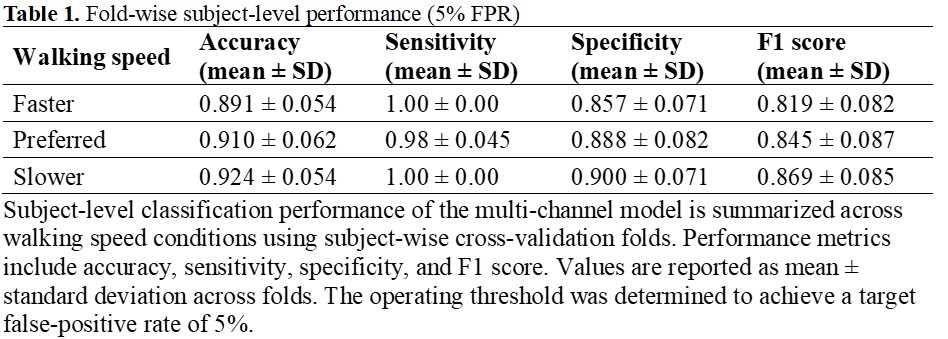
Table 1
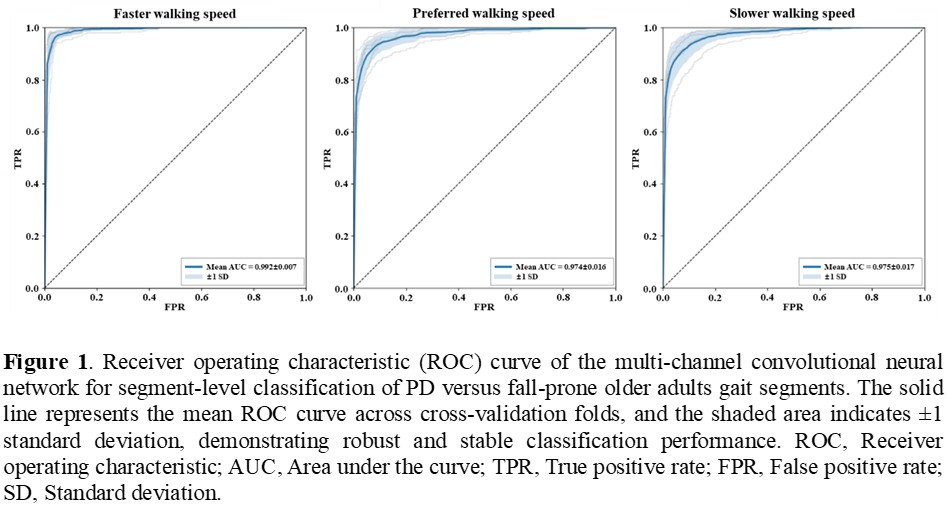
Figure 1
References: [1] Maetzler, W., Mirelman, A., Pilotto, A., & Bhidayasiri, R. (2024). Identifying subtle motor deficits before Parkinson’s disease is diagnosed: what to look for?. Journal of Parkinson’s Disease, 14(s2), S287-S296.
[2] Postuma, R. B., Berg, D., Stern, M., Poewe, W., Olanow, C. W., Oertel, W., … & Deuschl, G. (2015). MDS clinical diagnostic criteria for Parkinson’s disease. Movement disorders, 30(12), 1591-1601.
[3] Mancini, M., Afshari, M., Almeida, Q., Amundsen-Huffmaster, S., Balfany, K., Camicioli, R., … & Corcos, D. M. (2025). Digital gait biomarkers in Parkinson’s disease: Susceptibility/risk, progression, response to exercise, and prognosis. npj Parkinson’s Disease, 11(1), 51.
[4] Bradley, M., O’Loughlin, S., Donlon, E., Gallagher, A., O’Keeffe, C., Inocentes, J., … & Fearon, C. (2025). Determining falls risk in people with Parkinson’s disease using wearable sensors: A systematic review. Sensors, 25(13), 4071.
To cite this abstract in AMA style:
B. Kim, C. Youm, J. Hwang, M. Kim, S. Cheon. Segment-Level Gait Dynamics Reveal Parkinsonian Motor Signatures in Fall-Prone Older Adults Using Multi-Channel Time–Frequency Deep Learning [abstract]. Mov Disord. 2026; 41 (suppl 1). https://www.mdsabstracts.org/abstract/segment-level-gait-dynamics-reveal-parkinsonian-motor-signatures-in-fall-prone-older-adults-using-multi-channel-time-frequency-deep-learning/. Accessed October 1, 2026.« Back to 2026 International Congress
MDS Abstracts - https://www.mdsabstracts.org/abstract/segment-level-gait-dynamics-reveal-parkinsonian-motor-signatures-in-fall-prone-older-adults-using-multi-channel-time-frequency-deep-learning/