
Category: Drug-Induced Movement Disorders
Objective: Parkinson’s disease (PD) is characterized by disrupted dopaminergic signaling within the basal ganglia circuitry, particularly affecting the activity of subthalamic nucleus (STN) neurons [1, 2]. This study aimed to quantitatively examine the interaction between dopamine D2 receptors (D2R) and voltage-gated N-type calcium channels in STN neurons and to evaluate how this interaction influences neuronal excitability and firing dynamics relevant to Parkinson’s disease.
Background: Dopamine receptors can modulate intracellular signaling cascades that regulate ion channel conductance, potentially influencing membrane potential stability and neuronal firing patterns.
Method: A in silico modeling framework was developed to analyze the interaction between dopaminergic signaling and ion channel activity in STN neurons. First, experimentally reported electrophysiological parameters of STN ion channels were incorporated into a biophysical neuron model. Second, signaling pathways associated with G-protein–coupled D2 receptors were implemented to simulate modulation of cyclic AMP (cAMP). Third, pharmacological simulations were performed using dopamine receptor agonists to assess their influence on membrane potential dynamics.
Results: Model simulations demonstrated that activation of dopamine receptors by the agonist bromocriptine (10 µM) produced a shift in the half-activation voltage of N-type Ca²⁺ channels toward more depolarized potentials. This shift reduced the effective window current associated with these channels and led to a decrease in action potential firing frequency in STN neurons. Under a simulated 100 pA current injection, dopamine receptor activation produced a measurable reduction in neuronal excitability. The decrease in firing rate (Figure 1) was associated with a coordinated reduction in membrane window currents and changes in potassium channel conductance that stabilized the resting membrane potential.
Conclusion: The computational results suggest that dopaminergic modulation of calcium and potassium channel dynamics significantly influences STN neuronal activity in Parkinson’s disease. Targeting potassium channel pathways, in combination with dopamine receptor signaling, may represent a promising therapeutic strategy for regulating abnormal basal ganglia activity and improving neurological function in PD.
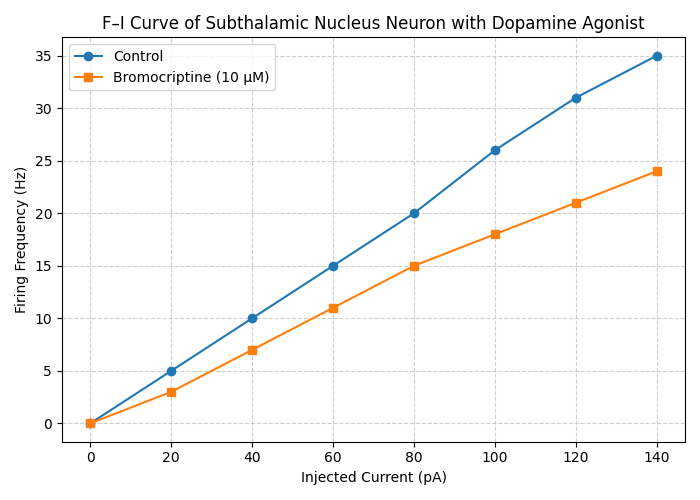
Figure 1
References: 1. Mahapatra C., Manchanda R. Computational assessment of calcium channel effects on subthalamic nucleus neuronal activity in Parkinson’s disease. Movement Disorders. 2016.
2. Surmeier D. J., Obeso J. A., Halliday G. M. Selective neuronal vulnerability in Parkinson’s disease. Nature Reviews Neuroscience. 2017.
To cite this abstract in AMA style:
A. Pradhan. In Silico Investigation of Dopamine Receptor–Calcium Channel Coupling in Subthalamic Nucleus Neurons: Implications for Parkinson’s Disease Therapy [abstract]. Mov Disord. 2026; 41 (suppl 1). https://www.mdsabstracts.org/abstract/in-silico-investigation-of-dopamine-receptor-calcium-channel-coupling-in-subthalamic-nucleus-neurons-implications-for-parkinsons-disease-therapy/. Accessed October 1, 2026.« Back to 2026 International Congress
MDS Abstracts - https://www.mdsabstracts.org/abstract/in-silico-investigation-of-dopamine-receptor-calcium-channel-coupling-in-subthalamic-nucleus-neurons-implications-for-parkinsons-disease-therapy/