
Category: Parkinson's Disease: Surgical Therapy
Objective: To describe our single center experience with implementing adaptive deep brain stimulation (aDBS) strategies into a high-volume neuromodulation center.
Background: Adaptive deep brain stimulation is a novel stimulation paradigm that was recently FDA approved for the treatment of Parkinson’s disease. In aDBS, the stimulation amplitude is automatically adjusted based on electrophysiological markers that are correlated with motor symptom severity. We present a single center experience of implementing aDBS in a real-world clinic environment.
Method: We conducted a prospective study of Parkinson’s disease patients with sensing-enabled DBS devices (Medtronic Percept) who activated aDBS between March 2025 and January 2026. A comprehensive electrophysiological assessment consisting of local field potential (LFP) recordings during monopolar review in the medication OFF and medication ON states was conducted using the best existing DBS parameters. The degree of beta (13-30 Hz) power modulation via levodopa and neuromodulation were taken into account to determine optimal adaptive configurations. The patients’ subjective experience and electrophysiologic recordings were collected.
Results: We present the results of the first 50 patients to participate in the University of Florida adaptive DBS program. Of these, 1 declined aDBS activation after electrophysiologic assessment and 3 developed problematic non-motor symptoms confounding the aDBS trial period. The experiences of 46 subjects (36 male, 10 female) were subsequently analyzed. The mean (SD) age at the time of aDBS activation was 66.9 (10.2) years. The mean (SD) disease duration and DBS duration were 14.2 (5.4) years and 3.4 (2.8) years respectively. 6 (13.0%) patients were set up on single threshold, 11 (23.9%) patients were set up on dual threshold, 11 (23.9%) patients were set up on single threshold with contralateral sensing, 2 (4.3%) patients were set up on dual threshold with contralateral sensing, and 16 (34.8%) patients were set up on pseudo single threshold. 30 (65.2%) patients found aDBS to be the same or better than their conventional DBS settings.
Conclusion: We report our single center experience for implementing aDBS in a high-volume neuromodulation center. The majority of subjects reported favorable responses to the aDBS paradigm after a single visit. Further investigations are needed to determine the optimal workflow given the high variability of electrophysiologic signals in the real world.
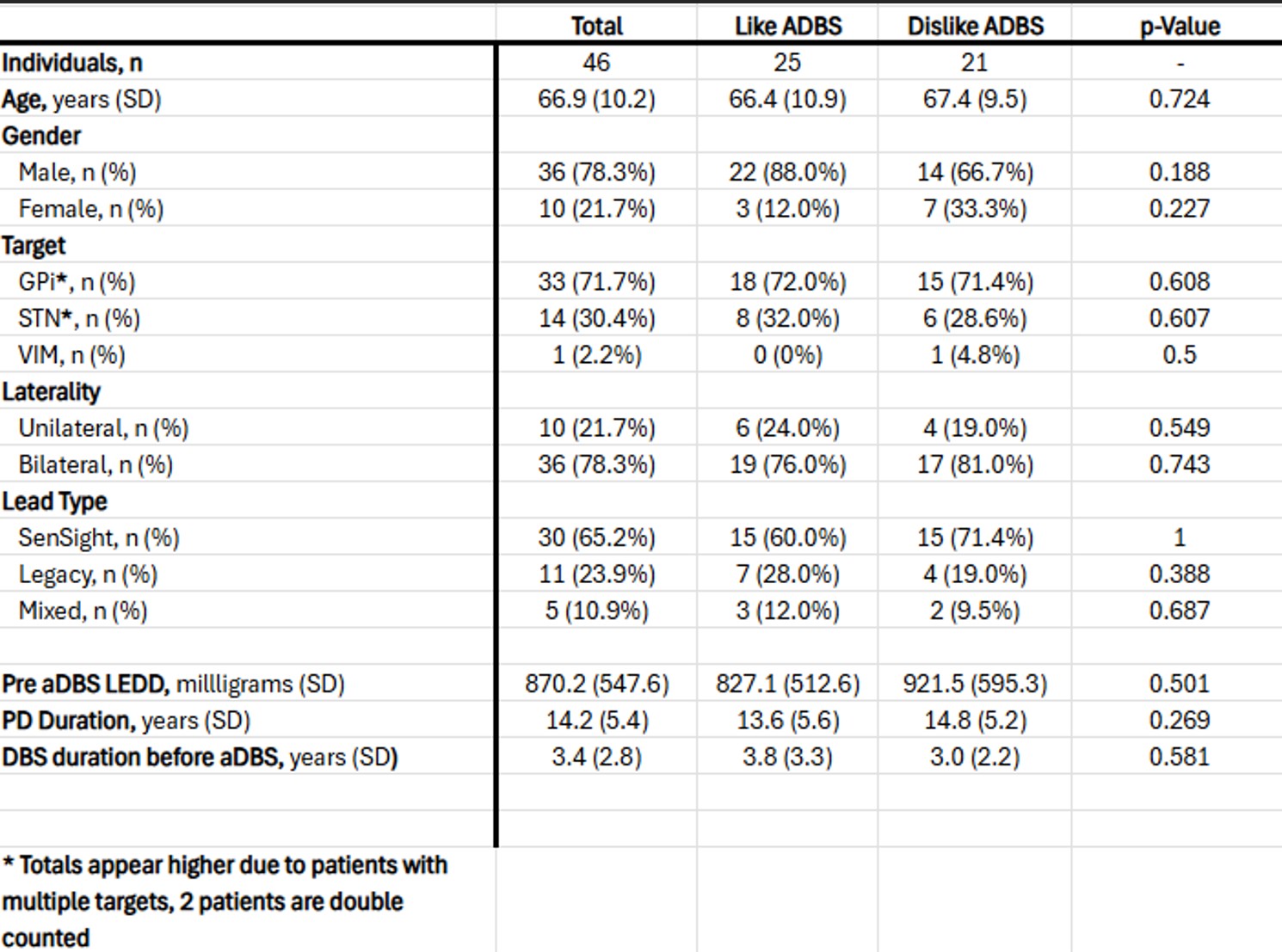
Table 1: aDBS Demographic Data
To cite this abstract in AMA style:
A. Madamangalam, D. Vuddandam, J. Cagle, J. Wong, C. de Hemptinne. The UF Adaptive Deep Brain Stimulation Experience [abstract]. Mov Disord. 2026; 41 (suppl 1). https://www.mdsabstracts.org/abstract/the-uf-adaptive-deep-brain-stimulation-experience/. Accessed October 1, 2026.« Back to 2026 International Congress
MDS Abstracts - https://www.mdsabstracts.org/abstract/the-uf-adaptive-deep-brain-stimulation-experience/