
Objective: To investigate plasma cytokines and chemokines with clinical correlations between Parkinson’s disease (PD) patients carrying LRRK2 p.G2385R and/or p.R1628P variants, idiopathic PD (iPD), and healthy controls.
Background: Peripheral inflammation is one of the pathological features in PD yet understanding of inflammation in Asian-prevalent LRRK2 p.G2385R and p.R1628P variants, each affecting 5-10% of PD patients, remains limited.
Method: This study included 240 participants, comprising PD-G2385R (n=53), PD-R1628P (n=58), PD-G2385R+R1628P (n=5), age- and sex-matched iPD (n=62), and healthy controls (HC; n=62) who were negative for p.G2385R and p.R1628P. Exclusion criteria were recent vaccination, acute illness, presence of autoimmune diseases, use of steroids or immune-modulating therapy, and inability to complete assessments. Plasma IL-6, TNF-α, CCL2, CX3CL1, CCL5 and VCAM-1 were measured using multiplexed immunoassay. Clinical severity was evaluated using standardised MDS-UPDRS, CISI-PD, and MoCA ratings.
Results: Compared to iPD and/or HC, TNF-α, CX3CL1, and CCL5 were significantly lower in PD-G2385R and IL-6, TNF-α, CCL2, and CCL5 were reduced in PD-R1628P [figure1]. Among PD patients, lower plasma TNF-α levels were associated with higher LRRK2 kinase activity. Higher CX3CL1 was correlated with greater motor severity in iPD, but it indicated less disability in both PD-G2385R and PD-R1628P [figure2]. In PD-G2385R, higher plasma CCL5 was correlated with fewer motor response complications, whereas in PD-R1628P, IL-6 and VCAM-1 were correlated with greater disability and/or poorer cognition.
Conclusion: PD-G2385R and PD-R1628P patients exhibited a mild but significantly reduced peripheral inflammatory profile, distinct from that in iPD. These findings suggest that the inflammatory profile in PD differs by LRRK2 genotype and may not follow a straightforward, uniformly proinflammatory pattern, which is an important factor to consider in anti-inflammatory PD trials.
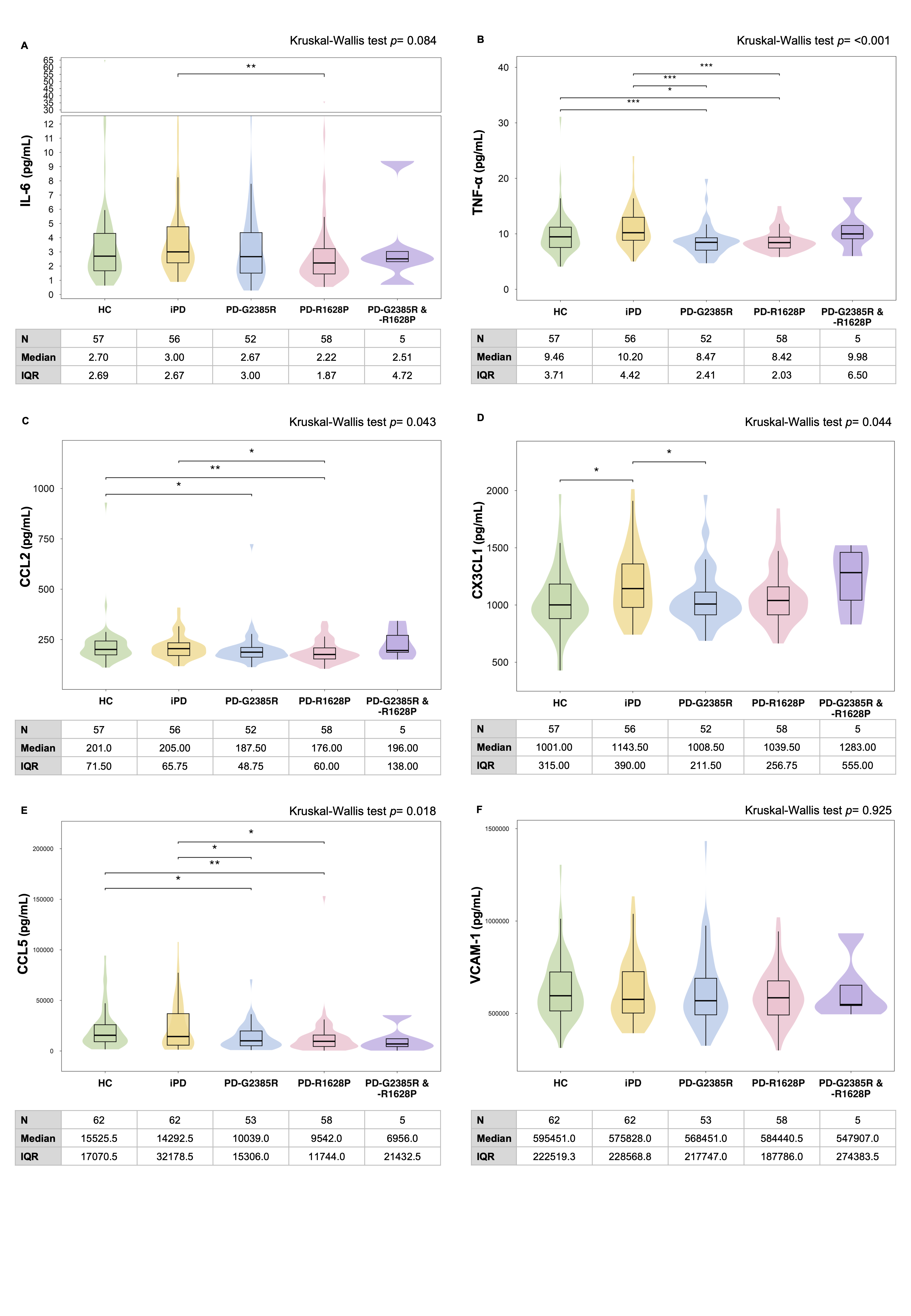
figure1
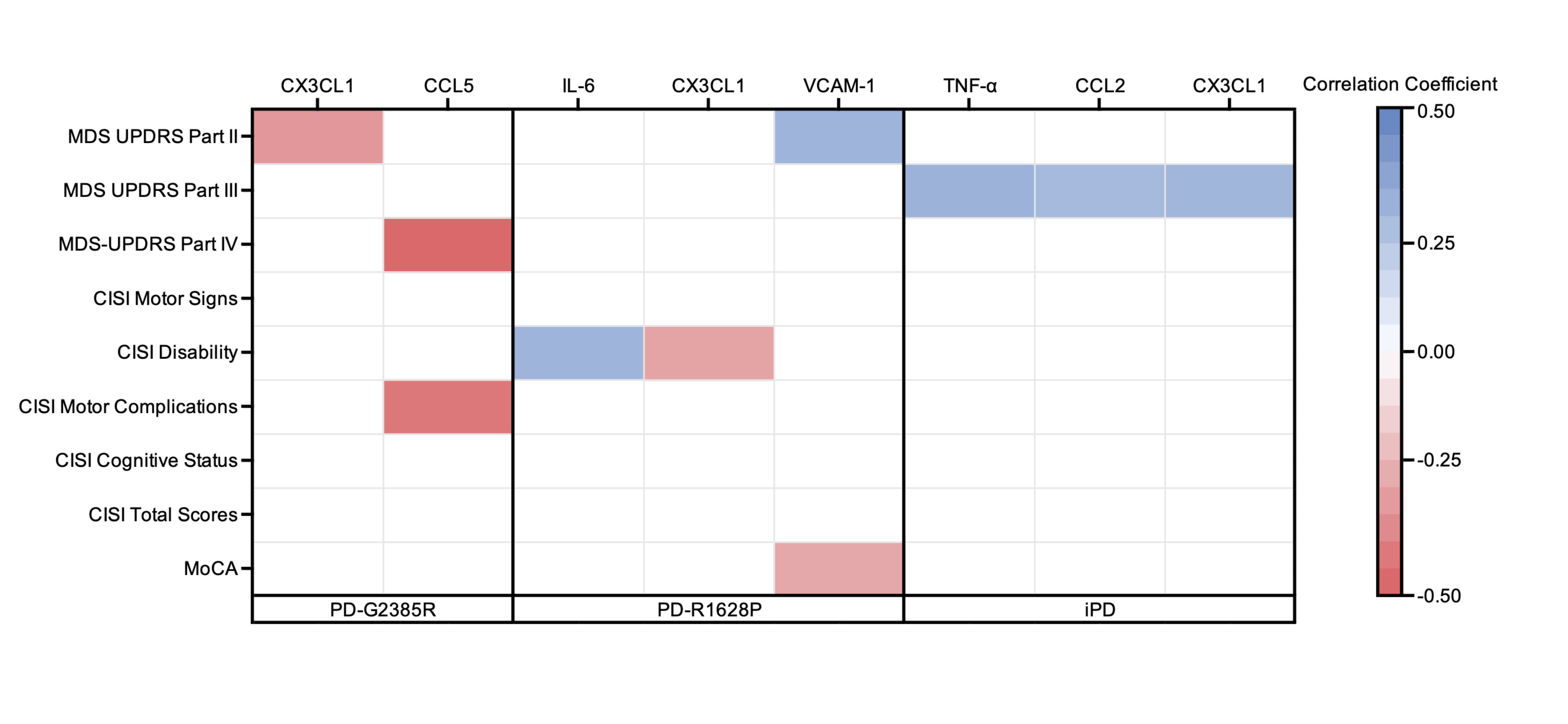
figure2
References: [1] Morris, H. R., Spillantini, M. G., Sue, C. M., & Williams-Gray, C. H. (2024). The pathogenesis of Parkinson’s disease. Parkinson’s Disease, 403(10423), 293–304. https://doi.org/10.1016/S0140-6736(23)01478-2
[2] Simpson, C., Vinikoor-Imler, L., Nassan, F. L., Shirvan, J., Lally, C., Dam, T., & Maserejian, N. (2022). Prevalence of ten LRRK2 variants in Parkinson’s disease: A comprehensive review. Parkinsonism & Related Disorders, 98, 103–113. https://doi.org/10.1016/j.parkreldis.2022.05.012
To cite this abstract in AMA style:
HX. Ding, TS. Toh, NJ. Zulkefli, NS. Zulhaimi, AN. Khairul Anuar, JW. Hor, YW. Tay, IX. Kong, YC. Pang, R. Rajasuriar, SY. Lim, AH. Tan, LC. Lit. Peripheral Inflammatory Markers and Clinical Correlations in Parkinson’s Disease Patients Carrying LRRK2 G2385R and R1628P Variants [abstract]. Mov Disord. 2026; 41 (suppl 1). https://www.mdsabstracts.org/abstract/peripheral-inflammatory-markers-and-clinical-correlations-in-parkinsons-disease-patients-carrying-lrrk2-g2385r-and-r1628p-variants/. Accessed October 1, 2026.« Back to 2026 International Congress
MDS Abstracts - https://www.mdsabstracts.org/abstract/peripheral-inflammatory-markers-and-clinical-correlations-in-parkinsons-disease-patients-carrying-lrrk2-g2385r-and-r1628p-variants/