
Category: Parkinson's Disease: Surgical Therapy
Objective: To evaluate motor improvement after bilateral STN-DBS in patients with Parkinson’s disease in the Dominican Republic. Secondary objectives included assessing reduction in dopaminergic medication load, changes in activities of daily living, evolution of motor complications, and stimulation-related adverse events.
Background: Deep brain stimulation of the subthalamic nucleus (STN-DBS) is an established therapy for advanced Parkinson’s disease (PD). However, clinical data from Caribbean countries remain scarce. DBS has only recently been introduced in the Dominican Republic, and outcomes from local programs have not yet been reported.
Method: We conducted a retrospective case series of patients with PD who underwent bilateral STN-DBS at a single tertiary center between 2024 and 2025. Motor outcomes were assessed using the MDS-UPDRS part III before surgery and at 1, 3, and 6 months postoperatively. Secondary outcomes included changes in levodopa equivalent daily dose (LEDD), UPDRS II and IV scores, Schwab & England functional scale, and quality-of-life measures. Stimulation-related adverse effects and surgical complications were recorded.
Results: Eight patients (mean age 61 years, mean disease duration 10 years) underwent bilateral STN-DBS. The mean preoperative MDS-UPDRS III OFF score was 55. Motor symptoms improved markedly after surgery, with mean UPDRS III scores of 11 at 1 month, 14 at 3 months, and 14 at 6 months, corresponding to approximately 70–75% motor improvement. Mean LEDD decreased from 957 mg preoperatively to 155 mg at 1 month and remained significantly reduced at 6 months (227 mg). Improvements in activities of daily living and motor complications were also observed. Stimulation-related adverse effects were mild and included dysarthria and mild dyskinesia, manageable with programming adjustments. One patient developed a postoperative infection of the DBS system requiring explantation of the device two months after implantation.
Conclusion: This study represents the first report of STN-DBS outcomes for Parkinson’s disease in the Dominican Republic. DBS was feasible and effective, with substantial motor improvement and marked reduction in dopaminergic medication, supporting the expansion of advanced movement disorder therapies in the Caribbean.
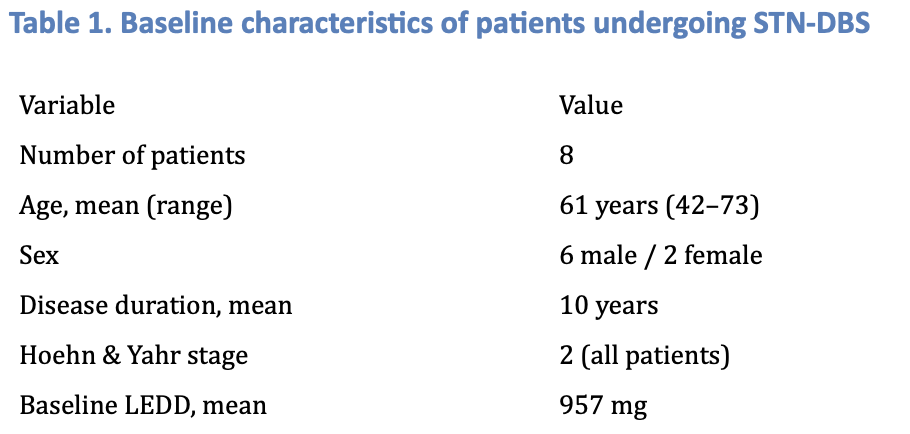
Patient characteristics
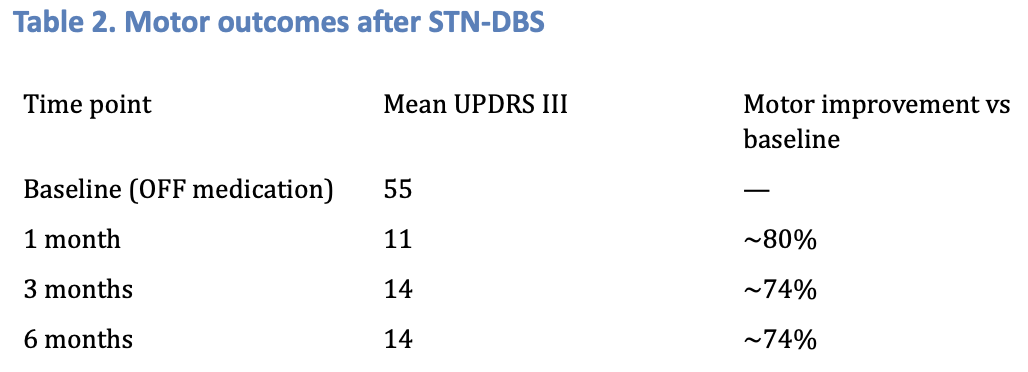
Motor outcome
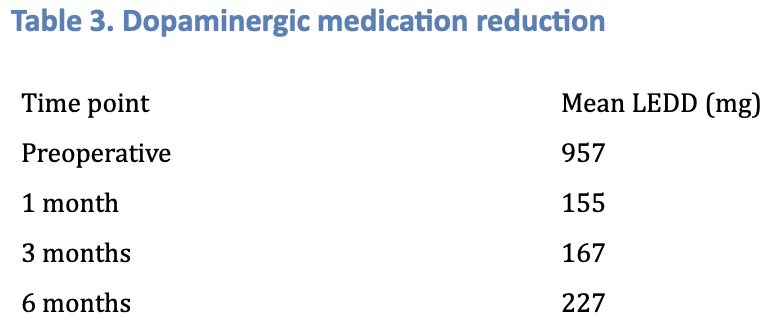
LEDD reduction
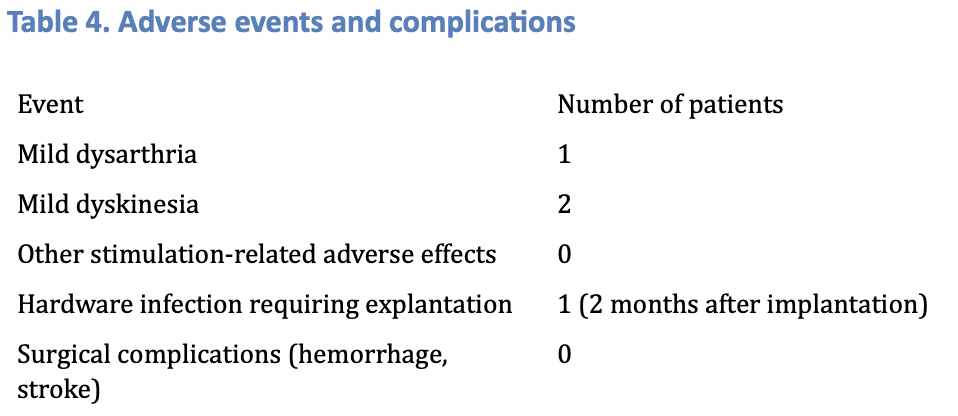
AEs and complications
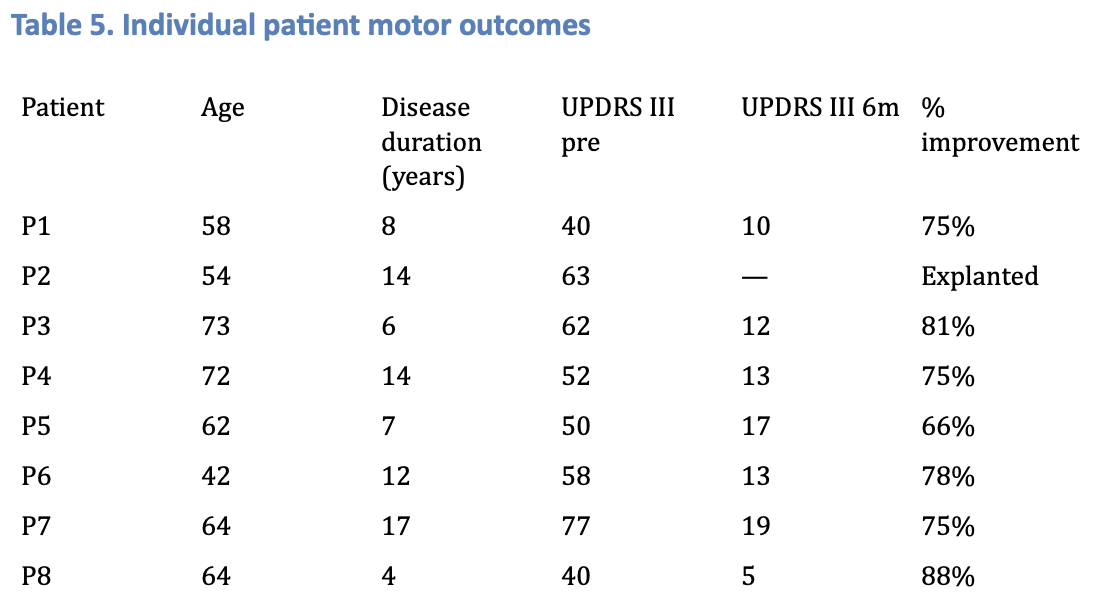
Individual motor outcome
To cite this abstract in AMA style:
W. Massih Montero, M. Espinosa Pérez, A. Segura Peña, V. Torres, A. Carreras, A. Pérez Fernández, K. Del Giudice. Clinical outcomes of deep brain stimulation for Parkinson’s disease in the Dominican Republic: results from a newly established single-center DBS program [abstract]. Mov Disord. 2026; 41 (suppl 1). https://www.mdsabstracts.org/abstract/clinical-outcomes-of-deep-brain-stimulation-for-parkinsons-disease-in-the-dominican-republic-results-from-a-newly-established-single-center-dbs-program/. Accessed October 1, 2026.« Back to 2026 International Congress
MDS Abstracts - https://www.mdsabstracts.org/abstract/clinical-outcomes-of-deep-brain-stimulation-for-parkinsons-disease-in-the-dominican-republic-results-from-a-newly-established-single-center-dbs-program/