
Objective: To evaluate whether video-based digital kinematic measures can quantify dose-dependent changes in finger tapping performance during deep brain stimulation (DBS) in Parkinson’s disease.
Background: DBS improves bradykinesia in Parkinson’s disease (PD), but objective quantification of motor changes during stimulation adjustment remains limited. Video-based kinematic analysis offers a scalable and objective approach to quantify digital movement measures associated with bradykinesia, including amplitude, speed, rhythm, and variability.
Method: Eleven PD patients with DBS (20 hands) performed repetitive finger tapping while stimulation amplitude was increased from 0 mA to the side-effect threshold in 0.5 mA increments. After each amplitude adjustment, participants rested for 30 seconds before performing 10 repetitions of index–thumb tapping with maximal movement amplitude. Videos were analyzed using VisionMD to extract digital kinematic measures previously associated with movement impairment in PD. Linear mixed-effects models with random intercepts and slopes for each hand tested the relationship between stimulation amplitude and each digital measure, including both linear and quadratic amplitude terms.
Results: Several digital measures demonstrated significant modulation with increasing DBS amplitude. Linear dose-response relationships were observed for mean movement amplitude (increase), amplitude variability (decrease), RMS velocity variability (decrease), amplitude decay (decrease), velocity decay (decrease), cycle duration (increase), and rate (decrease) (Table 1[Table 1]; Figure 1[Figure 1]). Additional measures, primarily reflecting movement speed and variability, showed nonlinear modulation across stimulation levels [Table 1]. Overall, DBS-responsive digital measures corresponded to established domains of bradykinesia, including movement amplitude, speed, rhythm, and sequence effect.
Conclusion: Video-derived digital kinematic measures detected dose-dependent motor changes during DBS modulation and captured multiple dimensions of bradykinesia. These findings support the use of video-based movement analysis as an objective and scalable tool for quantifying DBS-related motor effects.
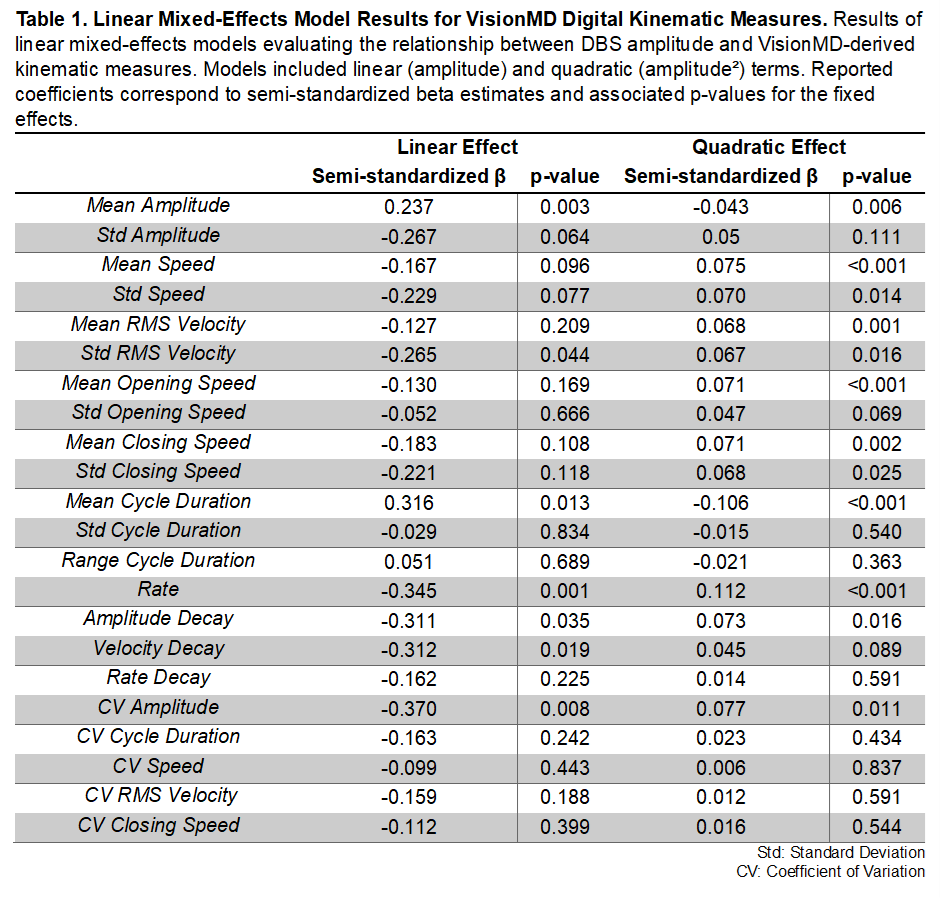
Table1
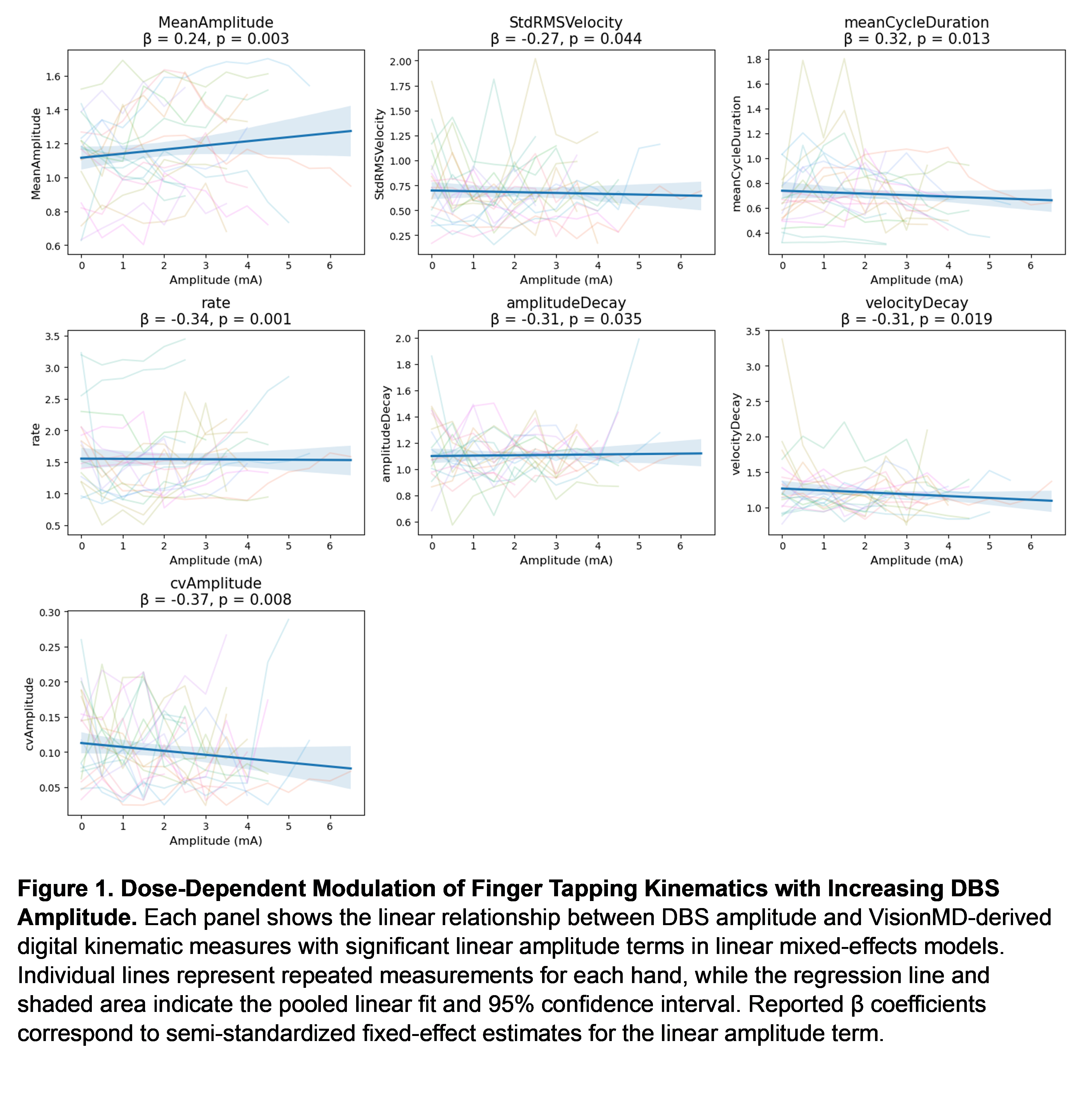
Figure1
To cite this abstract in AMA style:
G. Acevedo, D. Vuddandam, A. Madamangalam, G. Kenworthy, C. Dehemptinne, J. Cagle, J. Wong. Digital Kinematic Measures of Finger Tapping Detect Dose-Dependent Effects of Deep Brain Stimulation in Parkinson’s Disease [abstract]. Mov Disord. 2026; 41 (suppl 1). https://www.mdsabstracts.org/abstract/digital-kinematic-measures-of-finger-tapping-detect-dose-dependent-effects-of-deep-brain-stimulation-in-parkinsons-disease/. Accessed October 1, 2026.« Back to 2026 International Congress
MDS Abstracts - https://www.mdsabstracts.org/abstract/digital-kinematic-measures-of-finger-tapping-detect-dose-dependent-effects-of-deep-brain-stimulation-in-parkinsons-disease/