
Category: Parkinson's disease: Neuroimaging
Objective: To identify and validate a progression-sensitive network biomarker for iRBD (RBDPN) using resting-state functional MRI (rs-fMRI) and deep learning (DL).
Background: iRBD is a prodromal condition that often precedes synucleinopathies such as Parkinson’s disease and dementia with Lewy bodies. We evaluated rs-fMRI-derived iRBD progression patterns as a noninvasive, lower-cost biomarkers for tracking disease progression.
Method: We studied 24 subjects with polysomnography-verified iRBD as part of a US-China Collaborative Award and an independent cohort of 8 iRBD subjects from Seoul National University, South Korea. Participants were scanned at baseline and 24 months. A novel DL framework was used to identify a robust RBD progression network. Data were preprocessed using FSL [1] and ICA-AROMA [2], and group independent component analysis was performed using the GIFT toolbox [3]. In this framework, machine learning is integrated with explainable artificial intelligence (xAI) [4] and biologically guided data augmentation to enhance DL-based classification using ResNet101 [5]. This DL platform (termed MxD) is designed for the analysis of rs-fMRI data, particularly in small sample scenarios using MATLAB. Longitudinal scan data from 24 US-China iRBD subjects were used for model development, and 8 South Korean iRBD subjects were used for validation.
Results: The resulting RBDPN [Fig. 1A] was characterized by network-related changes involving the visual (IC15: occipital cortex), frontal (IC16: middle frontal cortex and cerebellum), default mode (IC17: precuneus and posterior cingulum), attention (IC18: middle occipital and parietal cortices), and sensorimotor (IC21: S1M1, SMA, putamen, and cerebellum) networks. RBDPN expression increased at a rate of 1.16±0.60 z-score units/year (p<0.0001) in the training cohort and 1.15±0.72 z-score units/year (p=0.003) in the testing cohort [Fig. 1B]. These findings demonstrate the sensitivity and reproducibility of the RBDPN in capturing network-level changes associated with disease progression.
Conclusion: A progression-related rs-fMRI network was identified and validated in iRBD using deep learning. Its consistent longitudinal increase across cohorts supports RBDPN as a reproducible, noninvasive biomarker for tracking prodromal synucleinopathy progression.
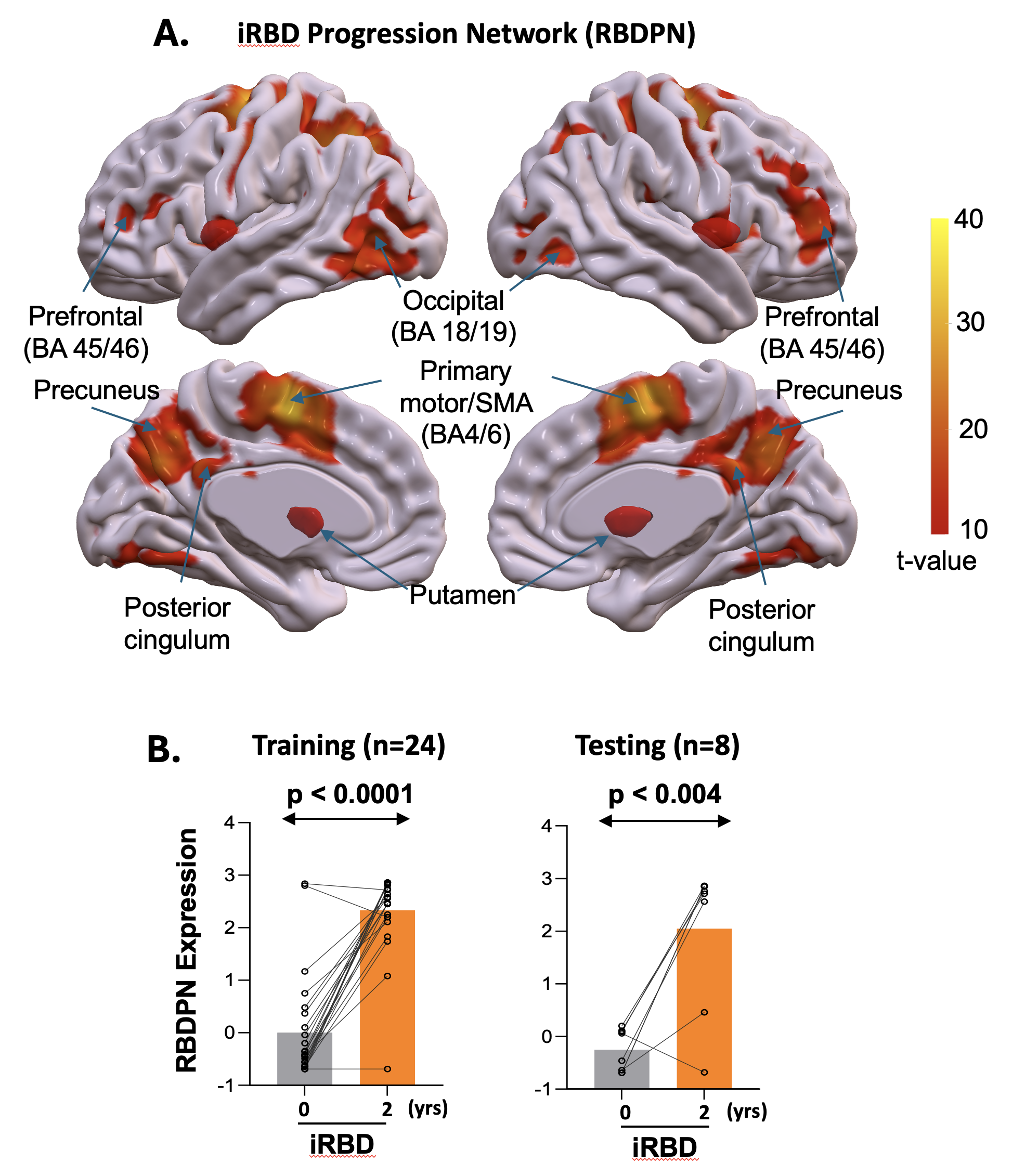
iRBD progression network (RBDPN)
References: 1. Jenkinson M, Beckmann CF, Behrens TEJ, Woolrich MW, Smith SM. FSL. Neuroimage. 2012;62(2):782–90.
2. Pruim RHR, Mennes M, van Rooij D, Llera A, Buitelaar JK, Beckmann CF. ICA-AROMA: A robust ICA-based strategy for removing motion artifacts from fMRI data. Neuroimage. 2015;112:267–77.
3. Meng X, Iraji A, Fu Z, Kochunov P, Belger A, Ford JM, et al. Multi-model order spatially constrained ICA reveals highly replicable group differences and consistent predictive results from resting data: A large N fMRI schizophrenia study. NeuroImage Clin. 2023;38:103434.
4. Ribeiro MT, Singh S, Guestrin C. “Why Should I Trust You?”: Explaining the Predictions of Any Classifier. In: Proceedings of the 22nd ACM SIGKDD International Conference on Knowledge Discovery and Data Mining (KDD ’16). New York, NY, USA; 2016. p. 1135-44.
5. He K, Zhang X, Ren S, Sun J. Deep residual learning for image recognition. In: Proceedings of the IEEE Computer Society Conference on Computer Vision and Pattern Recognition. 2016. p. 770-8.
To cite this abstract in AMA style:
N. Nguyen, A. Vo, S. Peng, D. Truong, P. Wu, C. Zuo, J. Lee, Y. Ma, D. Eidelberg. Deep learning-derived progression network in isolated REM sleep behavior disorder [abstract]. Mov Disord. 2026; 41 (suppl 1). https://www.mdsabstracts.org/abstract/deep-learning-derived-progression-network-in-isolated-rem-sleep-behavior-disorder/. Accessed October 1, 2026.« Back to 2026 International Congress
MDS Abstracts - https://www.mdsabstracts.org/abstract/deep-learning-derived-progression-network-in-isolated-rem-sleep-behavior-disorder/