
Category: Parkinsonism (Other)
Objective: We proposed a unified and standard autonomic and movement evaluation to discriminate patients’ Parkinsonism related to synucleinopathies from other conditions during a clinical office visit.
Background: Synucleinopathies are neurodegenerative disorders characterized by α-synuclein deposition affecting autonomic and movement networks. Diagnosis remains challenging, particularly in resource-limited settings, often leading to delays. We aimed to evaluate the utility of a standardized autonomic and movement assessment in classifying patients with undetermined and degenerative progressive parkinsonism (UaDPP) in a Mexican cohort.
Method: Between August 1, 2025, and February 1, 2026, consecutive patients referred with UaDPP underwent standardized autonomic evaluation (tilt-table testing in levodopa OFF and ON states, with glucose challenge), smell sense testing, cognitive screening (MoCA), peripheral temperature assessment (hands/feet), and bladder pre/post-void volume measurement. Clinical movement disorder phenotyping was performed, and final diagnoses were established.
Results: A total of 32 patients were included (males n=20, females n=12; mean age 70.9 years; Hispanic n=30 [93.75%]). Neurogenic orthostatic hypotension (nOH) was confirmed in 22 (68.75%), supine hypertension in 17 (53.13%), and postprandial hypotension in 16 (50.00%). Smell impairment was present in 30 (93.75%). Decreased temperature in hands and feet occurred in 19 (59.37%) and 21 (65.62%), respectively. Cognitive decline was observed in 22 (68.75%). Final diagnoses were synucleinopathies in 27 (84.38%) and miscellaneous conditions in 5 (15.62%).
Conclusion: In Mexican patients with UaDPP, a standardized autonomic and movement evaluation reliably detected autonomic involvement and supported clinical classification. While autonomic positivity alone did not differentiate synucleinopathies from miscellaneous conditions in this enriched sample, integration with movement phenotyping and supportive features (smell impairment, peripheral temperature dysregulation, cognitive status) provided valuable clinical clues for differential diagnosis, including synucleinopathies and non-synucleinopathy entities. These findings underscore the practical value of combined autonomic-movement assessment as a screening and classification tool in specialized centers.
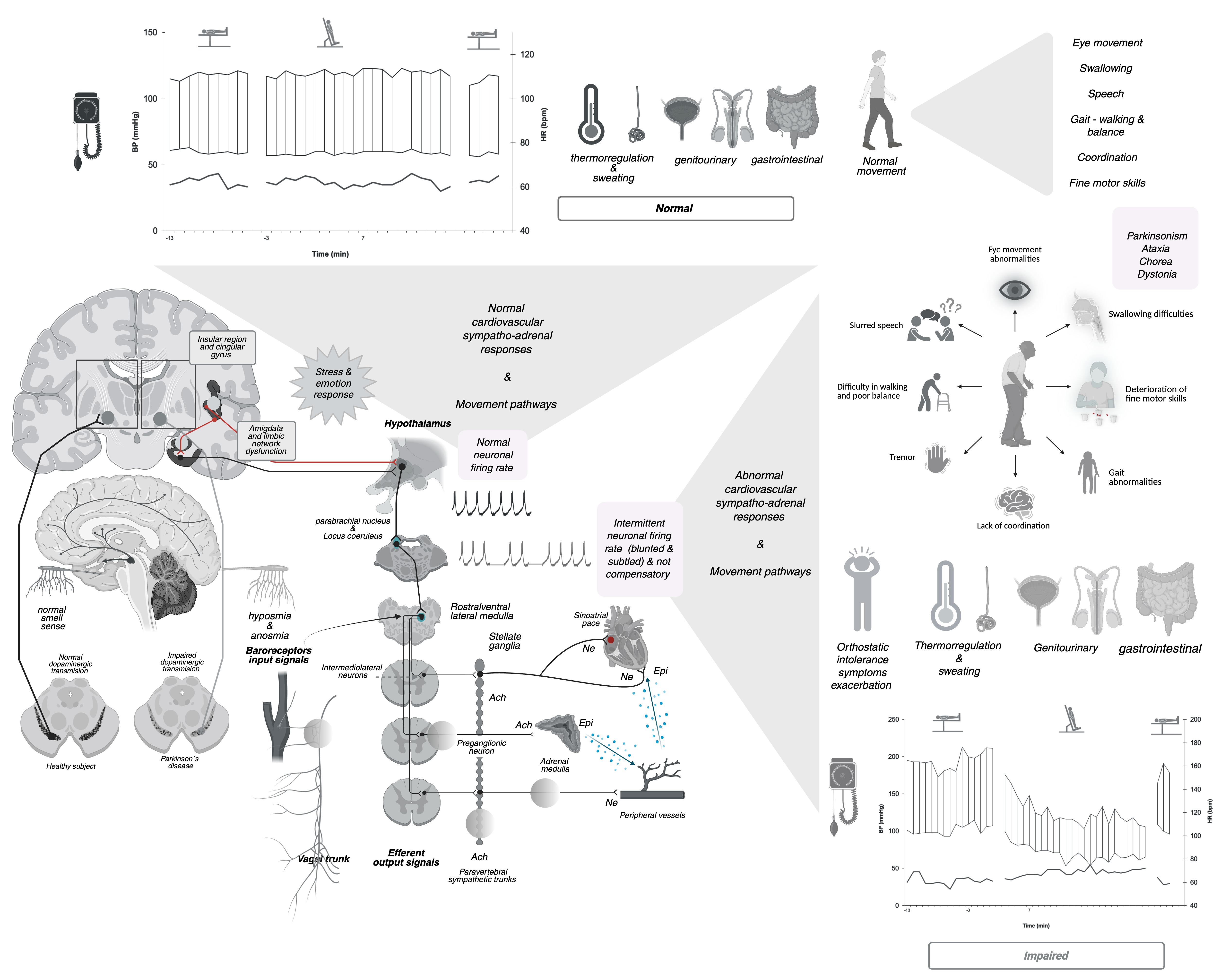
Motor and autonomic network
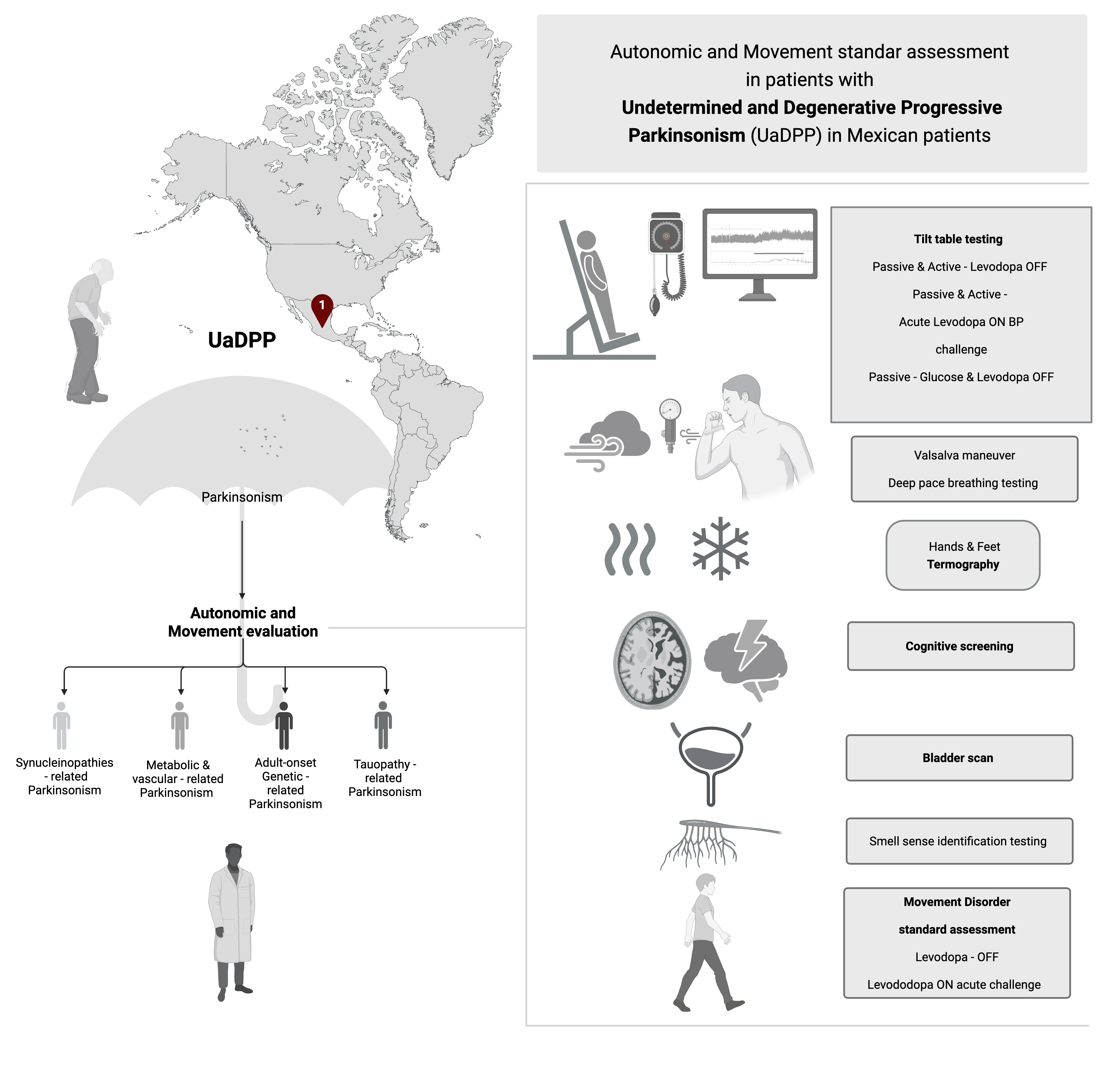
UaDPP
References: 1. Brenlla C, Lazaro-Hernandez C, Fernandez M, et al. Biomarkers of neurodegenerative parkinsonisms: From current clinical to future biological definitions – literature review and our experience. Neurol Neurochir Pol. 2025;59(2):97-110. doi:10.5603/pjnns.104070.
2. Kaufmann H, Norcliffe-Kaufmann L, Palma JA. Baroreflex Dysfunction. N Engl J Med. 2020;382(2):163-178. doi:10.1056/NEJMra1509723
To cite this abstract in AMA style:
DAN. Rebolledo-Garcia, ELB. Santiago, SAN. Robles-Bernal, NAN. Sánchez-González, DUL. Zayago-Angeles, BRE. González-Bedolla, FRA. Luna-Rangel. Standardized Autonomic and Movement Assessment in Mexican Patients with Undetermined and Degenerative Progressive Parkinsonism: A Single-Center Experience [abstract]. Mov Disord. 2026; 41 (suppl 1). https://www.mdsabstracts.org/abstract/standardized-autonomic-and-movement-assessment-in-mexican-patients-with-undetermined-and-degenerative-progressive-parkinsonism-a-single-center-experience/. Accessed October 1, 2026.« Back to 2026 International Congress
MDS Abstracts - https://www.mdsabstracts.org/abstract/standardized-autonomic-and-movement-assessment-in-mexican-patients-with-undetermined-and-degenerative-progressive-parkinsonism-a-single-center-experience/