
Category: MSA, PSP, CBS: Neuroimaging
Objective: To investigate whether distinctive cholinergic system changes are associated with FoG in PSP patients.
Background: Freezing of gait (FoG) is a profound mobility disturbance in Progressive Supranuclear Palsy (PSP), typically highly resistant to dopaminergic pharmacotherapies. This FoG feature implies that dopamine receptor losses and/or non-dopaminergic systems changes drive the pathophysiology of PSP FoG. Our previous work with vesicular acetylcholine transporter (VAChT) PET imaging demonstrated the critical role of cholinergic denervation in FoG in Parkinson disease. Information about the relationships between regional cholinergic terminal changes and FoG in PSP is scarce.
Method: Sixteen PSP subjects (11M/5F; age: 71.44±4.68; MDS-UPDRS Part III “off” state score: 45.875±11.53; Disease duration: 5.75±3.40 years) completed [18F]-fluoroethoxybenzovesamicol ([18F]FEOBV) VAChT PET. FoG was assessed using item 3.11 of the MDS-UPDRS-III. Voxel-based analysis using SPM12 was performed between PSP patients with and without FoG, adjusting for levodopa-equivalent dose (LED), age, and sex as nuisance variables.
Results: Nine PSP subjects exhibited FoG. Whole brain voxel-based analyses of [18F]FEOBV PET scans (P < 0.05, adjusted for LED, age, and sex) revealed that individuals with FoG had more severe cholinergic terminal deficits in right greater than left cerebellum, cerebellar vermis, bilateral thalamic nuclei, right caudate nucleus, right basal forebrain, left brainstem (including the red nucleus, ventral tegmental area, and substantia nigra pars compacta), right parahippocampal gyrus, right olfactory region, and right temporal pole (Figure 1).
Conclusion: Our findings suggest that FoG in PSP involves a complex network of cholinergic deficits in the brain, including bilateral thalamus, cerebellum, and right caudate nucleus. These findings differ from characterization of FoG in Parkinson disease. These findings suggest targets for novel cholinergic therapies in PSP.
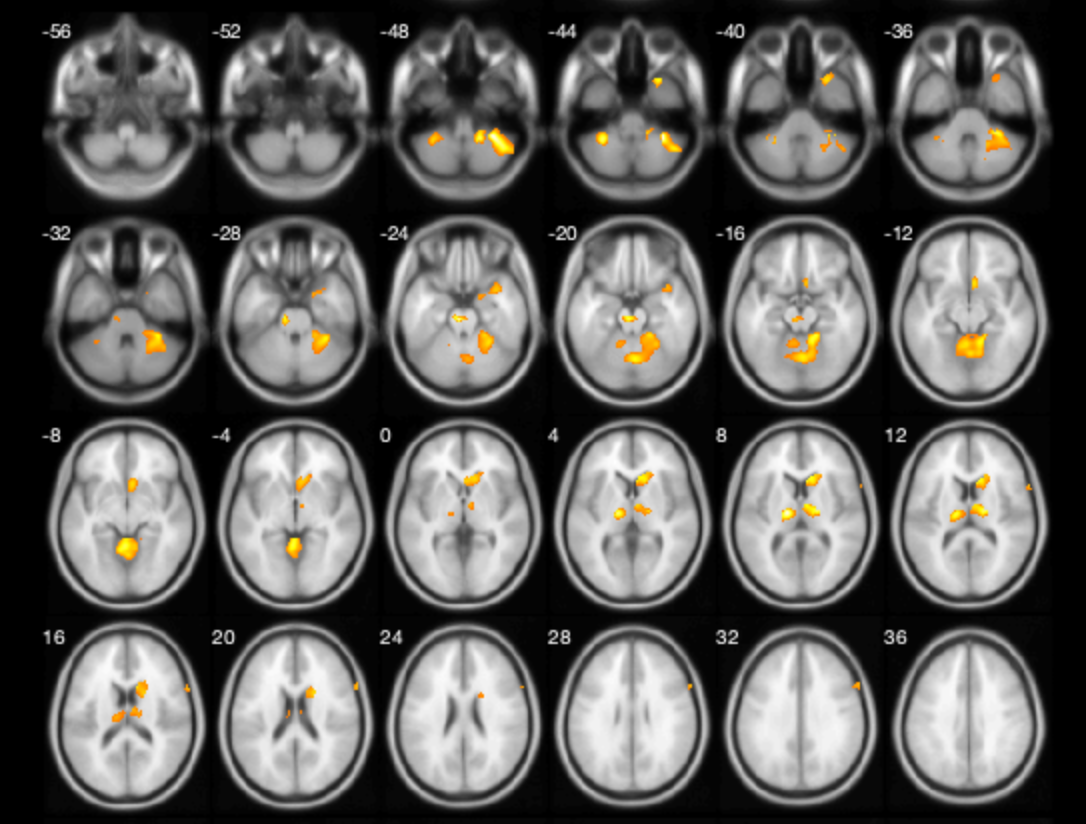
Figure 1.
To cite this abstract in AMA style:
P. Kanel, G. Carli, S. Roytman, J. Barr, R. Vangel, A. van Hout, C. Spears, P. Scott, R. Albin, N. Bohnen. Cholinergic Systems Changes Associated with Freezing of Gait in Progressive Supranuclear Palsy [abstract]. Mov Disord. 2026; 41 (suppl 1). https://www.mdsabstracts.org/abstract/cholinergic-systems-changes-associated-with-freezing-of-gait-in-progressive-supranuclear-palsy/. Accessed October 1, 2026.« Back to 2026 International Congress
MDS Abstracts - https://www.mdsabstracts.org/abstract/cholinergic-systems-changes-associated-with-freezing-of-gait-in-progressive-supranuclear-palsy/