
Objective: To examine longitudinal relationships between non-motor symptoms (NMS) and motor progression in Parkinson’s disease (PD), and to determine whether baseline NMS predict motor decline in early and moderate disease stages.
Background: Non-motor symptoms frequently precede motor onset and substantially contribute to disability in PD. While motor progression is well characterized, the longitudinal changes in neuropsychiatric and autonomic NMS and their interaction with motor deterioration remains insufficiently understood.
Method: Data were derived from the prospective MODEP cohort with semiannual assessments over five years. Participants included 22 early-stage PD (E-PD; < 3 years PD duration), 18 moderate-stage PD (M-PD; >3 years), and 24 healthy controls (HC). NMS were assessed using the total score of the MDS-UPDRS Part I and sum scores of neuropsychiatric and autonomic items. Motor outcomes comprised MDS-UPDRS Part III, step number, and step time variability during a 20-meter walk. Group differences in longitudinal NMS trajectories and associations between baseline NMS burden and motor changes were examined using Generalized Estimating Equations adjusted for age, sex, and L-dopa equivalent daily dose.
Results: Over five years, total NMS burden increased significantly in E-PD vs. HC (Time*Group; B=0.28±0.09, p=.003), which was particularly driven by worsening of autonomic symptoms. M-PD showed, compared with HC, increases in neuropsychiatric symptoms (B=0.19±0.02, p=.013; non-significant after correction for multiple testing) but not in total or autonomic symptoms. E-PD vs. M-PD showed non-significant differences in NMS score progression [Figure 1]. In E-PD, motor progression was not significantly associated with NMS at baseline. In M-PD, higher NMS at baseline were associated with lower MDS-UPDRS-III and step number but not lower step-time variability over time. However, motor deficits in M-PD show high variability and medication effects complicating interpretation.
Conclusion: Non-motor symptom progression may be more pronounced in E-PD, particularly for autonomic dysfunction, highlighting the importance of early monitoring of NMS in the disease course. NMS at baseline may not predict motor progression in E-PD, and the relevance of NMS for motor progression in M-PD needs further investigation, potentially also in larger cohorts.
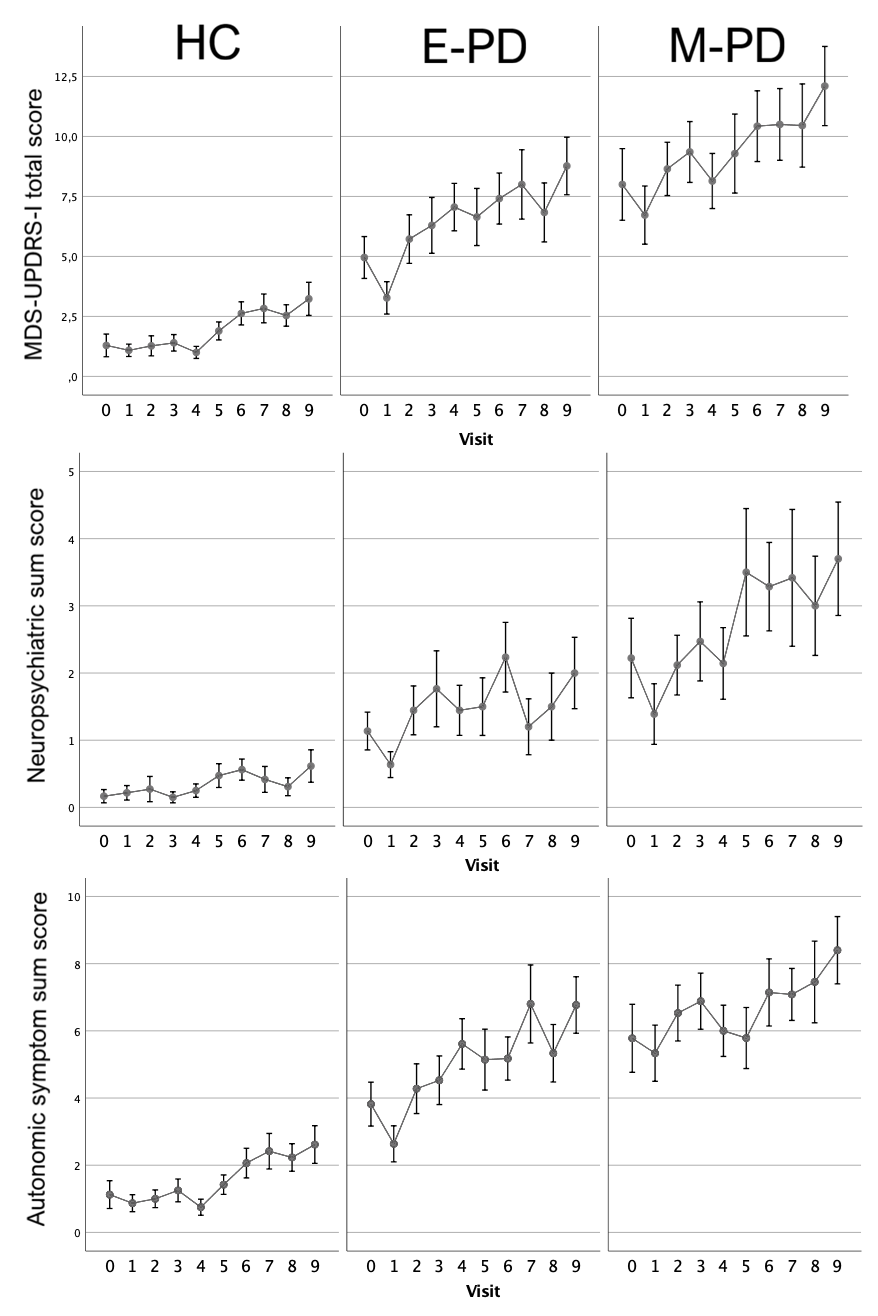
Changes in non-motor symptoms over 5 years.
To cite this abstract in AMA style:
S. Heinzel, Q. Destani-Dauti, M. Hobert, W. Maetzler, D. Berg. 5-year Longitudinal Changes in Non-motor Symptoms and Their Association With Motor Progression in Parkinson’s Disease [abstract]. Mov Disord. 2026; 41 (suppl 1). https://www.mdsabstracts.org/abstract/5-year-longitudinal-changes-in-non-motor-symptoms-and-their-association-with-motor-progression-in-parkinsons-disease/. Accessed October 1, 2026.« Back to 2026 International Congress
MDS Abstracts - https://www.mdsabstracts.org/abstract/5-year-longitudinal-changes-in-non-motor-symptoms-and-their-association-with-motor-progression-in-parkinsons-disease/