
Category: Technology
Objective: To evaluate clinical rationale and outcomes of advanced deep brain stimulation (DBS) programming for movement disorders.
Background: DBS is an effective treatment for medication refractory movement disorders. Yet, some patients may experience therapy attenuation – an abrupt loss of benefit after an initial response. Advanced programming methods include interleaving, cycling, and interleaving with cycling. Interleaving rapidly alternates between two different programs while cycling modifies the duty cycle of a DBS programming configuration. These methods have been employed when conventional programming strategies fail to provide satisfactory symptom control.
Method: We conducted a retrospective chart review of 880 patients with advanced DBS settings from 2024-2025 at our institution. Clinical demographics, DBS program parameters, and experiences with advanced settings were evaluated. Patients with incomplete documentation were excluded. Clinical reasoning for advanced programming was stratified by patient diagnosis and assessed for benefit. Subjective benefit was stratified by diagnosis as well as DBS lead location.
Results: Interleaving programming was implemented in 267 patients. Of these, therapy attenuation (27.3%) and refractory tremor (26.2%) were the most common reasons for advanced programming. 226 of the original cohort tried the setting and 157 reported benefit. 84 patients reported benefit in tremor control. Cycling programming was implemented in 119 patients. Of these, therapy attenuation (26.1%) and refractory tremor (25.2%) were the most common reasons for advanced programming. 103 of the original cohort tried the setting and 25 reported benefit. 13 patients reported benefit in tremor control. Interleaving with cycling was implemented in 54 patients. Of these, poor overall benefit (25.9%) and therapy attenuation (24.1%) were the most common reasons for advanced programming. 30 of the original cohort tried the setting and 12 reported benefit. 6 patients reported benefit in tremor control. Across all DBS targets 20% of patients reported a benefit with one of these advanced DBS settings (Fig 1,2).
Conclusion: Advanced DBS settings can be helpful optimization in cases such as therapy attenuation, refractory tremor or poor overall benefit. These advanced settings may be helpful as a rescue therapy for patients with unsatisfactory results from DBS surgery and potentially spare patients from DBS lead revisions.
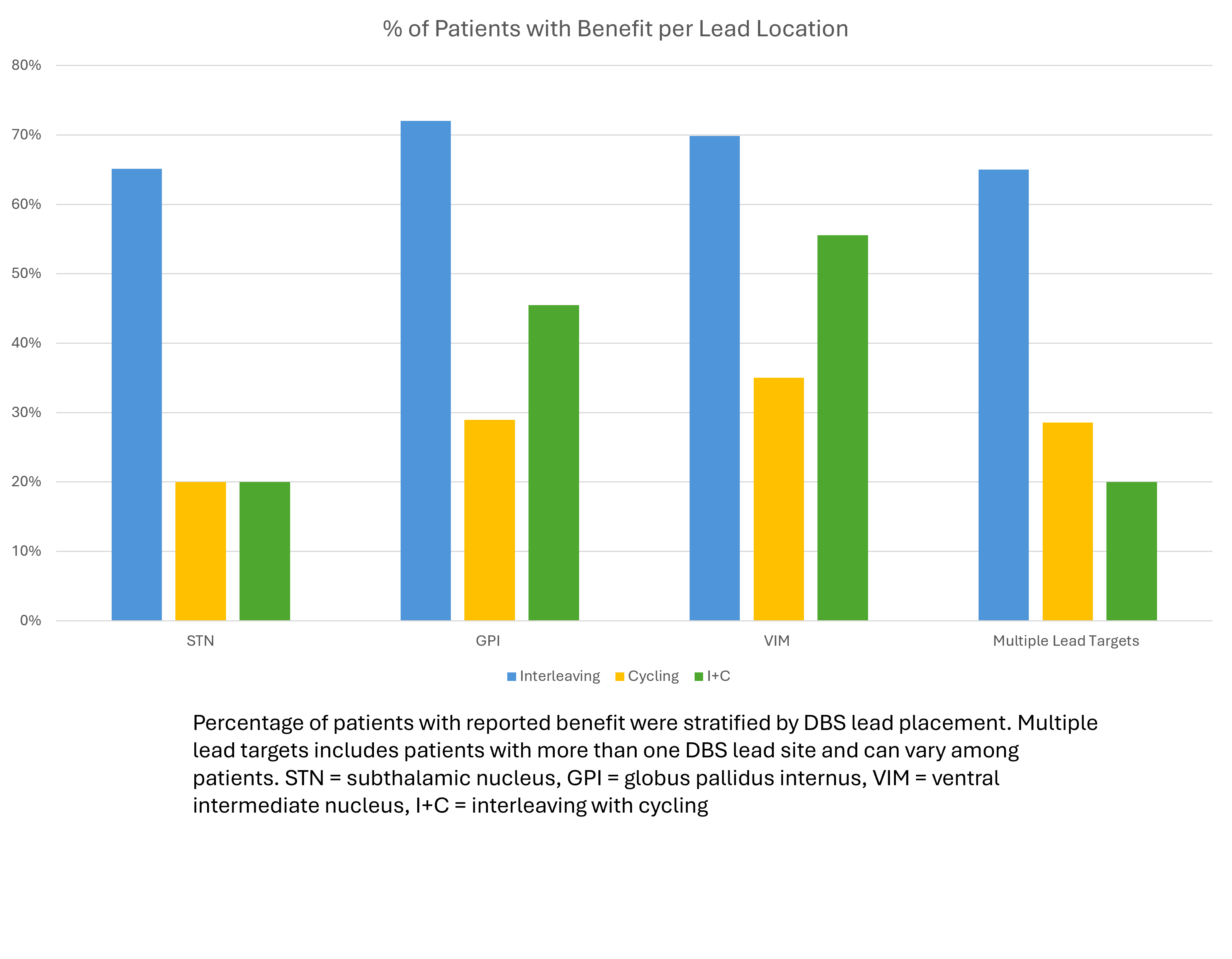
Figure 1
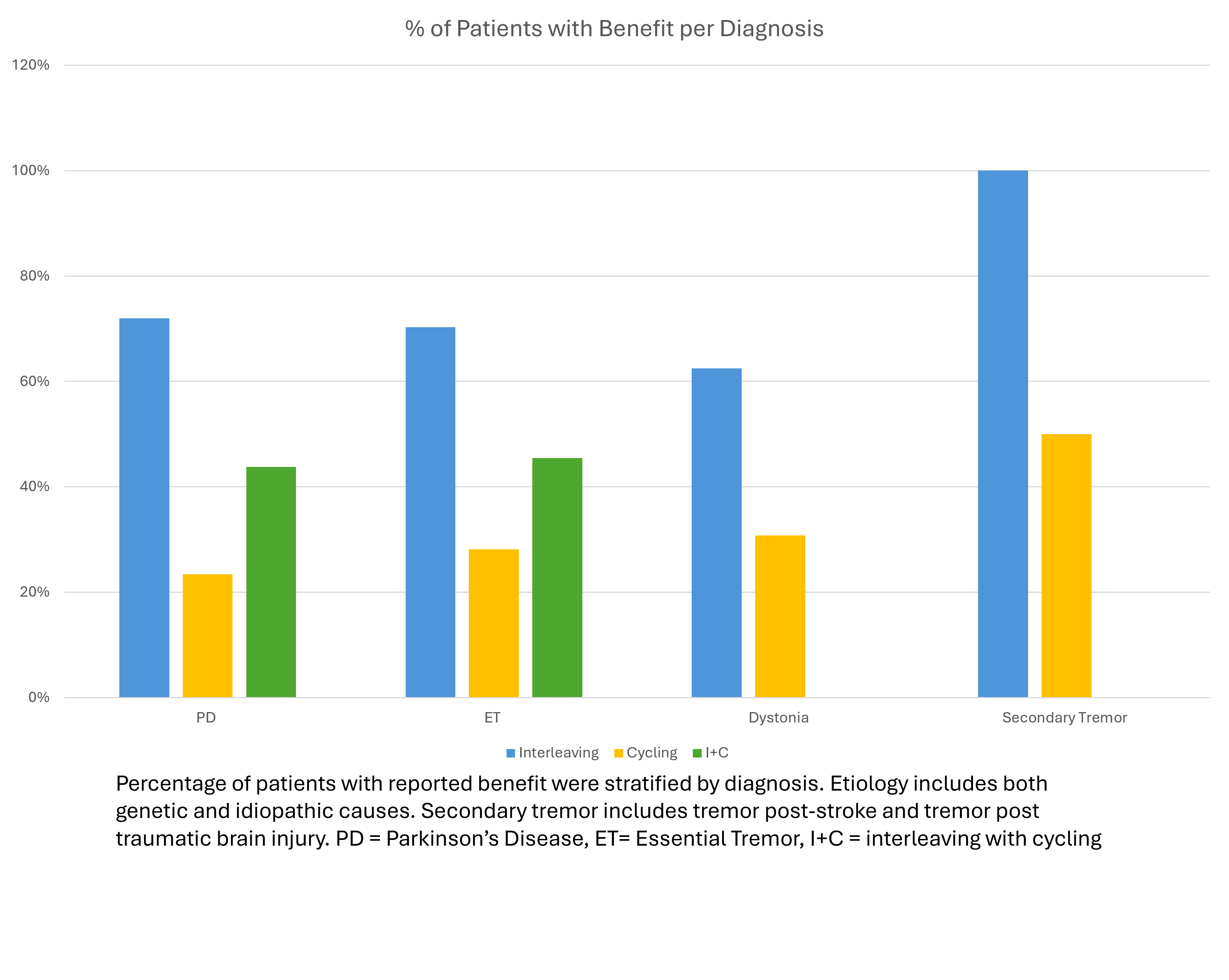
Figure 2
References: 1. Zhang S, Zhou P, Jiang S, Wang W, Li P. Interleaving subthalamic nucleus deep brain stimulation to avoid side effects while achieving satisfactory motor benefits in Parkinson disease: A report of 12 cases. Medicine (Baltimore). 2016 Dec;95(49):e5575. doi: 10.1097/MD.0000000000005575. PMID: 27930569; PMCID: PMC5266041
2. Enatsu R, Kitagawa M, Morishita T, Sasagawa A, Kuribara T, Hirano T, Arihara M, Mikami T, Mikuni N. Effect of Cycling Thalamosubthalamic Stimulation on Tremor Habituation and Rebound in Parkinson Disease. World Neurosurg. 2020 Dec;144:64-67. doi: 10.1016/j.wneu.2020.08.141. Epub 2020 Aug 22. PMID: 32841798.
To cite this abstract in AMA style:
P. Gupta, P. Graese, R. Burke, P. Zeilman, J. Wong. A Comprehensive Analysis of Advanced Deep Brain Stimulation Programming Strategies [abstract]. Mov Disord. 2026; 41 (suppl 1). https://www.mdsabstracts.org/abstract/a-comprehensive-analysis-of-advanced-deep-brain-stimulation-programming-strategies/. Accessed October 1, 2026.« Back to 2026 International Congress
MDS Abstracts - https://www.mdsabstracts.org/abstract/a-comprehensive-analysis-of-advanced-deep-brain-stimulation-programming-strategies/