
Category: MSA, PSP, CBS (Other)
Objective: To delineate the genetic architecture of progressive supranuclear palsy (PSP) in a large, multicenter, multinational Asian cohort using whole-exome sequencing (WES) and investigate the functional impact of identified variants on tau proteostasis.
Background: PSP is a rapidly progressive primary tauopathy. While GWAS have identified risk loci in European populations, the genetic architecture in Asians remains largely uncharacterized. As mechanism-targeted therapies emerge, defining population-specific risk profiles is critical.
Method: We analyzed whole-exome sequencing data from 549 PSP patients from East and Southeast Asia. Variant frequencies were compared with those in the combined East Asian and South Asian populations from the Genome Aggregation Database (gnomAD), and 1492 controls from the Taiwan Biobank. The identified novel variants were functionally validated their effects on tau aggregations in cellular and Drosophila models.
Results: Among 549 patients (mean onset: 65.06 ± 7.38 years; 60.5% men), 5.28% harbored pathogenic/likely pathogenic (P/LP) variants, and 23.13% had variants of uncertain significance (VUS). The most frequent P/LP variants occurred in SMPD1 (20.69%) and ABCA7 (20.69%), followed by BSN (10.34%), MAPT (6.90%), and APP (6.90%). Cumulative variant load analysis (P/LP + rare VUS) identified BSN as the leading contributor (21.97%), followed by ABCA7 (13.29%), LRRK2 (10.40%), and MAPT (6.94%). Notably, common Asian LRRK2 risk variants (G2385R and R1628P) were significantly more frequent in PSP patients than in East Asian and South Asian reference controls from gnomAD (both p<0.0001). Pathway analysis linked BSN to tau proteostasis, lysosomal function, and synaptic trafficking. Functional assays confirmed that rare BSN variants significantly enhanced tau aggregation and exacerbated neurodegeneration via a toxic gain-of-function mechanism.
Conclusion: Our findings delineate an ancestry-specific genetic architecture distinct from the MAPT-dominant pattern observed in European populations, providing insights into population-specific disease mechanisms for PSP.
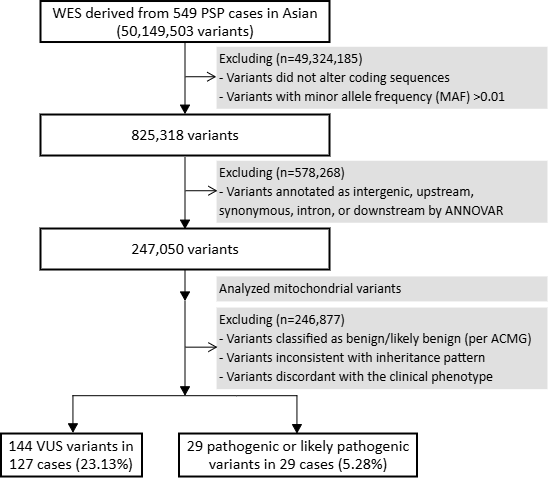
Analysis pipeline for whole-exome sequencing
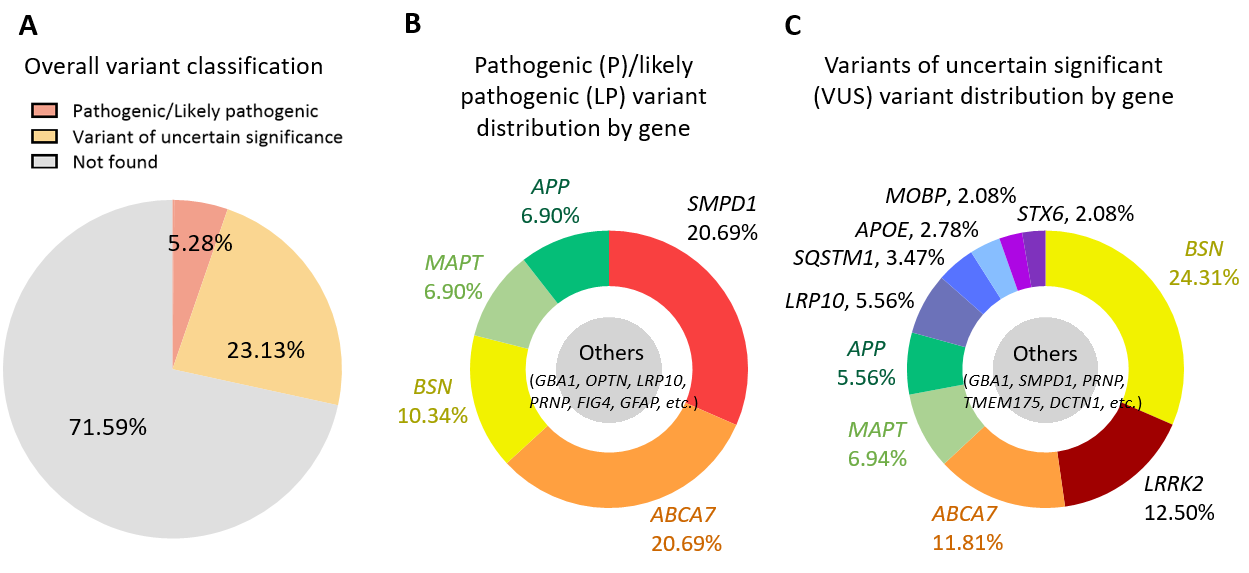
Variant classification and gene distribution
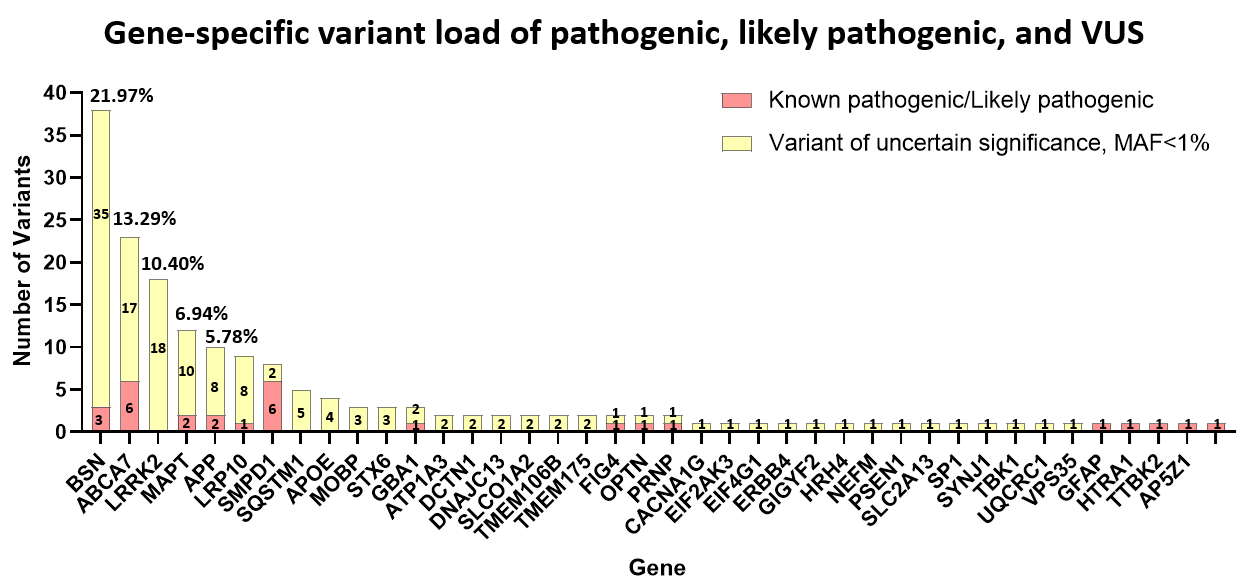
Gene-specific variant load
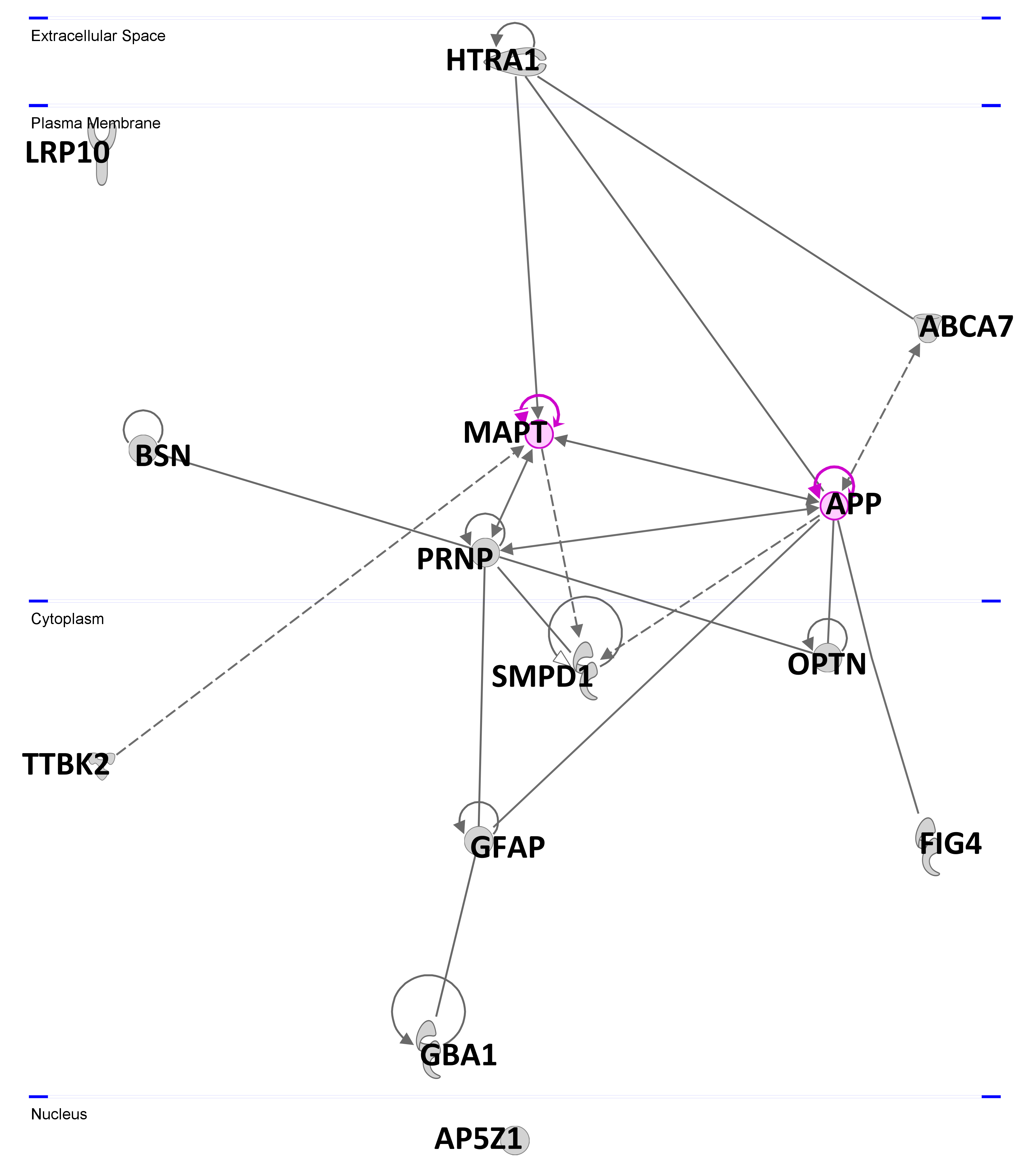
Functional interaction network
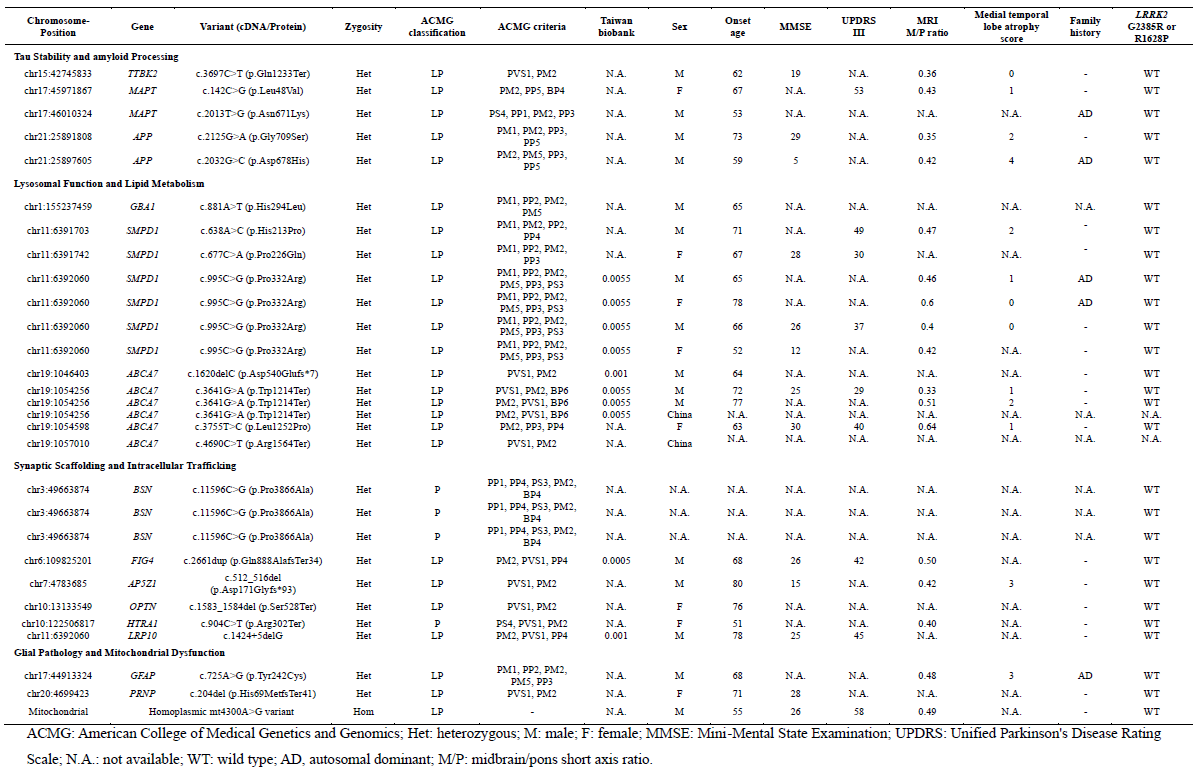
Details of identified P and LP variants
References: 1. Stamelou M, Respondek G, Giagkou N, et al. Evolving concepts in progressive supranuclear palsy and other 4-repeat tauopathies. Nat Rev Neurol 2021;17(10):601-20. doi: 10.1038/s41582-021-00541-5 [published Online First: 20210823]
2. Muller U, Hoglinger G, Dickson DW. Multifactorial etiology of progressive supranuclear palsy (PSP): the genetic component. Acta Neuropathol 2025;149(1):58. doi: 10.1007/s00401-025-02898-z [published Online First: 20250604]
3. Lim SY, Dy Closas AMF, Tan AH, et al. New insights from a multi-ethnic Asian progressive supranuclear palsy cohort. Parkinsonism Relat Disord 2023;108:105296. doi: 10.1016/j.parkreldis.2023.105296 [published Online First: 20230120]
4. Donker Kaat L, Boon AJ, Azmani A, et al. Familial aggregation of parkinsonism in progressive supranuclear palsy. Neurology 2009;73(2):98-105. doi: 10.1212/WNL.0b013e3181a92bcc [published Online First: 20090520]
5. Höglinger GU, Melhem NM, Dickson DW, et al. Identification of common variants influencing risk of the tauopathy progressive supranuclear palsy. Nat Genet 2011;43(7):699-705. doi: 10.1038/ng.859 [published Online First: 20110619]
6. Chen JA, Chen Z, Won H, et al. Joint genome-wide association study of progressive supranuclear palsy identifies novel susceptibility loci and genetic correlation to neurodegenerative diseases. Mol Neurodegener 2018;13(1):41. doi: 10.1186/s13024-018-0270-8 [published Online First: 20180808]
7. Farrell K, Humphrey J, Chang T, et al. Genetic, transcriptomic, histological, and biochemical analysis of progressive supranuclear palsy implicates glial activation and novel risk genes. Nat Commun 2024;15(1):7880. doi: 10.1038/s41467-024-52025-x [published Online First: 20240909]
8. Wang H, Chang TS, Dombroski BA, et al. Whole-genome sequencing analysis reveals new susceptibility loci and structural variants associated with progressive supranuclear palsy. Mol Neurodegener 2024;19(1):61. doi: 10.1186/s13024-024-00747-3 [published Online First: 20240816]
9. Jabbari E, Koga S, Valentino RR, et al. Genetic determinants of survival in progressive supranuclear palsy: a genome-wide association study. Lancet Neurol 2021;20(2):107-16. doi: 10.1016/S1474-4422(20)30394-X [published Online First: 20201217]
10. Kukkle PL, Neupane R, Pantelyat A, et al. Progressive Supranuclear Palsy-A Global Review. Mov Disord Clin Pract 2025 doi: 10.1002/mdc3.70338 [published Online First: 20250903]
11. Rizig M, Bandres-Ciga S, Makarious MB, et al. Identification of genetic risk loci and causal insights associated with Parkinson’s disease in African and African admixed populations: a genome-wide association study. Lancet Neurol 2023;22(11):1015-25. doi: 10.1016/S1474-4422(23)00283-1 [published Online First: 20230823]
12. Heckman MG, Brennan RR, Labbé C, et al. Association of MAPT Subhaplotypes With Risk of Progressive Supranuclear Palsy and Severity of Tau Pathology. JAMA Neurol 2019;76(6):710-17. doi: 10.1001/jamaneurol.2019.0250
13. Farrer MJ, Stone JT, Lin CH, et al. Lrrk2 G2385R is an ancestral risk factor for Parkinson’s disease in Asia. Parkinsonism Relat Disord 2007;13(2):89-92. doi: 10.1016/j.parkreldis.2006.12.001 [published Online First: 20070110]
14. Ng ASL, Tan AH, Tan YJ, et al. Identification of Genetic Variants in Progressive Supranuclear Palsy in Southeast Asia. Mov Disord 2024;39(10):1829-42. doi: 10.1002/mds.29932 [published Online First: 20240816]
15. Xiao X, Yang Q, Wen Y, et al. Genetics of progressive supranuclear palsy in a Chinese population. Neurobiol Dis 2022;172:105819. doi: 10.1016/j.nbd.2022.105819 [published Online First: 20220713]
16. Kukkle PL, Neupane R, Pantelyat A, et al. Progressive Supranuclear Palsy-A Global Review. Mov Disord Clin Pract 2025 doi: 10.1002/mdc3.70338 [published Online First: 20250903]
17. Dam T, Boxer AL, Golbe LI, et al. Safety and efficacy of anti-tau monoclonal antibody gosuranemab in progressive supranuclear palsy: a phase 2, randomized, placebo-controlled trial. Nat Med 2021;27(8):1451-57. doi: 10.1038/s41591-021-01455-x [published Online First: 20210812]
18. Dunning EE, Decourt B, Zawia NH, et al. Pharmacotherapies for the Treatment of Progressive Supranuclear Palsy: A Narrative Review. Neurol Ther 2024;13(4):975-1013. doi: 10.1007/s40120-024-00614-9 [published Online First: 20240514]
19. Dam T, Boxer AL, Golbe LI, et al. Safety and efficacy of anti-tau monoclonal antibody gosuranemab in progressive supranuclear palsy: a phase 2, randomized, placebo-controlled trial. Nat Med 2021;27(8):1451-57. doi: 10.1038/s41591-021-01455-x [published Online First: 20210812]
20. Hoglinger GU, Litvan I, Mendonca N, et al. Safety and efficacy of tilavonemab in progressive supranuclear palsy: a phase 2, randomised, placebo-controlled trial. Lancet Neurol 2021;20(3):182-92. doi: 10.1016/S1474-4422(20)30489-0
21. Tsai RM, Miller Z, Koestler M, et al. Reactions to Multiple Ascending Doses of the Microtubule Stabilizer TPI-287 in Patients With Alzheimer Disease, Progressive Supranuclear Palsy, and Corticobasal Syndrome: A Randomized Clinical Trial. JAMA Neurol 2020;77(2):215-24. doi: 10.1001/jamaneurol.2019.3812
22. Höglinger GU, Respondek G, Stamelou M, et al. Clinical diagnosis of progressive supranuclear palsy: The movement disorder society criteria. Mov Disord 2017;32(6):853-64. doi: 10.1002/mds.26987 [published Online First: 20170503]
23. Wu MC, Chang YY, Lan MY, et al. A Clinical and Integrated Genetic Study of Isolated and Combined Dystonia in Taiwan. J Mol Diagn 2022;24(3):262-73. doi: 10.1016/j.jmoldx.2021.12.003 [published Online First: 2022/01/19]
24. Feng YA, Chen CY, Chen TT, et al. Taiwan Biobank: A rich biomedical research database of the Taiwanese population. Cell Genom 2022;2(11):100197. doi: 10.1016/j.xgen.2022.100197 [published Online First: 20221012]
25. Jaganathan K, Kyriazopoulou Panagiotopoulou S, McRae JF, et al. Predicting Splicing from Primary Sequence with Deep Learning. Cell 2019;176(3):535-48.e24. doi: 10.1016/j.cell.2018.12.015 [published Online First: 20190117]
26. Zhang W, Cui H, Wong LJ. Comprehensive one-step molecular analyses of mitochondrial genome by massively parallel sequencing. Clin Chem 2012;58(9):1322-31. doi: 10.1373/clinchem.2011.181438 [published Online First: 20120709]
27. Richards S, Aziz N, Bale S, et al. Standards and guidelines for the interpretation of sequence variants: a joint consensus recommendation of the American College of Medical Genetics and Genomics and the Association for Molecular Pathology. Genet Med 2015;17(5):405-24. doi: 10.1038/gim.2015.30 [published Online First: 20150305]
28. McCormick EM, Lott MT, Dulik MC, et al. Specifications of the ACMG/AMP standards and guidelines for mitochondrial DNA variant interpretation. Hum Mutat 2020;41(12):2028-57. doi: 10.1002/humu.24107 [published Online First: 20201110]
29. Tomizawa K, Omori A, Ohtake A, et al. Tau-tubulin kinase phosphorylates tau at Ser-208 and Ser-210, sites found in paired helical filament-tau. FEBS Lett 2001;492(3):221-7. doi: 10.1016/s0014-5793(01)02256-6
30. Bloom GS. Amyloid-beta and tau: the trigger and bullet in Alzheimer disease pathogenesis. JAMA Neurol 2014;71(4):505-8. doi: 10.1001/jamaneurol.2013.5847
31. Liu CY, Chen HY, Lee CY, et al. A Novel Rapidly Progressive Parkinsonism Phenotype with Ophthalmoplegia Associated with the APP p.D678H Mutation. Mov Disord Clin Pract 2025 doi: 10.1002/mdc3.70439 [published Online First: 20251118]
32. Picataggi A, Rodrigues A, Cromley DA, et al. Specificity of ABCA7-mediated cell lipid efflux. Biochim Biophys Acta Mol Cell Biol Lipids 2022;1867(7):159157. doi: 10.1016/j.bbalip.2022.159157 [published Online First: 20220403]
33. von Maydell D, Wright SE, Pao PC, et al. ABCA7 variants impact phosphatidylcholine and mitochondria in neurons. Nature 2025;647(8089):462-71. doi: 10.1038/s41586-025-09520-y [published Online First: 20250910]
34. Jenkins RW, Canals D, Hannun YA. Roles and regulation of secretory and lysosomal acid sphingomyelinase. Cell Signal 2009;21(6):836-46. doi: 10.1016/j.cellsig.2009.01.026
35. Klein AD, Outeiro TF. Glucocerebrosidase mutations disrupt the lysosome and now the mitochondria. Nat Commun 2023;14(1):6383. doi: 10.1038/s41467-023-42107-7 [published Online First: 20231011]
36. Chew EG, Liu Z, Li Z, et al. Exome sequencing in Asian populations identifies low-frequency and rare coding variation influencing Parkinson’s disease risk. Nat Aging 2025;5(2):205-18. doi: 10.1038/s43587-024-00760-7 [published Online First: 20241121]
37. Yabe I, Yaguchi H, Kato Y, et al. Mutations in bassoon in individuals with familial and sporadic progressive supranuclear palsy-like syndrome. Sci Rep 2018;8(1):819. doi: 10.1038/s41598-018-19198-0 [published Online First: 20180116]
38. Quadri M, Mandemakers W, Grochowska MM, et al. LRP10 genetic variants in familial Parkinson’s disease and dementia with Lewy bodies: a genome-wide linkage and sequencing study. Lancet Neurol 2018;17(7):597-608. doi: 10.1016/s1474-4422(18)30179-0 [published Online First: 20180607]
39. Castle AR, Gill AC. Physiological Functions of the Cellular Prion Protein. Front Mol Biosci 2017;4:19. doi: 10.3389/fmolb.2017.00019 [published Online First: 20170406]
40. Dey S, Debnath M, Yelamanchi R, et al. Novel Insights into the Genetic Basis of Progressive Supranuclear Palsy in Asian-Indian Population. Mov Disord 2024;39(4):753-55. doi: 10.1002/mds.29740 [published Online First: 20240205]
41. Stanford PM, Halliday GM, Brooks WS, et al. Progressive supranuclear palsy pathology caused by a novel silent mutation in exon 10 of the tau gene: expansion of the disease phenotype caused by tau gene mutations. Brain 2000;123 ( Pt 5):880-93. doi: 10.1093/brain/123.5.880
42. Li H, Li Q, Weng Q, et al. A novel MAPT variant (E342K) as a cause of familial progressive supranuclear palsy. Front Neurol 2024;15:1372507. doi: 10.3389/fneur.2024.1372507 [published Online First: 20240419]
43. Wen Y, Zhou Y, Jiao B, et al. Genetics of Progressive Supranuclear Palsy: A Review. J Parkinsons Dis 2021;11(1):93-105. doi: 10.3233/JPD-202302
44. Baker M, Litvan I, Houlden H, et al. Association of an extended haplotype in the tau gene with progressive supranuclear palsy. Hum Mol Genet 1999;8(4):711-5. doi: 10.1093/hmg/8.4.711
45. Wang H, Chang TS, Dombroski BA, et al. Copy Number Variation and Haplotype Analysis of 17q21.31 Reveals Increased Risk Associated with Progressive Supranuclear Palsy and Gene Expression Changes in Neuronal Cells. Mov Disord 2025;40(5):950-61. doi: 10.1002/mds.30150 [published Online First: 20250308]
46. Hoglinger GU, Melhem NM, Dickson DW, et al. Identification of common variants influencing risk of the tauopathy progressive supranuclear palsy. Nat Genet 2011;43(7):699-705. doi: 10.1038/ng.859 [published Online First: 20110619]
47. Sanchez-Contreras MY, Kouri N, Cook CN, et al. Replication of progressive supranuclear palsy genome-wide association study identifies SLCO1A2 and DUSP10 as new susceptibility loci. Mol Neurodegener 2018;13(1):37. doi: 10.1186/s13024-018-0267-3 [published Online First: 20180709]
48. Farrell K, Humphrey J, Chang T, et al. Genetic, transcriptomic, histological, and biochemical analysis of progressive supranuclear palsy implicates glial activation and novel risk genes. Nat Commun 2024;15(1):7880. doi: 10.1038/s41467-024-52025-x [published Online First: 20240909]
49. Wang H, Chang TS, Dombroski BA, et al. Whole-genome sequencing analysis reveals new susceptibility loci and structural variants associated with progressive supranuclear palsy. Mol Neurodegener 2024;19(1):61. doi: 10.1186/s13024-024-00747-3 [published Online First: 20240816]
50. Martinez P, Patel H, You Y, et al. Bassoon contributes to tau-seed propagation and neurotoxicity. Nat Neurosci 2022;25(12):1597-607. doi: 10.1038/s41593-022-01191-6 [published Online First: 20221107]
51. Tanaka D, Yaguchi H, Yoshizaki K, et al. Behavioral and histological analyses of the mouse Bassoon p.P3882A mutation corresponding to the human BSN p.P3866A mutation. Front Neurosci 2024;18:1414145. doi: 10.3389/fnins.2024.1414145 [published Online First: 20240726]
52. Wakita M, Yaguchi H, Otuski M, et al. Pathological study of progressive supranuclear palsy the cases with mutations in Bassoon. Neuropathology 2025;45(2):140-52. doi: 10.1111/neup.13009 [published Online First: 20241031]
53. Maas C, Torres VI, Altrock WD, et al. Formation of Golgi-derived active zone precursor vesicles. J Neurosci 2012;32(32):11095-108. doi: 10.1523/JNEUROSCI.0195-12.2012
54. Shapira M, Zhai RG, Dresbach T, et al. Unitary assembly of presynaptic active zones from Piccolo-Bassoon transport vesicles. Neuron 2003;38(2):237-52. doi: 10.1016/s0896-6273(03)00207-1
55. Ziv NE, Garner CC. Cellular and molecular mechanisms of presynaptic assembly. Nat Rev Neurosci 2004;5(5):385-99. doi: 10.1038/nrn1370
56. Davydova D, Marini C, King C, et al. Bassoon specifically controls presynaptic P/Q-type Ca(2+) channels via RIM-binding protein. Neuron 2014;82(1):181-94. doi: 10.1016/j.neuron.2014.02.012
57. Jing Z, Rutherford MA, Takago H, et al. Disruption of the presynaptic cytomatrix protein bassoon degrades ribbon anchorage, multiquantal release, and sound encoding at the hair cell afferent synapse. J Neurosci 2013;33(10):4456-67. doi: 10.1523/JNEUROSCI.3491-12.2013
58. Montenegro-Venegas C, Annamneedi A, Hoffmann-Conaway S, et al. BSN (bassoon) and PRKN/parkin in concert control presynaptic vesicle autophagy. Autophagy 2020;16(9):1732-33. doi: 10.1080/15548627.2020.1801259 [published Online First: 20200810]
59. Okerlund ND, Schneider K, Leal-Ortiz S, et al. Bassoon Controls Presynaptic Autophagy through Atg5. Neuron 2018;97(3):727. doi: 10.1016/j.neuron.2018.01.010
60. Waites CL, Leal-Ortiz SA, Okerlund N, et al. Bassoon and Piccolo maintain synapse integrity by regulating protein ubiquitination and degradation. EMBO J 2013;32(7):954-69. doi: 10.1038/emboj.2013.27 [published Online First: 20130212]
61. Sudhof TC. The presynaptic active zone. Neuron 2012;75(1):11-25. doi: 10.1016/j.neuron.2012.06.012
62. Gundelfinger ED, Reissner C, Garner CC. Role of Bassoon and Piccolo in Assembly and Molecular Organization of the Active Zone. Front Synaptic Neurosci 2015;7:19. doi: 10.3389/fnsyn.2015.00019 [published Online First: 20160112]
63. Andrews SV, Kukkle PL, Menon R, et al. The Genetic Drivers of Juvenile, Young, and Early-Onset Parkinson’s Disease in India. Mov Disord 2024;39(2):339-49. doi: 10.1002/mds.29676 [published Online First: 20231128]
64. Guzman SG, Ruggiero SM, Ganesan S, et al. Variants in BSN, encoding the presynaptic protein Bassoon, result in a distinct neurodevelopmental disorder with a broad phenotypic range. Am J Hum Genet 2025;112(6):1415-29. doi: 10.1016/j.ajhg.2025.04.011 [published Online First: 20250519]
65. Campbell AS, Ho CCG, Atik M, et al. Clinical Deep Phenotyping of ABCA7 Mutation Carriers. Neurol Genet 2022;8(2):e655. doi: 10.1212/NXG.0000000000000655 [published Online First: 20220113]
66. Nuytemans K, Maldonado L, Ali A, et al. Overlap between Parkinson disease and Alzheimer disease in ABCA7 functional variants. Neurol Genet 2016;2(1):e44. doi: 10.1212/NXG.0000000000000044 [published Online First: 20160114]
67. Wang N, Lan D, Gerbod-Giannone M, et al. ATP-binding cassette transporter A7 (ABCA7) binds apolipoprotein A-I and mediates cellular phospholipid but not cholesterol efflux. J Biol Chem 2003;278(44):42906-12. doi: 10.1074/jbc.M307831200 [published Online First: 20030812]
68. Quazi F, Molday RS. Differential phospholipid substrates and directional transport by ATP-binding cassette proteins ABCA1, ABCA7, and ABCA4 and disease-causing mutants. J Biol Chem 2013;288(48):34414-26. doi: 10.1074/jbc.M113.508812 [published Online First: 20131004]
69. Kim WS, Li H, Ruberu K, et al. Deletion of Abca7 increases cerebral amyloid-beta accumulation in the J20 mouse model of Alzheimer’s disease. J Neurosci 2013;33(10):4387-94. doi: 10.1523/JNEUROSCI.4165-12.2013
70. Fang SC, Wang L, Cheng MT, et al. Structural insights into human ABCA7-mediated lipid transport. Structure 2025;33(3):583-93 e5. doi: 10.1016/j.str.2024.12.015 [published Online First: 20250117]
71. Bennett RE, DeVos SL, Dujardin S, et al. Enhanced Tau Aggregation in the Presence of Amyloid beta. Am J Pathol 2017;187(7):1601-12. doi: 10.1016/j.ajpath.2017.03.011 [published Online First: 20170510]
72. Sawa A, Amano N, Yamada N, et al. Apolipoprotein E in progressive supranuclear palsy in Japan. Mol Psychiatry 1997;2(4):341-2. doi: 10.1038/sj.mp.4000285
73. Wisniewski T, Drummond E. APOE-amyloid interaction: Therapeutic targets. Neurobiol Dis 2020;138:104784. doi: 10.1016/j.nbd.2020.104784 [published Online First: 20200204]
74. Terwel D, Muyllaert D, Dewachter I, et al. Amyloid activates GSK-3beta to aggravate neuronal tauopathy in bigenic mice. Am J Pathol 2008;172(3):786-98. doi: 10.2353/ajpath.2008.070904 [published Online First: 20080207]
75. Choi BJ, Park MH, Jin HK, et al. Acid sphingomyelinase as a pathological and therapeutic target in neurological disorders: focus on Alzheimer’s disease. Exp Mol Med 2024;56(2):301-10. doi: 10.1038/s12276-024-01176-4 [published Online First: 20240209]
76. Picillo M, Petrucci S, Valente EM, et al. Progressive Supranuclear Palsy-Like Phenotype in a GBA E326K Mutation Carrier. Mov Disord Clin Pract 2017;4(3):444-46. doi: 10.1002/mdc3.12406 [published Online First: 20160727]
77. Zimmermann M, Schuster S, Boesch S, et al. FIG4 mutations leading to parkinsonism and a phenotypical continuum between CMT4J and Yunis Varón syndrome. Parkinsonism Relat Disord 2020;74:6-11. doi: 10.1016/j.parkreldis.2020.03.021 [published Online First: 20200328]
78. Retailleau É, Kahwagi GJ, Obadia A, et al. Unmasking the Unexpected: FIG4-Related Disorder Presenting with Progressive Supranuclear Palsy-Like Features. Mov Disord Clin Pract 2025;12(7):1017-19. doi: 10.1002/mdc3.70037 [published Online First: 20250310]
79. Hagemeier B, Ripkens K, Schulze N, et al. The serine protease HTRA1 targets tau fibrils and provides a proteolytic barrier against pathogenic protein conformations. J Biol Chem 2025;301(10):110729. doi: 10.1016/j.jbc.2025.110729 [published Online First: 20250916]
80. Vergouw LJM, Melhem S, Donker Kaat L, et al. LRP10 variants in progressive supranuclear palsy. Neurobiol Aging 2020;94:311 e5-11 e10. doi: 10.1016/j.neurobiolaging.2020.04.016 [published Online First: 20200430]
81. Vergouw LJM, Geut H, Breedveld G, et al. Clinical and Pathological Phenotypes of LRP10 Variant Carriers with Dementia. J Alzheimers Dis 2020;76(3):1161-70. doi: 10.3233/jad-200318
82. Vergouw LJM, Melhem S, Donker Kaat L, et al. LRP10 variants in progressive supranuclear palsy. Neurobiol Aging 2020;94:311.e5-11.e10. doi: 10.1016/j.neurobiolaging.2020.04.016 [published Online First: 20200430]
83. Stezin A, Chaithra SP, Holla VV, et al. A novel OPTN variant causing PSP-CBS-like phenotype in familial amyotrophic lateral sclerosis. Parkinsonism Relat Disord 2019;69:147-49. doi: 10.1016/j.parkreldis.2019.11.003 [published Online First: 20191109]
84. Wang S, Long H, Hou L, et al. The mitophagy pathway and its implications in human diseases. Signal Transduct Target Ther 2023;8(1):304. doi: 10.1038/s41392-023-01503-7 [published Online First: 20230816]
85. Shiina A, Ishikawa D, Ishizawa K, et al. Alexander disease with a novel GFAP insertion-deletion mutation mimicking progressive supranuclear palsy. Clin Neurol Neurosurg 2024;240:108261. doi: 10.1016/j.clineuro.2024.108261 [published Online First: 20240327]
86. Ruiz-Barrio I, Horta-Barba A, Illán-Gala I, et al. Genotype-Phenotype Correlation in Progressive Supranuclear Palsy Syndromes: Clinical and Radiological Similarities and Specificities. Front Neurol 2022;13:861585. doi: 10.3389/fneur.2022.861585 [published Online First: 20220426]
87. Race B, Williams K, Striebel JF, et al. Prion-associated cerebral amyloid angiopathy is not exacerbated by human phosphorylated tau aggregates in scrapie-infected mice expressing anchorless prion protein. Neurobiol Dis 2020;144:105057. doi: 10.1016/j.nbd.2020.105057 [published Online First: 20200821]
88. Sala-Jarque J, Gil V, Andrés-Benito P, et al. The cellular prion protein does not affect tau seeding and spreading of sarkosyl-insoluble fractions from Alzheimer’s disease. Sci Rep 2024;14(1):21622. doi: 10.1038/s41598-024-72232-2 [published Online First: 20240916]
89. Gavín R, Del Río JA. Exploring the Biological Connection Between Tau and PrP(C) in Neuronal Cells: GSK3β as a Possible Key Player. Mol Neurobiol 2025;62(12):15284-94. doi: 10.1007/s12035-025-05163-2 [published Online First: 20250628]
90. Valentino RR, Heckman MG, Johnson PW, et al. Association of mitochondrial genomic background with risk of Multiple System Atrophy. Parkinsonism Relat Disord 2020;81:200-04. doi: 10.1016/j.parkreldis.2020.10.040 [published Online First: 20201029]
91. Tan EK, Skipper L, Chua E, et al. Analysis of 14 LRRK2 mutations in Parkinson’s plus syndromes and late-onset Parkinson’s disease. Mov Disord 2006;21(7):997-1001. doi: 10.1002/mds.20875
92. Madzar D, Schulte C, Gasser T. Screening for LRRK2 R1441 mutations in a cohort of PSP patients from Germany. Eur J Neurol 2009;16(11):1230-2. doi: 10.1111/j.1468-1331.2009.02702.x [published Online First: 20090615]
93. Evans LD, Strano A, Tuck E, et al. Tau uptake by human neurons depends on receptor LRP1 and kinase LRRK2. EMBO J 2025;44(18):5149-86. doi: 10.1038/s44318-025-00514-0 [published Online First: 20250811]
94. Kawakami F, Shimada N, Ohta E, et al. Leucine-rich repeat kinase 2 regulates tau phosphorylation through direct activation of glycogen synthase kinase-3beta. FEBS J 2014;281(1):3-13. doi: 10.1111/febs.12579 [published Online First: 20131128]
95. Lin CH, Tsai PI, Wu RM, et al. LRRK2 G2019S mutation induces dendrite degeneration through mislocalization and phosphorylation of tau by recruiting autoactivated GSK3ss. J Neurosci 2010;30(39):13138-49. doi: 10.1523/JNEUROSCI.1737-10.2010
96. Kalogeropulou AF, Purlyte E, Tonelli F, et al. Impact of 100 LRRK2 variants linked to Parkinson’s disease on kinase activity and microtubule binding. Biochem J 2022;479(17):1759-83. doi: 10.1042/BCJ20220161
To cite this abstract in AMA style:
P. Chen, R. Lin, H. Chen, W. Luo, H. Chiang, C. Chen, Y. Wu, Y. Chang, C. Lu, H. Kim, G. Saranza, T. Nomura, H. Yaguchi, W. Lee, A. Tan, E. Tan, C. Chan, I. Yabe, S. Lim, C. Lin. A Distinct Genetic Landscape of Progressive Supranuclear Palsy in Asians: Beyond the MAPT-Dominant Paradigm [abstract]. Mov Disord. 2026; 41 (suppl 1). https://www.mdsabstracts.org/abstract/a-distinct-genetic-landscape-of-progressive-supranuclear-palsy-in-asians-beyond-the-mapt-dominant-paradigm/. Accessed October 1, 2026.« Back to 2026 International Congress
MDS Abstracts - https://www.mdsabstracts.org/abstract/a-distinct-genetic-landscape-of-progressive-supranuclear-palsy-in-asians-beyond-the-mapt-dominant-paradigm/