
Category: Parkinson's disease: Neuroimaging
Objective: To develop a dopamine transporter (DAT) SPECT imaging staging framework for Parkinson’s disease (PD) using a latent disease-time model that quantifies progression as a “dopamine clock”.
Background: Neuronal synuclein disease (NSD) characterized by the presence of aggregated synuclein followed by dopaminergic dysfunction has been proposed as a biologic definition for PD and related synucleinopathies. The NSD-ISS is an integrated biologic and clinical staging system that reflects NSD progression but relies on qualitative (yes/no) biologic measures. Latent time modeling can reconstruct a canonical DAT progression pattern and estimate each subject’s position within the disease course independent of timing of biomarker measurements or diagnosis.
Method: DAT SPECT imaging data were analyzed from over 1,000 asyn SAA positive participants in the Parkinson’s Progression Markers Initiative (PPMI). Putamen DAT binding was modeled using a latent time variable framework in which dopaminergic decline was parameterized by a logistic decay function (Figure 1). This estimates a canonical trajectory of DAT loss across disease progression with DU, DL, and k estimated for the population and thalf estimated for each subject. An “Age of Dopamine Deficit Onset” (ADDO) was calculated for each subject as the time at which DAT dropped below 80% DU. Disease Stage boundaries were defined as 0-I = 80% DU, I-II = 60% DU, II-III = 40% DU and III-IV = 20% DU.
Results: The model identified a consistent logistic pattern of putamen DAT decline. Alignment of individual trajectories to the canonical curve enabled estimation of a subject-specific dopamine clock representing biological disease time post ADDO (Fig 2A,B,C). Derived stages (0–IV) corresponded to progressive reductions in DAT binding. (Fig 2 D). The progression of derived DAT disease stages reflects similar changes in NSD-ISS, UPDRS Part III and Total and Hoehn & Yahr score supporting the dopamine clocks utility as a useful longitudinal biomarker (Fig 2 E).
Conclusion: Latent disease-time modeling of longitudinal DAT imaging enables reconstruction of a canonical trajectory of dopaminergic decline in PD and estimation of a dopamine clock in individual subjects. The clock provides a quantitative estimate of biological disease time and enables staging based on dopamine loss. This framework may improve biological staging, patient stratification, and progression monitoring in PD research and clinical trials.
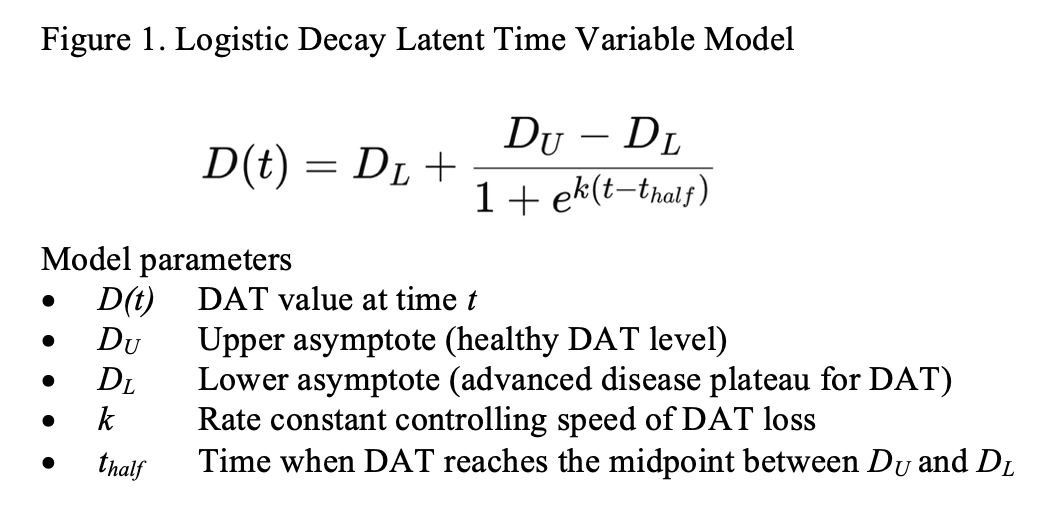
Figure 1
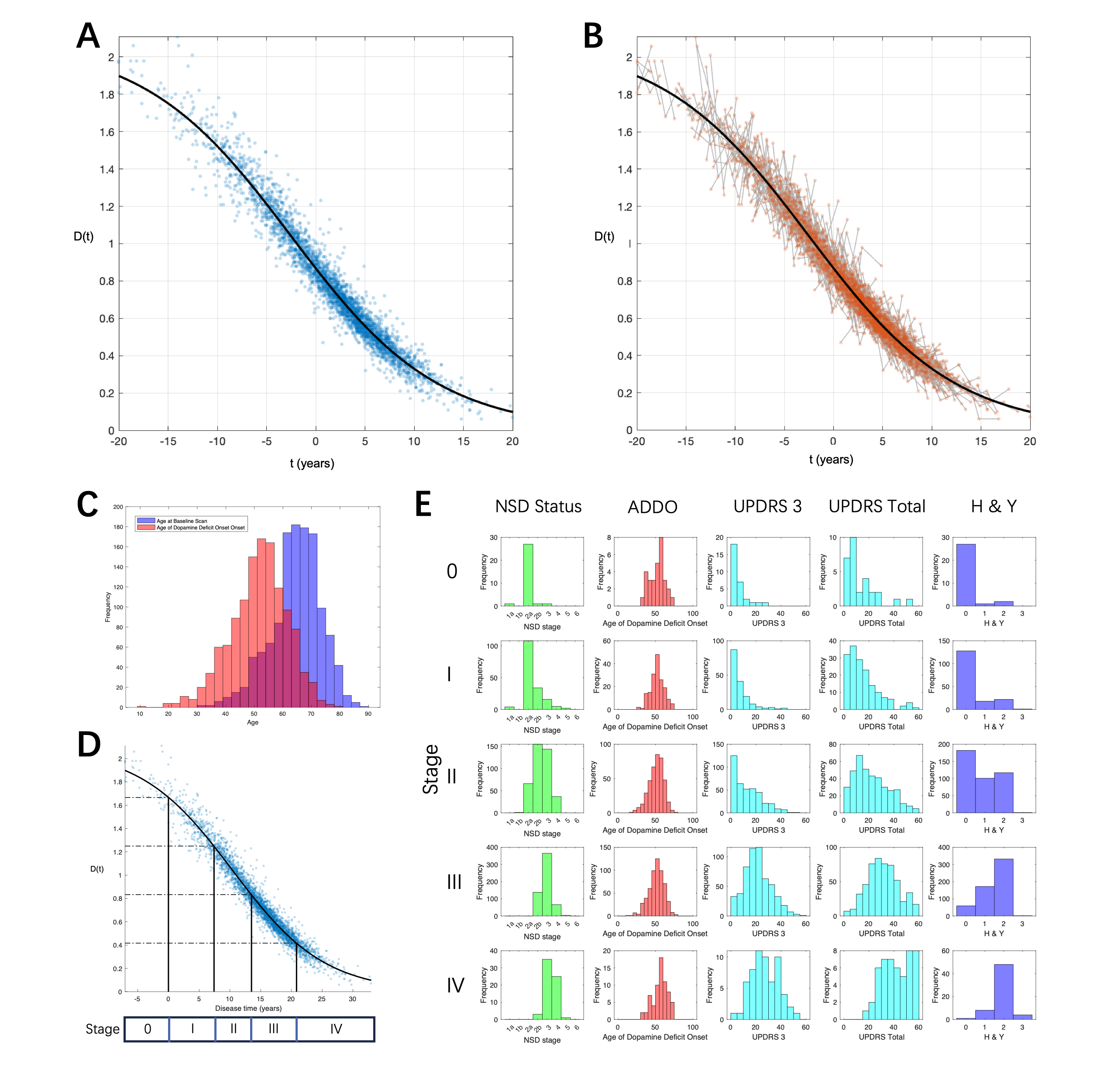
Figure 2
To cite this abstract in AMA style:
R. Gunn, G. Searle, G. Rizzo, Z. Fan, T. Tropea, T. Simuni, K. Poston, A. Siderowf, L. Chahine, J. Seibyl, K. Marek. A Dopamine Clock for Biological Staging of Parkinson’s Disease [abstract]. Mov Disord. 2026; 41 (suppl 1). https://www.mdsabstracts.org/abstract/a-dopamine-clock-for-biological-staging-of-parkinsons-disease/. Accessed October 1, 2026.« Back to 2026 International Congress
MDS Abstracts - https://www.mdsabstracts.org/abstract/a-dopamine-clock-for-biological-staging-of-parkinsons-disease/