
Objective: To assess the diagnostic accuracy, inter-rater reliability, and clinical feasibility of the “vibration” sign for identifying Functional Movement Disorders (FMD).
Background: FMD account for a substantial proportion of movement disorders, yet diagnostic delay are common. Diagnosis relies on identifying positive clinical signs demonstrating internal inconsistency. While established features such as distractibility and entrainment are widely used, additional reliable bedside markers could improve diagnostic confidence. We describe and evaluate a novel clinical sign, the “vibration” sign, that may distinguish functional from organic movement disorders.
Method: We conducted a prospective diagnostic accuracy pilot study at a tertiary movement disorders centre. Consecutive adults with clinically definite FMD (based on Fahn-Williams criteria) and patients with established organic movement disorders were recruited. Participants underwent standardized neurological examination including testing for the “vibration” sign, performed using a predefined protocol (Table 1) and recorded on video. Two blinded movement disorder specialists independently rated the presence of the sign. The reference diagnosis was established by a separate expert panel based on accepted diagnostic criteria. Sensitivity, specificity, positive and negative predictive values were calculated. Inter-rater reliability was assessed using Cohen’s κ.
Results: Fifty participants were included (25 FMD, 25 organic movement disorders including Parkinson disease, essential tremor, dystonia, chorea and myoclonus). The “vibration sign” was present in 21/25 (84%) patients with FMD compared with 0/25 (0%) controls, yielding a sensitivity of 84% and specificity of 100% for identifying FMD. Inter-rater agreement for detection of the sign was κ = 0.80, indicating substantial reliability. The examination maneuver required less than one minute and was feasible in all participants.
Conclusion: The “vibration” sign is a simple bedside maneuver demonstrating promising diagnostic accuracy and good inter-rater reliability for distinguishing hyperkinetic FMD from organic movement disorders. These findings support further validation in larger multicenter cohorts and suggest that this sign may complement existing positive diagnostic markers in routine clinical practice.
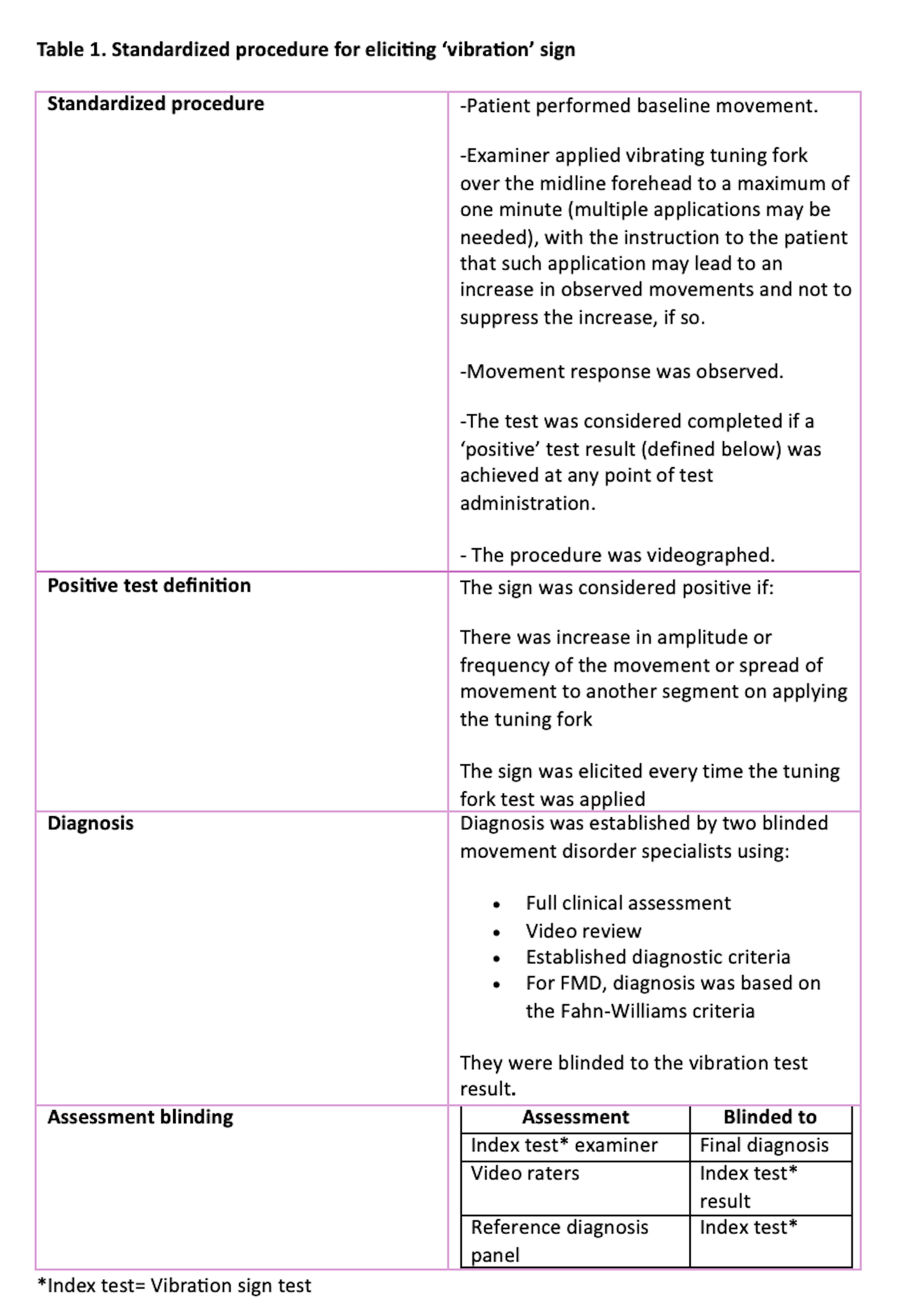
Table 1.
To cite this abstract in AMA style:
D. Garg, F. Mustafa, A. Agarwal, V. Patil, A. Srivastava. A Novel Bedside Clinical Test (“Vibration” Sign) Improves Diagnostic Differentiation of Functional Movement Disorders: A Prospective Pilot Study [abstract]. Mov Disord. 2026; 41 (suppl 1). https://www.mdsabstracts.org/abstract/a-novel-bedside-clinical-test-vibration-sign-improves-diagnostic-differentiation-of-functional-movement-disorders-a-prospective-pilot-study/. Accessed October 1, 2026.« Back to 2026 International Congress
MDS Abstracts - https://www.mdsabstracts.org/abstract/a-novel-bedside-clinical-test-vibration-sign-improves-diagnostic-differentiation-of-functional-movement-disorders-a-prospective-pilot-study/